
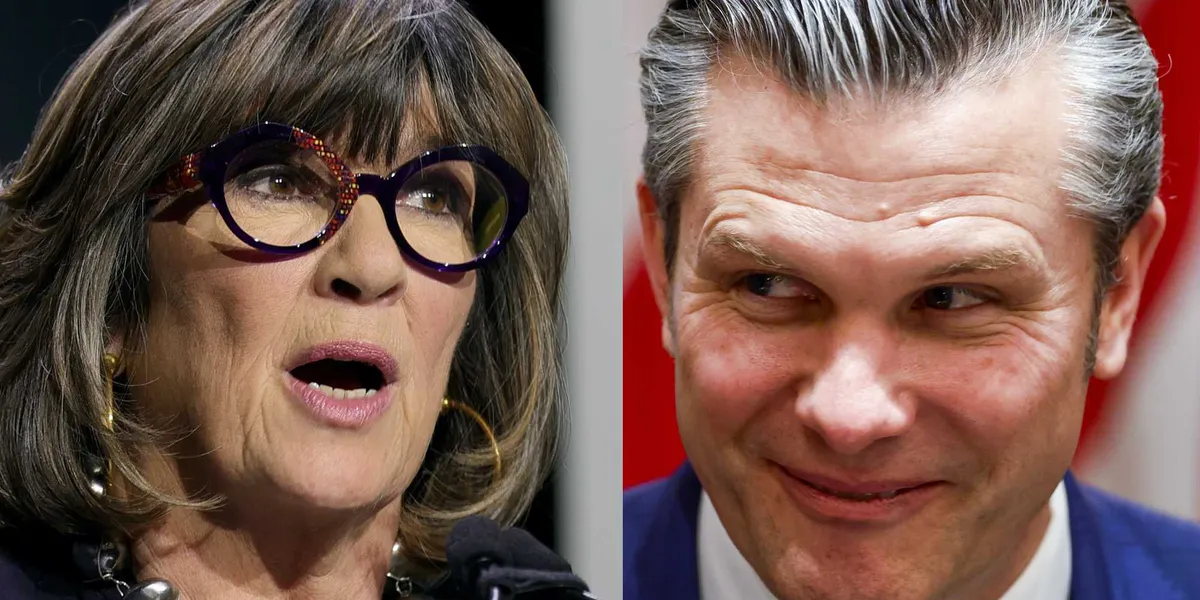
Christiane Amanpour and Secretary of War Pete Hegseth clashed publicly after Hegseth likened parts of the mainstream press to Biblical Pharisees, and Amanpour fired back on social media, prompting a sharp conservative backlash. This piece reviews the exchange, highlights the exact quotations that provoked the reaction, and frames the dispute from a perspective that questions elite media credibility and defends a veteran’s service record.
Pete Hegseth used a Pentagon briefing to accuse parts of the press of behaving like the Pharisees, arguing they ignore context and focus on catching leaders in technical missteps rather than acknowledging results. That comparison landed as a provocation meant to challenge media narratives that often focus on scandal over substance. The pushback from the press, led by Christiane Amanpour, was immediate and personal, not just professional.
Amanpour’s response moved quickly from institutional defense to a more personal, combative tone. She wrote, “Using the Pentagon podium to lash out at journalists in extreme biblical terms is unprecedented, misguided, and frankly wrong on the substance,” . Her message framed journalists as truth-tellers and painted Hegseth’s comparison as an attack on press freedom.
She doubled down by invoking Sunday school and a sense of moral duty in journalism, saying, “Ever since Sunday School Catholic classes, I have been well aware of the Scribes and the Pharisees. They were the bad guys against Jesus, the good guy … in current U.S. good v evil war parlance. Bearing witness to the truth is what we journalists are commanded to do, without fear nor favor.” That appeal to religious imagery and moral authority escalated the tone and moved the debate from policy into character.
Hegseth’s point was straightforward: the Pharisees missed the larger reality of Jesus’s actions while hunting for technical violations, and he used that as a metaphor for media that ignore presidential achievements to focus on criticism. His argument was meant to defend leadership decisions and highlight what he sees as biased coverage. Conservatives took that as a legitimate critique of elites who set the narrative without serving in uniform.
The exchange turned personal when Amanpour tried to equate her experience with military rank, writing, “I am also well aware of the Ten Commandments, and therefore urge any government radical anywhere, to follow the 9th … against bearing false witness,” and adding, “And finally an observation: the current Secretary of War, f/k/a Defence, left the military with the rank of Major,” she added. “I recall my dogtag in the first Gulf war had the rank of major … the very same rank. Just sayin’!” That claim struck many as either a bizarre attempt at equivalence or a factual overreach, and it became the flashpoint for ridicule.
https://x.com/amanpour/status/2045178770756190419
‘You have *never* been in the United States military, and you should be absolutely drummed out of journalism for attempting to equivocate (sic) yourself to an [actual] member of the military.’ Those words, originally aimed at Amanpour, were repeated across social channels and became the clearest expression of the conservative outrage. The reaction focused on respect for actual service and the idea that lived military experience should not be trivialized by media elites.
Online responses were quick and unforgiving, with critics mocking the rank comparison and accusing Amanpour of stolen valor. One rapid reply read, “Read the last paragraph, folks. If @CNN had any editorial standards, Christiane Amanpour would be fired for her bizarre attack on @SecWar’s military service,” . Another jabed, “A Major, really? Perhaps, a major pain in the ass, but definitely not Major,” . And yet another accused her of false equivalence: “You have *never* been in the United States military, and you should be absolutely drummed out of journalism for attempting to equivocate (sic) yourself to an [actual] member of the military. Quite literally the definition of stolen valor,” .
This episode highlights two broader themes conservatives worry about: an out-of-touch media that often interprets public service through an ideological lens, and a double standard where elite credentials are traded for deference while real sacrifices by veterans are questioned or mocked. The tone and the personal nature of the insults show why many on the right see media culture as divorced from the experiences that shape national service and sacrifice.
The debate is likely to keep simmering because it touches raw nerves on both sides: journalists defending institutional norms and veterans defending honor and record. For those who prioritize deference to service, Amanpour’s comments were a misstep that invited ridicule rather than reasoned rebuttal. The public argument now stands as another example of a media establishment and conservative ranks speaking past one another instead of engaging on policy substance.
