
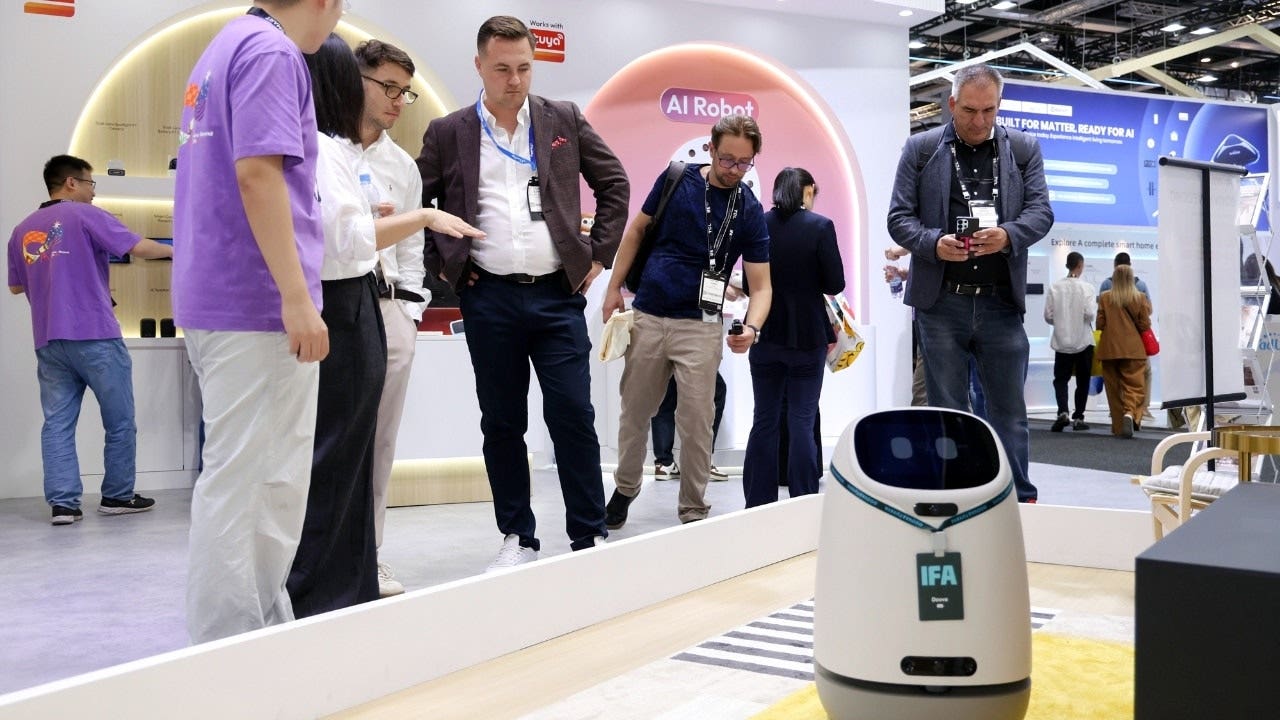
Tuya’s Doova is a compact AI robot built around a big idea: help older adults stay independent without leaving families guessing when something goes wrong. It can move toward a person who calls for help, connect relatives through live video if the situation turns serious, and handle everyday home tasks that can make life a little easier. That mix of safety, convenience, and constant connection is exactly why this little machine stands out.
Doova was shown off at IFA 2026 in Berlin as a wheeled home companion aimed at seniors living on their own. Instead of acting like a dumb gadget sitting on a shelf, it can travel through the home and respond to a voice call from another room. For families worried about falls, confusion, or sudden emergencies, that mobility changes the whole conversation.
The robot uses LDS LiDAR for navigation, four microphones to pick up where a voice is coming from, and AI vision to read a person’s posture. If someone says, “Hey Tuya, help,” Doova rolls over to check on the situation. If the person does not answer within 60 seconds, Tuya says it can trigger an emergency workflow and open a two-way live video call for family members.
That sounds helpful, but it is also worth keeping expectations realistic. Tuya has not said Doova automatically detects falls on its own, and it does not appear to directly call 911 or a professional monitoring service. So for now, it looks more like an extra layer of support than a full medical alert replacement.
Where Doova gets more interesting is in the way it tries to act like a companion, not just a safety device. It uses a multimodal large language model, which means conversation is supposed to feel more natural and less like barking out rigid commands. That could matter a lot for seniors who want a little company during long hours at home.
The robot can also help with simple daily routines. Tuya says Doova can remind users about medication, keep track of schedules, share weather updates, and remember preferences over time. It is even designed to help interpret confusing bills or letters, which could make it useful in situations where reading small print or sorting through paperwork becomes a hassle.
One feature that immediately jumps out is scam awareness. Tuya says Doova can spot possible fraud risks, which could be handy for older adults who receive suspicious texts or odd requests. Still, no AI robot should be treated as the final word on whether something is safe, legitimate, or trustworthy.
That caution matters because AI can be wrong, sometimes in ways that are easy to miss until it is too late. If Doova flags something as suspicious, the smartest move would still be to double-check it with another person or through a separate trusted source. The robot may help slow someone down, but it should not become the only thing standing between a scammer and a target.
Doova also doubles as a home monitor when nobody is around. Tuya says it can move to selected spots in a room, scan a full 360 degrees, and send a safety report to a phone. When the battery gets low, it can return to its dock on its own, which makes it a little more practical for everyday use.
Privacy is where the conversation gets sharper. A moving robot with microphones, cameras, live video, and learning features can be incredibly useful, but it also collects a lot of personal information inside the home. Anyone considering a device like this would want clear answers about where data goes, who can see it, and how much control the user has over deletion.
Tuya’s announcement leaves some of those details open, and that is not a small thing. A robot that can watch, listen, and learn needs more than a slick demo and a friendly face. It needs strong boundaries, because trust gets fragile fast when a camera is able to wander through someone’s living room.
The smart-home angle adds another layer. Doova can reportedly control connected lights, curtains, and other compatible devices through voice commands, which could make a complicated setup easier for older adults to manage. Instead of juggling different apps and menus, a simple conversation could handle a lot of the little tasks that make a home feel comfortable.
Tuya has also given the robot a 10.1-inch HD display with animated expressions, and that matters more than it might sound. A friendly-looking machine can feel less intimidating than a boxy device with blinking lights and sharp edges. For a senior who is already hesitant about tech, that softer design could make the difference between trying it and ignoring it.
Even with all that promise, a few big questions remain hanging in the air. Tuya has not released a price or said when Doova will actually be available to buyers, and the real-world test is still the toughest one. Rugs, cords, narrow hallways, and stairs can turn a polished demo into a very different experience once a robot enters an actual home.
The biggest test may be what happens during a genuine emergency. A person might be scared, hurt, quiet, or out of reach in a way a robot cannot easily handle, and that is where reliability starts to matter more than novelty. Doova is trying to carve out a future where AI does more than answer questions, and that future only works if the machine can earn trust in the spaces where people live and age.
