
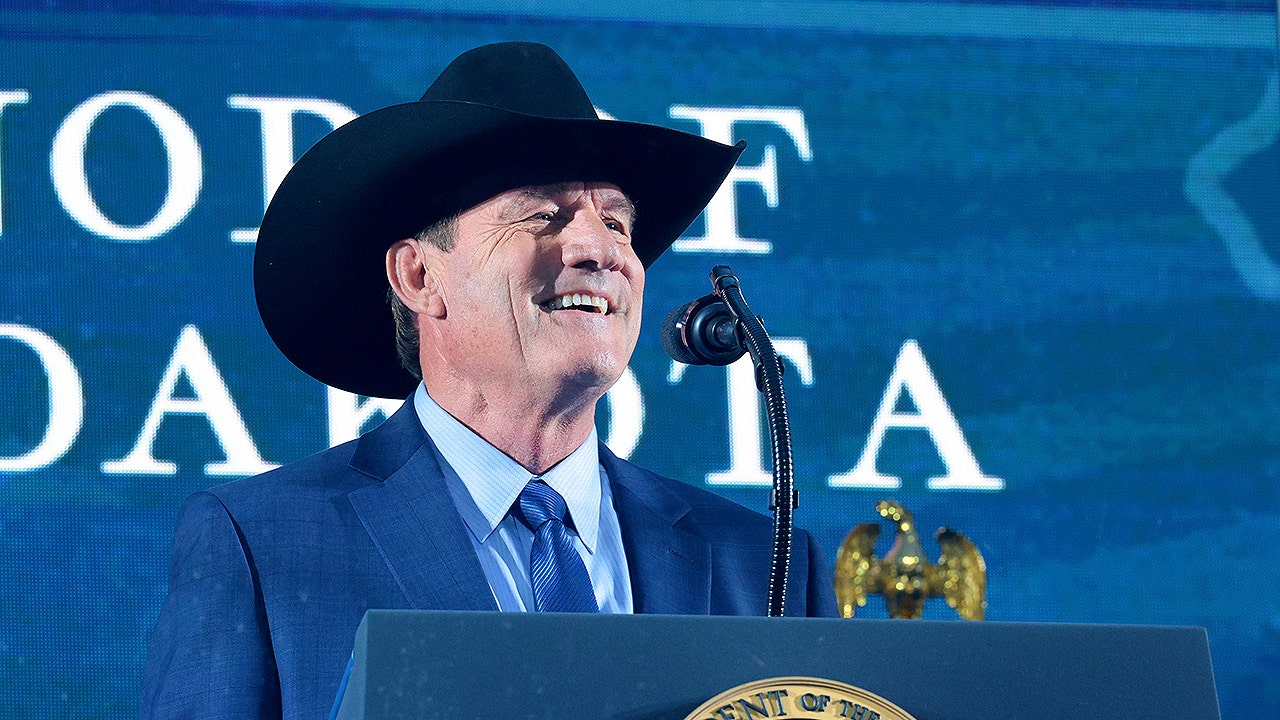
South Dakota managed to do what so many Republican states could not on a rough election night for the GOP. While Democrats surged across the map and chipped away at red-state margins, the Mount Rushmore State stayed stubbornly red, with Republicans keeping a strong grip on statewide offices, the legislature, and the governor’s mansion.
Gov. Larry Rhoden won about 63.5% of the vote, nearly matching Donald Trump’s 2024 showing in the state. Republicans also swept the statewide races and kept their legislative edge, even as Democrats picked up four seats and made a little noise in and around Sioux Falls.
That result came against Democrat Dan Ahlers, who tried to sell himself as a “conservative Democrat” with a pitch built around affordability, rural health care, education, and the usual kitchen-table concerns. It was a familiar strategy, but it never really threatened South Dakota’s Republican foundation, and Ahlers ended up with just 36.5%.
The contrast with other deep-red states was hard to miss. In places like Idaho and Wyoming, GOP candidates still won easily but saw their vote shares slip from Trump’s 2024 numbers, while South Dakota barely budged at all. That kind of consistency stood out on a night when a lot of Republicans were bracing for damage and then watching the damage keep spreading.
Rhoden’s win was only part of the story. Republicans also held nearly all of the state’s political machinery, showing that the party’s message still landed in a state where conservative instincts run deep and voters are usually quick to punish weak leadership. Even with some Democratic gains, the overall picture was still one of Republican control, not a real contest for power.
Down in Sioux Falls, though, Democrats found a few openings. The party flipped four legislative seats there, its first state legislative gains in South Dakota since 2008, which says plenty about how much the city has changed. A growing population, a less conservative electorate, and frustration over major data-center projects gave Democrats a foothold they could not find in much of the rest of the state.
Those local shifts mattered, but they did not erase the bigger Republican advantage. South Dakota’s GOP leaders pointed to policy wins like property tax cuts, limits on rising utility costs, efforts to rein in corporate eminent domain, and a balanced state budget as reasons voters stayed put. In a state where people are watching the cost of living closely, that kind of record still carries weight.
The numbers back up why the message had staying power. South Dakota’s unemployment rate has been hovering around 2% since last September, about half the national rate, and wages rose roughly 4% in 2025. Even with rent climbing faster than pay in some places, the state remains one of the more affordable spots in the country, which helps explain why economic alarm bells did not ring as loudly as Democrats hoped.
At the top of the ticket, Republicans kept rolling. Sen. Mike Rounds won comfortably with 60.5% of the vote, and Attorney General Marty Jackley took the state’s at-large House seat with about 64%, though that was still down from Dusty Johnson’s stronger 2024 performance. It was a reminder that even in a friendly state, the national mood can still shave off a few points.
That national shift hit other Republican strongholds much harder. Texas saw Democrats flip 21 GOP-held state House seats, while Republicans in states like New Hampshire, Arizona, Pennsylvania, Wisconsin, Georgia, North Carolina, and Michigan all took hits in their legislatures. South Dakota did not escape the wave entirely, but it looked a lot more like a sturdy shoreline than a place getting washed away.
Republican leaders in the state framed that outcome as a matter of trust. They argued that voters rewarded promises backed by actual results, not polished slogans or last-minute messaging, and that the party’s focus on practical issues kept people onboard. In a year when plenty of GOP candidates got knocked around, South Dakota showed there is still a big difference between a red state and a state that knows how to act like one.
