
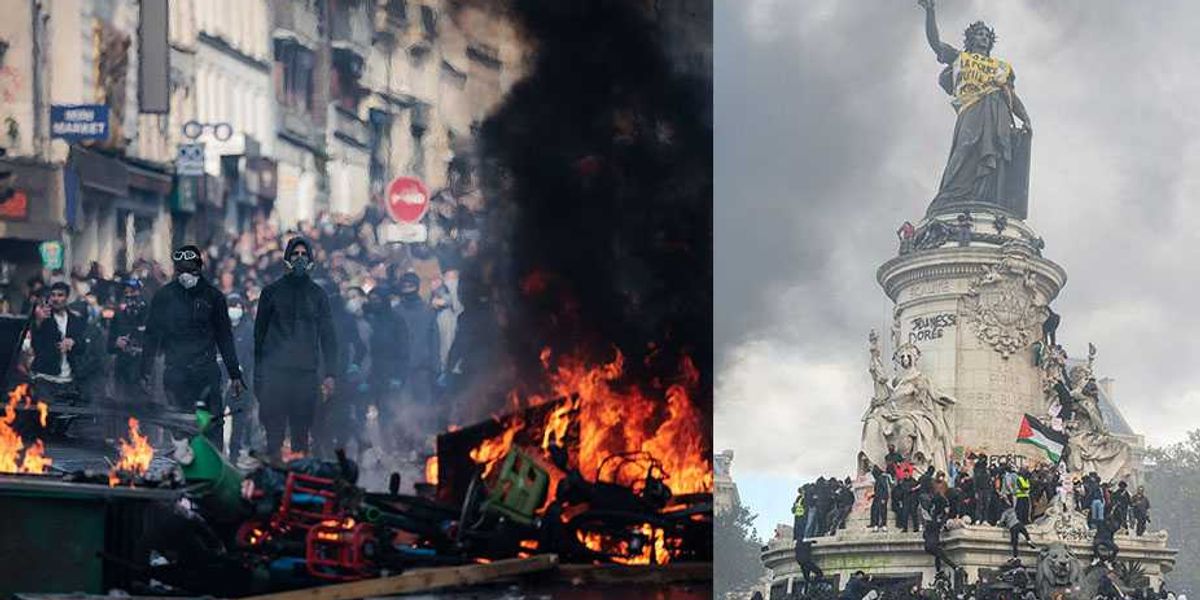
France is once again staring down a familiar kind of chaos: street unrest, political frustration, and a government that looks weaker every time the pressure rises. At the center of it all is a hard truth that keeps getting louder in French public life, that loose alliances between radical left activists and uncontrolled immigration have helped turn ordinary civic tension into something much uglier. The result is a country where public order feels fragile, trust is thinning, and patience is wearing out.
What makes this moment so explosive is that it is not happening in a vacuum. Across France, anger has been building over crime, rising insecurity, and the sense that national leaders keep talking around the problem instead of confronting it head-on. People who used to shrug off unrest are now watching neighborhoods, schools, and public spaces get pulled into the same cycle of disorder.
President Emmanuel Macron is caught in the middle, and not in a good way. His government has struggled to project control while critics say it has spent too much time managing appearances and too little time restoring confidence in the basics like law, borders, and public safety. When citizens think the state is hesitant, every flare-up feels bigger than the last.
That is why the phrase “unholy alliance” has gained traction. It points to the ugly overlap between ideological militants who thrive on confrontation and migration pressures that have strained local communities well beyond their capacity to absorb the shock. The combination is combustible because it feeds resentment on every side, leaving moderates squeezed and common sense drowned out.
Paris, as usual, sits near the center of the storm. The capital is not just a postcard city with cafés and monuments; it is where frustration spills into the open and where political symbolism matters most. When tensions rise there, the rest of the country sees it as a sign that the whole system is wobbling.
The deeper issue is not simply about one protest, one riot, or one bad week. It is about a broader failure to enforce standards that once made French civic life feel stable and predictable. When rules are treated like suggestions and consequences are uneven, the public eventually notices, and anger hardens into something tougher.
Immigration sits at the heart of that debate, and for good reason. Communities cannot be expected to function smoothly when arrivals outpace integration, housing, and local services, especially when officials seem determined to deny the strain rather than measure it honestly. That denial has become a political accelerant, giving the sense that ordinary French concerns are always one step behind elite narratives.
At the same time, the radical left has made a habit of framing disorder as resistance, which gives cover to the people who break windows, torch cars, and threaten public safety. That message may sound righteous in activist circles, but on the street it looks like permission. Once violence gets wrapped in politics, it becomes easier to excuse and harder to stop.
None of this means France is beyond repair, but it does mean the bill is coming due. Governments that ignore border pressure, undermine police confidence, and treat public anxiety as a branding problem eventually lose the room. French voters can feel when a country is being managed for optics instead of protected in reality.
What happens next will depend on whether leaders can rediscover the most basic job of government: keeping order and telling the truth about what is tearing at the seams. That means admitting that social peace does not survive on slogans, and that a nation already under strain cannot afford more political theater. The streets are speaking, and they are not exactly whispering.
