
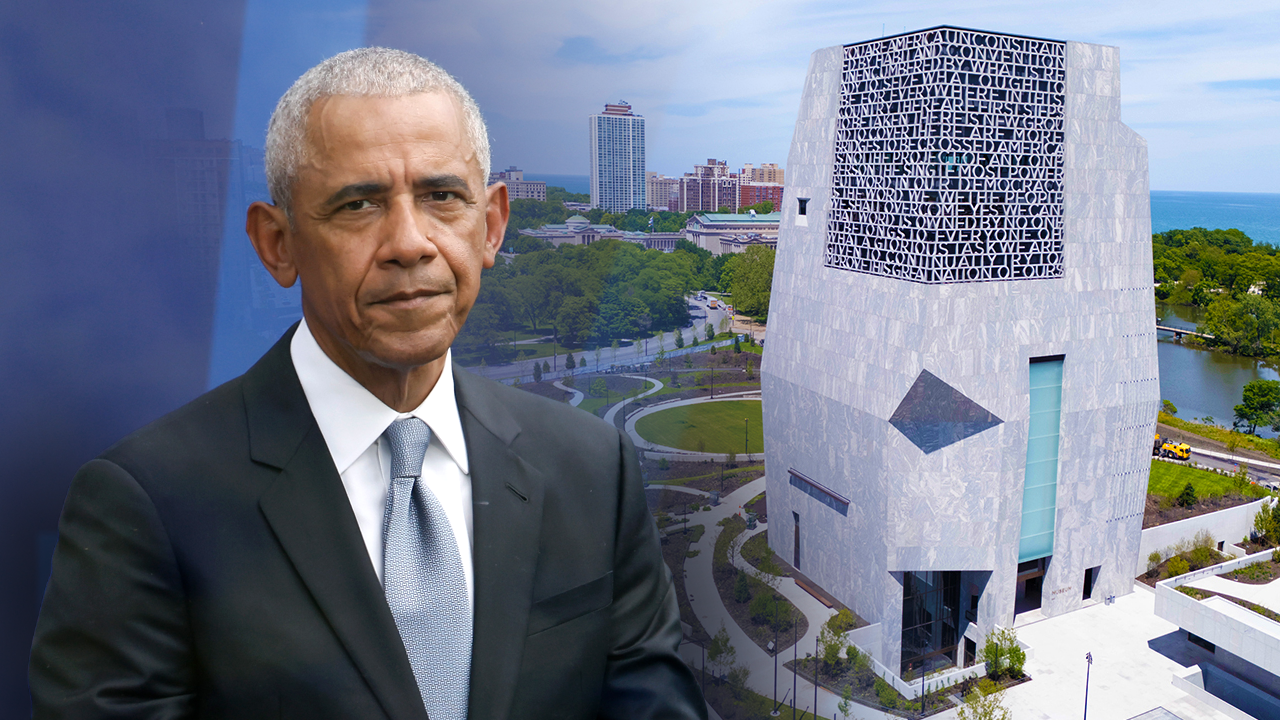
The Obama Presidential Center has crossed into a new and expensive phase, with its expected construction bill now projected to pass $1 billion, far above the original estimate. The long-delayed Chicago project has also drawn fresh scrutiny over fundraising, liabilities, and whether the sprawling campus can support itself once the ribbon-cutting buzz fades.
The center was first pitched as a major South Side landmark that would open in 2021 with a price range of roughly $300 million to $350 million. Instead, years of reviews, legal fights, construction headaches, and public criticism pushed the opening all the way to June 2026, while costs kept climbing into the hundreds of millions.
By the end of 2025, audited financial statements showed about $909 million in construction-related spending, with the final total now expected to land around $1 billion. A foundation spokeswoman said the higher number reflects added public art, insurance, scope changes in the Home Court facility, project management, and exhibit installation, all covered through private donations.
The campus itself is more than a memorial to a presidency. It includes a museum, the Obama Foundation headquarters, a public library branch, and an athletic center, though it does not house the original presidential records that are usually associated with traditional presidential libraries.
New financial filings give a broader look at the foundation behind the project, and the picture is mixed. Donations and grants fell to about $151 million in 2025 from $195 million in 2024, continuing a choppy fundraising pattern that has swung sharply from year to year.
Those filings also show liabilities climbing fast near the end of construction, reaching about $103.5 million in 2025, up from $35 million the year before. Borrowing also grew, rising from $15 million at the end of 2025 to roughly $63.5 million by July 2026, which the nonprofit said was needed to cover short-term construction costs.
Even with those pressures, a nonprofit accounting professor who reviewed the records said the foundation still appears financially strong overall. He pointed to more than $1.1 billion in net assets at the end of 2025 and said the group had cash, investments, and liquidity, while also noting that a large share of its wealth is tied up in buildings rather than easy-to-spend funds.
That distinction matters because construction is one thing and upkeep is another. Money tends to flow more easily when the pitch is about building something new, but the grind of paying for insurance, utilities, repairs, and staffing can be a much tougher sell over time.
The center sits on 19.3 acres of historic public parkland in Jackson Park, secured through a 99-year deal with the city for a one-time payment of just $10. The land and buildings are owned by Chicago, even though the foundation funded the construction.
Critics have also focused on the proposed $470 million endowment that was supposed to help cover long-term expenses and reduce the chance that taxpayers would be left with the tab if things went sideways. That concern has only sharpened as the project has grown more expensive and the cost of keeping it running remains unclear.
The foundation says operating costs are covered through revenue and private donations, but it has not publicly broken out the center’s annual maintenance bill. That leaves plenty of room for debate, especially for a campus that was sold as a community boost, a jobs engine, and a lasting symbol of legacy.
Obama has argued that the center was never meant to be a dusty monument. During the opening ceremony, he said, “We designed the center not to be some lifeless mausoleum,” and added, “While we are non-partisan, we are not value-neutral. We have a point of view.”
Supporters still frame the project as a big investment in the neighborhood and a place built to inspire future leaders, while critics see something more ideological and far more costly than advertised. The real test now is whether the campus can keep living up to the hype without turning into a financial burden that never stops growing.
