
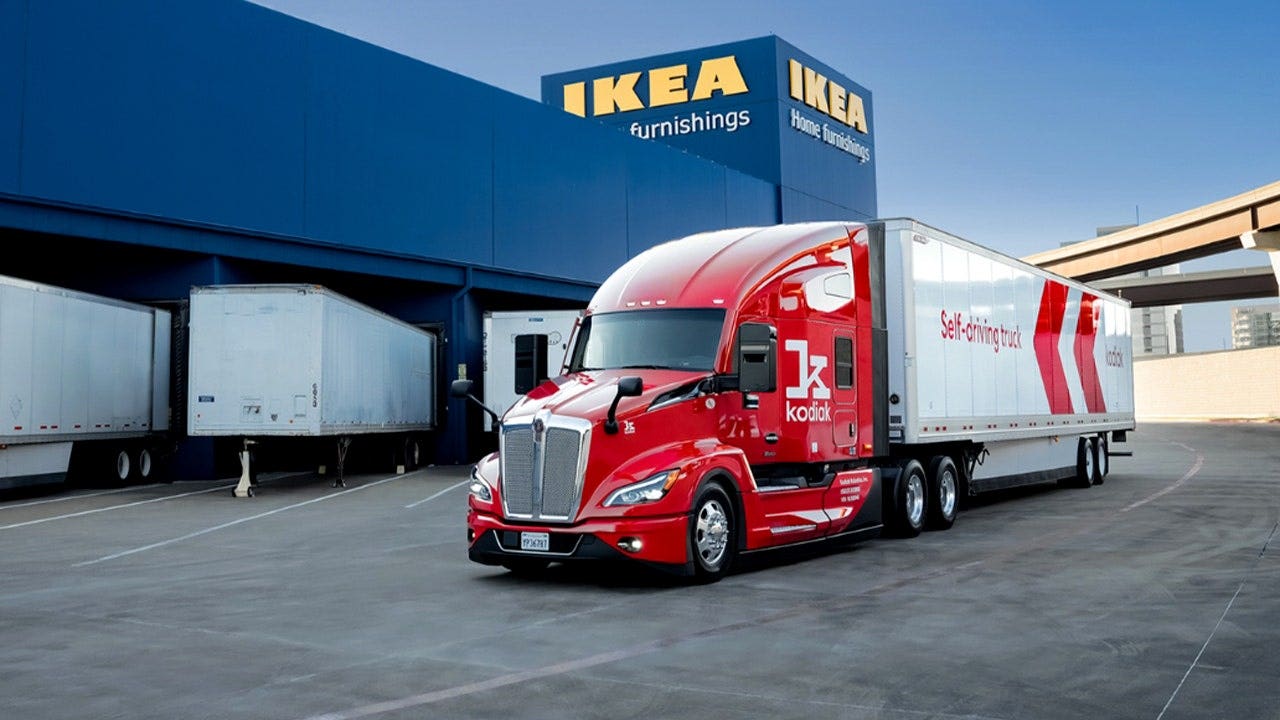
Kodiak AI is pushing driverless trucking into a new lane, with IKEA freight set to move between Dallas and Houston with no one in the cab. The move puts a spotlight on safety, emergency response, cybersecurity, and what all this means for long-haul trucking as a whole.
On a Texas highway, the sight of a massive semi rolling along with an empty driver’s seat is no longer science fiction. Kodiak AI plans to haul IKEA products on a 219-mile stretch of Interstate 45 later this year, and the big shift is simple to say but huge in practice: nobody will be aboard. The company has already spent years running freight with a safety observer, but this next step removes the last human inside the truck.
That is where the questions get real fast. What happens if a sensor fails at highway speed, or a mechanical issue pops up without warning? How does the vehicle react when police, ambulances, or a crash scene appear ahead? And if the truck is basically a computer on wheels, what keeps someone from trying to break in through the software side?
Kodiak says the answer is not one magic breakthrough, but a long trail of testing and operating experience. The company’s autonomous system, called the Kodiak Driver, has been built around the idea that something eventually will go wrong, and the truck needs to handle it calmly instead of panicking. Burnette said the system is designed to be “predictable, courteous, conservative and defensive,” which is exactly the kind of boring most people would want from an 18-wheeler.
The company tracks its progress with an internal benchmark called an Autonomy Readiness Measure. By the end of September, Kodiak said 96% of the evidence needed for its long-haul safety case was complete, with the remaining work focused on final verification and safety checks. The goal is to launch driverless long-haul service by the end of 2026, but the company is already running empty-cab trucks commercially in the Permian Basin.
That earlier work matters because it shows the concept is not brand new. Kodiak-powered trucks have been operating for Atlas Energy Solutions without anyone aboard since December 2024, and the company says dozens of those trucks have already piled up tens of thousands of hours of driverless driving. The IKEA route is different in setting, but not in principle, since the truck itself has already been doing this job in the real world.
The Dallas-Houston route will cover 219 miles on I-45, part of a longer 292-mile delivery path connecting IKEA’s distribution center in Baytown and its store in Frisco. Kodiak has been hauling IKEA products on that corridor for four years with a safety observer in the cab, which gave the company time to work through route timing, maintenance schedules, and the less flashy logistics that make or break freight operations.
If something goes wrong mid-route, Kodiak says the truck is built to respond on its own. The system watches more than 1,000 safety-critical components across the vehicle, sensors, hardware, and autonomy software, and if a serious issue is detected, it can shift into a fallback maneuver that brings the truck to a controlled stop. The idea is not to pretend problems will never happen, but to make sure the truck knows exactly what to do when they do.
That logic extends to the truck’s operating limits too. Kodiak uses what the industry calls an Operational Design Domain, or ODD, which is basically the set of conditions the system is approved to handle. If the truck drifts outside those boundaries, it is designed to back off and stop safely instead of guessing its way through a situation it was never meant to face.
No, there is not a person secretly steering from miles away. Kodiak does have a command center south of Dallas, but Burnette said it is there to help guide the truck if it needs support, not to act as a remote driver. The truck must still remain safe if it loses connectivity, which is why the company says it cannot depend on a communications link to stay in control.
Emergency vehicles add another layer of complexity. Kodiak says the system is built to detect police cars, ambulances, lane closures, stopped vehicles, and accident scenes, then slow down or move over as needed. The company also works with first responders and has a retired California Highway Patrol officer on staff to help law enforcement understand how to deal with driverless trucks on the road.
Cybersecurity is just as important as road behavior, maybe more so. Burnette said Kodiak has minimized access points into the truck, isolated safety-critical functions like steering and braking from outside communications, and built monitoring and response procedures around potential threats. The basic philosophy is clear: connectivity should never become a back door into the systems that keep a truck from doing something dangerous.
Even with all those safeguards, the biggest test is still ahead. Once the driver leaves the cab for good, the public gets a front-row seat to see whether all that software, redundancy, and planning really holds up when the truck is sharing the road with everybody else. And for an industry built on trust, that is where the story gets interesting fast.
