
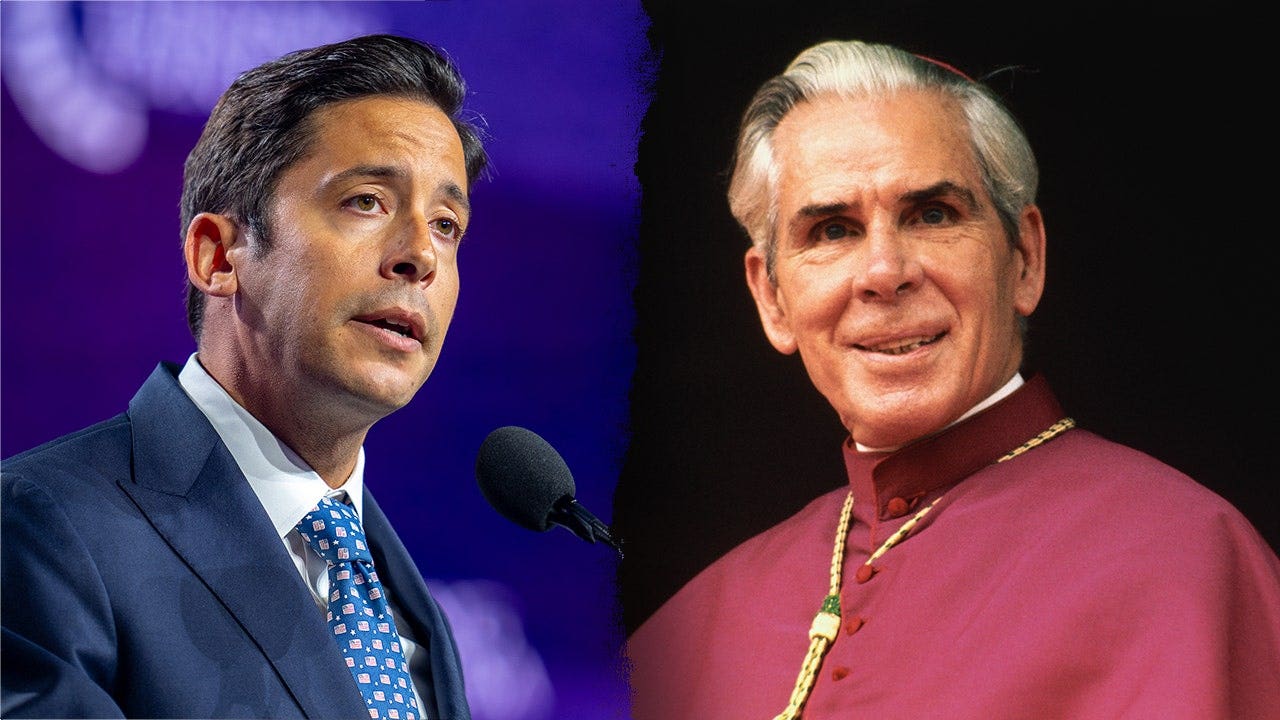
Archbishop Fulton Sheen pulled in enormous crowds with a chalkboard, a sharp mind, and a fearless way of talking about faith, morality, and the danger of communism. Decades later, his rise to beatification is drawing fresh attention, along with the idea that his blunt message would land very differently in today’s culture. Conservative commentator Michael Knowles says Sheen would still sound like Sheen, but modern critics would likely rush to label him before he finished a sentence.
Sheen’s reach was remarkable for an era without podcasts, streaming, or social media. His radio program, “The Catholic Hour,” reached millions, and his television show, “Life Is Worth Living,” became a national fixture that pulled in viewers far beyond the usual church crowd.
That success came from a style that felt simple but hit hard. Standing in clerical robes before a chalkboard, Sheen spoke about suffering, the human person, sin, and hope in a way that mixed theology with humor and story. Knowles called him the first televangelist, not because he copied anyone else, but because he understood where the audience already was.
Sheen’s beatification in St. Louis put his name back in the spotlight and reminded many Americans how visible he once was. He was not some quiet figure tucked away in church history. He competed with stars like Milton Berle and Frank Sinatra, landed on the cover of Time, and even won an Emmy for television personality.
That kind of fame did not soften his message. Sheen stayed direct about Christianity, marriage, sex, and the dignity of human life, and that plainspoken approach is exactly why Knowles thinks he would provoke outrage in the current media climate. The same words that once filled living rooms with conviction could easily trigger accusations of extremism now.
The anti-communist side of Sheen’s work was a big part of his public identity too. The White House message tied his ministry to a world threatened by communism, and Sheen himself warned in the 1960s about a culture obsessed with tearing things down instead of building anything up. That warning still lands because the argument behind it has not gone away.
Knowles pointed to original sin as the missing piece in many modern political dreams. In his view, systems built on the fantasy that people are naturally good and institutions can fix everything tend to collapse fast when real human nature shows up. Sheen, he argued, saw that clearly and never apologized for saying so.
His path to sainthood also reached far beyond television and politics. The Church opened his cause in Peoria in 2002, and the miracle tied to his beatification involved a child born without a heartbeat or respiration who later recovered after a long stretch of prayer and concern. Pope Francis approved that miracle in 2019, clearing a major hurdle on the road to the ceremony in St. Louis.
There is also a deep personal thread running through Sheen’s story and into the modern papacy. Pope Leo XIV has recalled seeing Sheen’s evangelization while growing up, and the Vatican account says Sheen’s life intersected with future popes John Paul II and Benedict XVI during the Second Vatican Council. Later, just months before Sheen died in 1979, John Paul II embraced him in New York and praised him for speaking well of Christ.
For Knowles, the reason Sheen still matters is not just because he was famous. It is because he carried serious ideas without acting gloomy about them, and he never confused gravity with vanity. That mix made him memorable on television, and it is part of why his voice still feels fresh in a culture that often seems allergic to conviction.
Sheen’s daily Holy Hour before the Eucharist was a private habit that sat behind the public persona. He called it “the hour that makes my day,” and that detail says plenty about what powered the polished broadcaster behind the microphone. The big audience came first, but the engine was always prayer, discipline, and a priest who meant what he said.
