
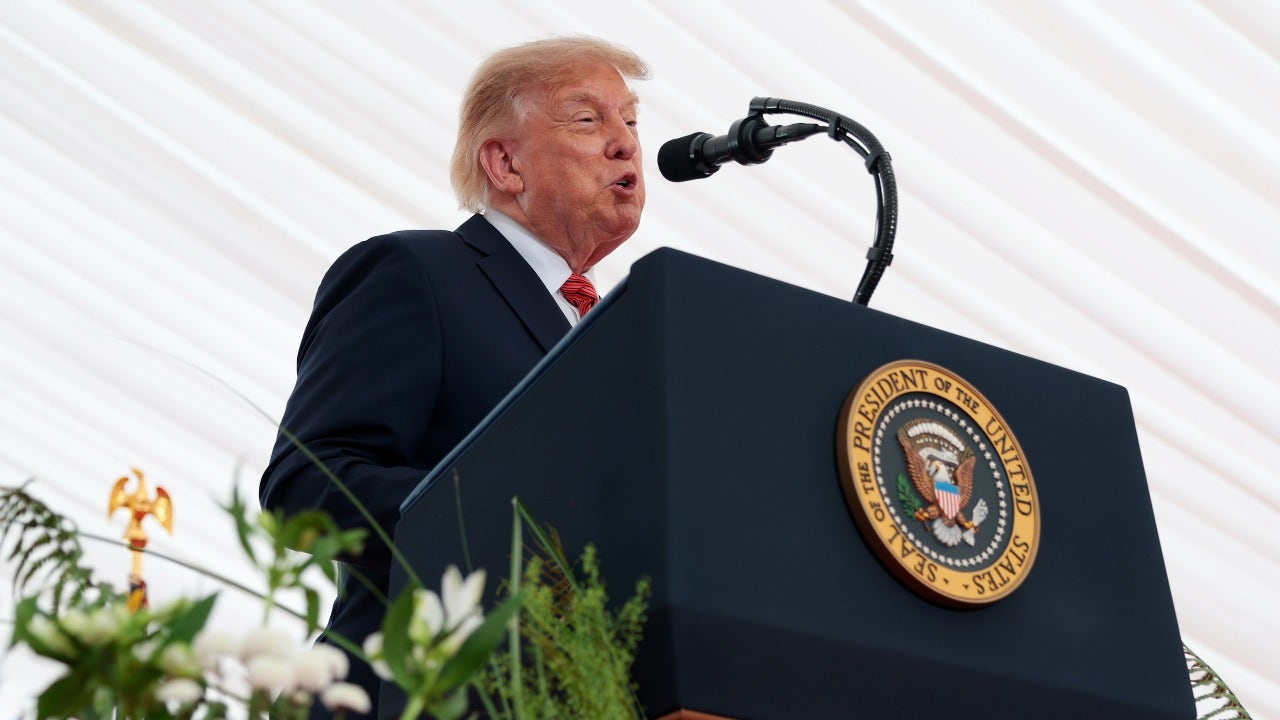
Donald Trump’s comments in Dublin put Irish reunification back in the spotlight, mixing blunt rhetoric with a long-running dispute that still shapes politics on both sides of the Irish Sea. The issue reaches deep into history, from independence and partition to the violence of the Troubles and the fragile peace that followed, while today’s debate still turns on identity, voting rules, and the future of Northern Ireland inside or outside the United Kingdom.
President Donald Trump said in Ireland that he would “love to see” the island unified, calling it something that could eventually happen. Speaking alongside Taoiseach Micheál Martin, he framed the idea as a positive outcome while acknowledging that the United Kingdom would clearly have a say in the matter.
His remarks landed in a place where history is never far from the surface. The Republic of Ireland broke away from the United Kingdom in 1922, while Northern Ireland, created a year earlier, stayed under British rule.
Trump didn’t sound interested in stirring up trouble, but he didn’t soften the point either. “I don’t want to cause any problems, but I will tell you, I’d love to see it unified. I have friends on both sides, great people. They’re Irish people. How can they be bad, right?” he said in Dublin.
He then added that unification would be a “great feather in everybody’s cap” and said, “It’s going to happen eventually.” Later, he repeated the thought in a more casual way, calling it a “cool thing.”
For Irish politics, though, “cool” is not the word most people would use. Unification has been one of the island’s most charged questions for decades, because it touches religion, national identity, and the old fault lines that divided communities for generations.
That divide turned deadly during the Troubles, the period of sectarian violence that ran from the late 1960s into the late 1990s. Irish nationalists and republicans, many from Northern Ireland’s Catholic minority, wanted the island under one Irish government, while unionists and loyalists, mostly from the Protestant majority, wanted to stay tied to the U.K.
More than 3,500 people were killed over those years in violence involving paramilitary groups and British security forces. The peace deal in 1998 brought the fighting down and created a political system meant to give both sides a seat at the table, but the old tensions never fully disappeared.
The Good Friday Agreement, also called the Belfast Agreement, remains the backbone of the current settlement. It says Northern Ireland stays in the U.K. unless a majority of voters choose otherwise in a referendum, which means any move toward unity has to go through a public vote.
That is where the conversation gets even more complicated. A 2024 U.K. Parliament report said 90% of students in Northern Ireland attend schools that are “effectively segregated along religious lines,” a reminder that the past still shapes daily life in subtle but stubborn ways.
Brexit also threw fresh fuel on the debate. Northern Ireland voted to remain in the European Union even as the U.K. overall voted to leave, and that split gave new energy to those who see unity as a path toward political and economic stability.
At the same time, no referendum has been proposed or scheduled, which keeps the issue in the realm of argument rather than action. That leaves plenty of room for speeches, speculation, and symbolic gestures, but the actual road to change still runs through law, consent, and numbers on a ballot.
Trump’s comments also came during a broader visit that mixed diplomacy with public remarks and a touch of showmanship. Later at the Deerfield Residence, the official home of the U.S. ambassador to Ireland, he revisited the question after being asked about it earlier in the day.
The scene carried its own symbolism, with U.S. Ambassador Edward S. Walsh introducing him and Lee Greenwood’s “God Bless the USA” playing as he took the stage. Even there, the Irish unity question stayed in the air, proof that some topics never really leave the room once they are mentioned.
