
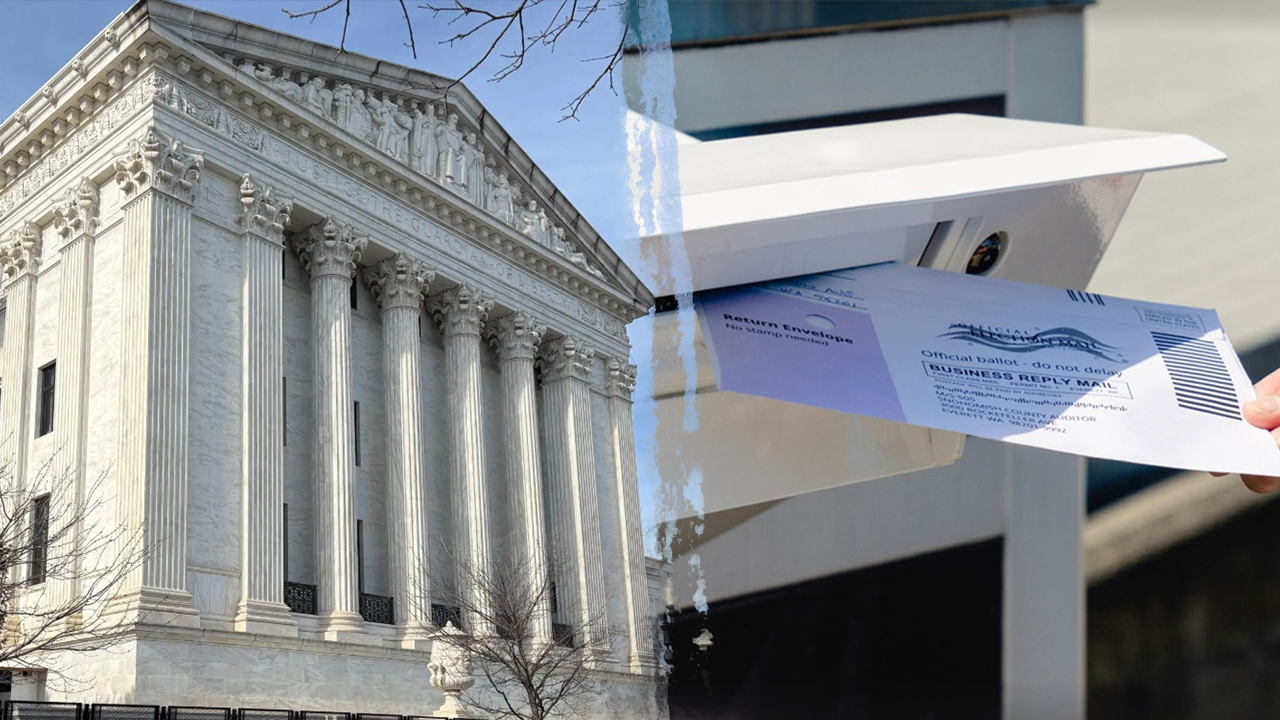
The Supreme Court just handed the Trump administration a major win, clearing the way for revised mail-ballot restrictions to move forward before the midterms. The decision keeps the fight over mail-in voting front and center, with the White House framing it as a straight-up election integrity issue and critics warning it could reshape how ballots are handled in key states.
In a 6-3 ruling, the justices lifted an injunction that had frozen the policy in 23 states. That means the federal government can now enforce the order while the legal battle keeps rolling, and the Postal Service has already said it will move ahead with the new rules.
The immediate effect is practical, but the political meaning is even bigger. The order directs the Postal Service to compare mail-ballot distribution against citizenship-based voter lists maintained by the Department of Homeland Security, a move Republicans argue helps tighten election security and reduce the risk of fraud.
Supporters of the policy see it as a necessary correction after years of expanding mail voting. They point to concerns about mismatched voter rolls, weaker verification, and the ease with which bad actors could exploit a system that relies heavily on ballots moving through the mail.
Trump has been especially vocal on the subject, repeating that widespread mail voting creates a system too vulnerable to abuse. He recently brought up the 2026 Los Angeles mayoral race, saying the unusual flow of late-counted ballots looked suspicious and fit the pattern he has been warning about for years.
“You know, they don’t have voting booths; everything’s by mail. I don’t think a Republican can win in California unless you pass the Save America Act,” Trump told Fox News, referring to GOP legislation aimed at narrowing mail voting and strengthening voter-ID rules.
“They’re going to have to get rid of mail-in voting.”
That kind of blunt message has long played well with conservatives who believe elections should be easier to trust, not harder. For them, the issue is not about making voting inconvenient, but about making sure every valid vote is protected and every illegal one is screened out before it can matter.
Trump’s executive order, titled “Preserving and protecting the integrity of American elections,” took a direct shot at the federal government’s role in election enforcement. It pushed agencies to build citizenship-based voter lists and told the Postal Service to deliver mail-in ballots only to people appearing on approved rolls.
The order argued that federal law already bars noncitizens from voting, while state systems often fall short in checking citizenship status. The administration said the government had not done enough to enforce those rules, and that the new approach was meant to close gaps that should never have been left open in the first place.
The Supreme Court’s majority did not decide whether the order is ultimately legal. Instead, the justices focused on standing and said the states challenging the policy could not show the kind of concrete harm needed to keep the injunction in place.
In plain terms, the court said the order was aimed at federal agencies, not the states themselves. That distinction mattered enough for the majority to let the policy proceed, even while leaving the door open for more litigation later.
“[It] directs the Secretary of Homeland Security to take appropriate action to create and distribute State Citizenship Lists. This provision is an internal directive from the President to a subordinate. It imposes no obligations on the States, so they ‘suffer no concrete harm from’ it, and without concrete harm, there is no standing,” the court wrote.
Justices Sonia Sotomayor, Elena Kagan and Ketanji Brown Jackson dissented, signaling that the fight over how far the federal government can go in election oversight is far from settled. Even so, the ruling gives the administration breathing room at a moment when both sides are gearing up for a fierce battle over voting rules, ballot counting, and the basic mechanics of election confidence.
The decision lands at a time when concerns about mail voting have only grown sharper, especially in races where ballot drops stretch the final count for days or even weeks. For Republicans, that delay fuels suspicion and strengthens the argument that elections need tighter guardrails before another national showdown hits.

1 Comment
Hooray for honesty!