
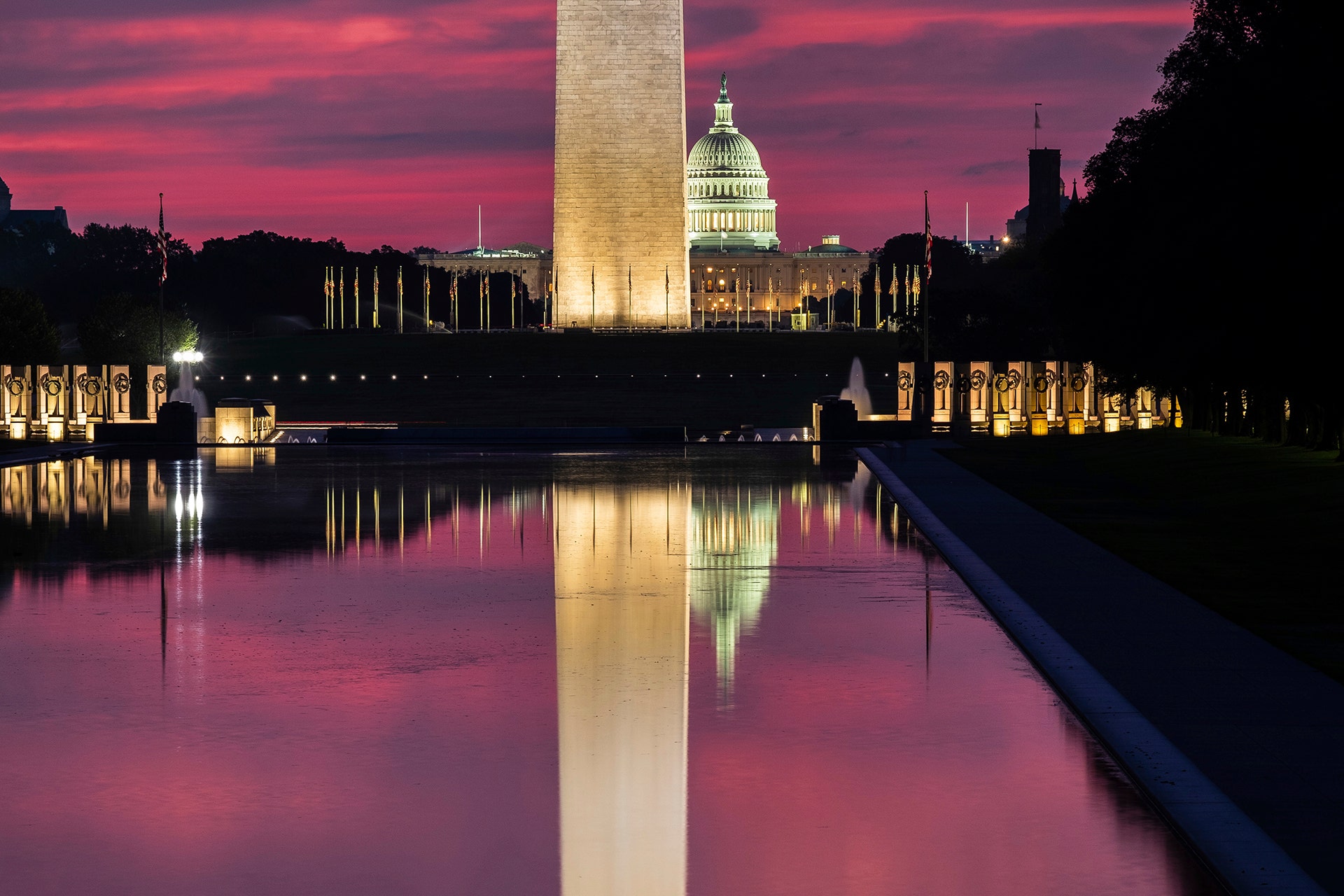
The Lincoln Memorial Reflecting Pool has become the center of a messy political fight, but the bigger story is how quickly a routine repair turned into a national argument. What should have been a simple maintenance issue instead spiraled into accusations, headlines, and a fresh round of partisan score-settling.
On Friday, Jeanine Pirro made the right call by dropping charges against David Hearn, a former Olympic athlete who had been facing serious prison time over the alleged damage. The new information showed the problem was tied to faulty installation by the contractor, not some grand act of vandalism.
That matters because Hearn was not accused of destroying a national landmark for sport or spite. He was said to have pulled up pieces of newly installed sealant, and his explanation was that he was checking out damage that was already there. Maybe that was careless, maybe it was annoying, but it was never a felony-level crime.
The pool itself has always carried deep symbolism. It is tied to one of the most important moments in American history, the 1963 “I Have a Dream,” speech by the Rev. Martin Luther King, Jr., but now it has been dragged into the mud by people who are more interested in scoring points than getting facts straight.
Pirro deserves credit for not letting politics drive the outcome, something that became all too common in Biden-era Justice Department cases involving January 6 and abortion protests. Justice is supposed to be about evidence and the law, not whether the accused fits someone’s preferred narrative.
The whole mess also shows how a basic public works project can get warped into a symbol of everything people already believe about Washington. Critics of Trump wanted the pool’s problems to prove cronyism and failure, while others saw the damage as proof that sabotage and hostility were the real story.
That divide is exactly why the reflecting pool grabbed so much attention. A cracked surface or peeling sealant should have prompted a technical fix and maybe a quiet apology, not a culture-war brawl on cable news and across social media.
There is also a simple reality that gets lost in all the noise. The reflecting pool is not easy to maintain, and past work has run into similar issues before. That makes the rush to assign evil motives a lot less convincing than the people pushing it would like.
The Interior Department came out looking especially bad because it appears to have told Trump what he wanted to hear instead of the truth. When government officials hide behind a convenient story rather than deal with the facts, they create exactly the kind of confusion that can put an innocent person in legal jeopardy.
At the same time, it is not hard to understand why suspicion flared in the first place. In an era when vandalism, rage, and ideological stunts are common, a government worker or contractor could easily wonder whether someone was tampering with the site on purpose.
What makes this episode sting is that Washington cannot seem to resist turning every inconvenience into a moral crusade. Even as the city has seen improvements in safety and appearance, plenty of people would rather fixate on a pool than acknowledge what is working.
The result is a perfect little snapshot of our politics. One side sees corruption everywhere, the other sees bad faith everywhere, and in the middle sits a public monument that should be inspiring reflection, not feeding paranoia.
There is something almost tragic about that. The same place that once stood for unity now gets treated like a prop in a bitter fight, and the public is left with more suspicion than clarity.
If anything good came out of this, it is that the charges were dropped before the situation got even uglier. But the larger problem is still out there, and it is not about concrete, sealant, or algae. It is the ugly habit of assuming the worst about anyone on the other side before the facts even have a chance to speak.
