
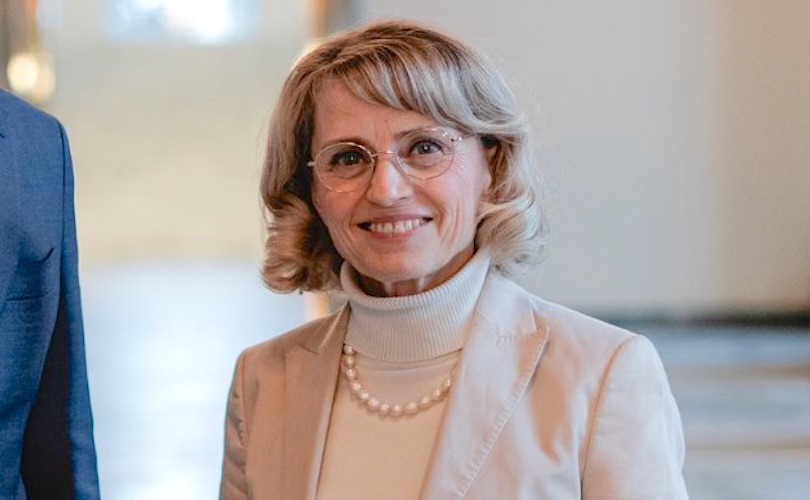
Finnish lawmaker Päivi Räsänen is taking her case to the European Court of Human Rights after being convicted over a church booklet and a Bible-based post, turning a national courtroom fight into a bigger test of free speech and religious liberty across Europe. Her appeal lands after years of legal pressure, fines, and orders tied to statements she says were simply an expression of her Christian beliefs about marriage and sexuality.
Räsänen’s legal battle has stretched for nearly seven years, and it has already moved through multiple courts with wildly different outcomes. She and her co-defendants, including Bishop Juhana Pohjola and the Luther Foundation Finland, were acquitted before Finland’s highest court later upheld part of the case and convicted them over the 2004 booklet.
The booklet at the center of the dispute was written for Räsänen’s church and was never a flashy political stunt. It reflected traditional Christian teaching, and the court’s punishment included fines and an order that the challenged passages be removed from public access and destroyed.
For Räsänen, this is about far more than one conviction on a sheet of paper. She says the case will help determine whether Finland and the wider European legal system still protect the right to speak openly about faith without being dragged through the criminal courts.
That argument has made her case a flashpoint well beyond Finland’s borders. Supporters say it shows how quickly “hate speech” laws can be used to police peaceful religious expression, especially when the views in question clash with the cultural mood of the moment.
Räsänen’s own words reflect that concern in plain language. “Appealing my conviction is about much more than a fine or a decades-old church booklet,” she said after filing the appeal. “My case stands to determine whether the fundamental rights of religious freedom and free speech are still protected in Finland and across Europe, and whether these societies are still willing to stand up for the rights of all – even those they disagree with.”
She also warned that laws meant to target offensive speech can end up crushing legitimate debate. “‘Hate speech’ laws that criminalize peaceful expression are incompatible with a truly democratic society. As a Member of Parliament and a Christian who has faced censorship and years of criminal investigation, I am profoundly aware of the devastating consequences of curtailing basic liberties. The European Court of Human Rights must decisively uphold these freedoms and promote the common good across Europe,” Räsänen said.
Pohjola, who is appealing too, says the stakes are just as high for churches and religious leaders. “If authorities can censor religious teaching and dictate how faith leaders instruct their followers, religion becomes a tool of the state rather than a means to freedom and human flourishing. The European Court of Human Rights must recognise this fact, and once again affirm that religious freedom – which is inseparable from freedom of expression – must be protected in a pluralistic and free society.”
The case has also spilled into travel and public appearances. In July 2026, Räsänen learned that her Electronic Travel Authorisation for the United Kingdom had been cancelled after first being approved, and Pohjola was denied clearance as well.
That meant she could not even pass through London’s Heathrow Airport, and it raised the possibility that she could miss a planned religious freedom conference in Belfast. She said the irony was hard to ignore, especially for a conference where she intended to speak about free speech and basic rights.
“I have been invited to give the keynote speech at a religious freedom conference in Belfast in August, where I intended to discuss the importance of free speech. I find it shocking and deeply ironic that in a democratic country like the UK, I am being prevented from speaking at a conference about fundamental freedoms due to my conviction for ‘hate speech’,” Räsänen said.
Her legal team argues that the travel ban is heavy-handed and unnecessary. “Päivi Räsänen has been criminally convicted for peacefully expressing her Christian beliefs,” said Lorcán Price, barrister at Alliance Defending Freedom, who is representing Räsänen before the European Court. “Her ban from entering the United Kingdom is completely disproportionate and unnecessary.”
Price went even further, calling the whole situation a warning sign for Europe. “It is clear that Europe is facing a crisis of censorship, of which the conviction for a 20-year-old church booklet is among the most egregious examples. The European Court of Human Rights has long held that freedom of expression protects not only inoffensive ideas, but also those that offend, shock or disturb. No state should have the power to silence disfavoured perspectives, and widely-held Christian beliefs should never be an exception to this rule.”
He added that the court now has a chance to draw a line in the sand. “Europe’s highest court must now decide whether European law will continue to protect the freedom to peacefully express one’s beliefs in the public square; because if peaceful expression like a decades-old church booklet can be criminalised and retroactively censored, free and open debate in Europe is no more. We urge the Court to admit this case, which presents a critical opportunity to reaffirm these basic freedoms and ensure that citizens are not prosecuted for peacefully expressing their beliefs.”
Räsänen, a former Finnish Interior Minister, doctor, and grandmother of 12, has faced this fight since a 2019 tweet and a radio discussion brought renewed scrutiny to her views on marriage and human sexuality. She was later charged in 2021 under a part of the criminal code tied to “agitation against a minority group,” even though two lower courts had already cleared her before the Supreme Court revived part of the case and convicted her over the booklet.
The final appeal now sits with the European Court of Human Rights, which will decide whether Finland’s punishment stands or falls. Whatever happens next, the fight has already become one of Europe’s most watched clashes over belief, speech, and how far the state can go when it dislikes what people say out loud.
