
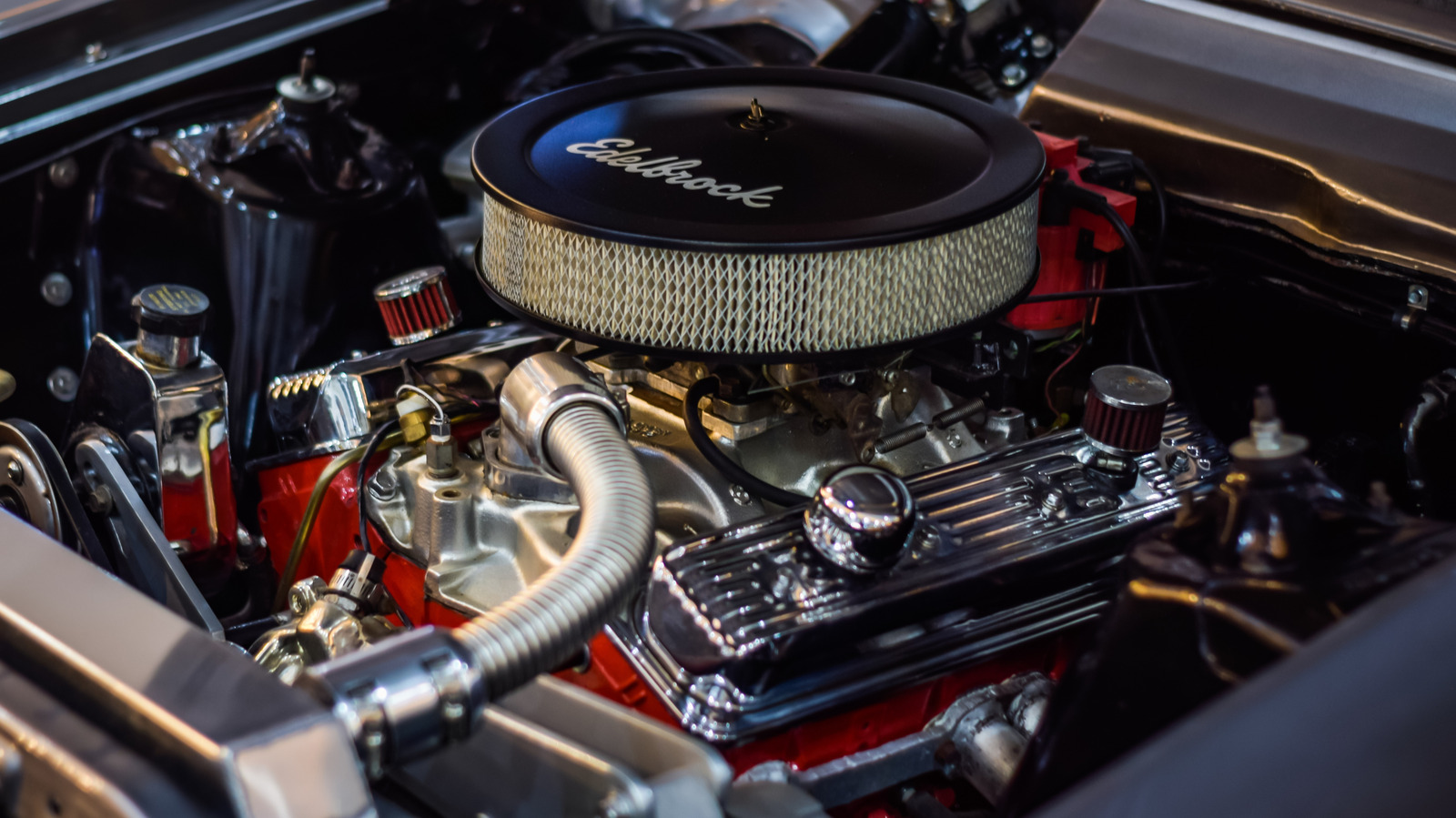
Pushrod V8s may be old-school, but they still know how to throw a punch. In a market obsessed with turbochargers, downsizing, and clever packaging, a few factory pushrod engines keep showing up with the kind of power and straight-line violence that refuses to fade quietly.
The basic formula is simple: camshaft in the block, lifters, pushrods, and rocker arms doing the valve work, with fewer moving parts than a modern overhead-cam setup. That makes the engine compact, rugged, and easier to service, which is exactly why manufacturers have kept it alive in trucks, muscle cars, and performance SUVs even as the industry keeps chasing boost and efficiency.
Turbo engines have real advantages, no question. They squeeze big output from small displacement and help automakers meet emissions and fuel-economy goals, but raw numbers still matter to enthusiasts. And when you line up some of the baddest factory pushrod mills against modern turbocharged rivals, the old architecture still holds its ground in a way that feels almost defiant.
The wildest example is the Demon 170’s supercharged 6.2-liter HEMI, a drag-strip monster that hits 1,025 horsepower on E85 and 945 lb-ft of torque. Even on E10 pump gas, it still puts down 900 horsepower and 810 lb-ft, which is enough to make Dodge’s own twin-turbo Hurricane six look modest by comparison.
That shove translates into serious performance. Dodge says the Demon 170 can blast to 60 mph in 1.66 seconds and run the quarter mile in 8.91 seconds at 151.17 mph, making it the first factory muscle car to break into the eight-second zone.
Chevrolet’s ZZ632/1000 crate engine takes a different path, leaning on pure displacement instead of boost. At 632 cubic inches, or 10.4 liters, it makes 1,004 horsepower and 876 lb-ft of torque on premium pump gas, all while using CNC-machined heads and a symmetrical-port design that helps it breathe more evenly than old-school big blocks usually did.
There’s no factory car attached to the ZZ632, so it doesn’t come with an official track time. Still, simulated testing has shown what happens when that kind of power gets dropped into a lightweight classic, and the answer is simple enough: the engine has more than enough muscle to embarrass a lot of newer performance hardware.
The Corvette ZR1’s supercharged LT5 is another standout, and one that proved GM could still make a front-engine pushrod V8 feel completely unhinged. With 755 horsepower and 715 lb-ft of torque, plus a 2.6-liter supercharger spinning hard enough to build serious boost, it turned the C7 ZR1 into a blunt-force speed machine.
Chevrolet claimed a 2.9-second run to 60 mph and a 10.6-second quarter mile, and independent testing came in close to that. More importantly, it did all of that with a cam-in-block layout that had no business sounding so modern, so violent, or so fast.
Dodge’s supercharged 6.2-liter Hellcat HEMI deserves its own spotlight because it became the template for a whole era of over-the-top factory power. In the Ram 1500 TRX, the standard-tune version still delivers 702 horsepower and 650 lb-ft of torque, which is enough to turn a full-size pickup into something that feels almost absurd when the throttle opens wide.
Drop that same architecture into a lighter car and the numbers jump again. The Redeye and Super Stock variants pushed Hellcat performance into a zone where low 3-second sprints and 10-second quarter-mile times became part of the conversation, not some fantasy bench-racing claim.
Then there’s the Escalade-V, which proves a luxury family hauler can still be genuinely ridiculous. Its supercharged LT4 makes 682 horsepower and 653 lb-ft of torque, and that’s enough to hurl a three-row SUV to 60 mph in the low 4-second range while hauling around well over 6,000 pounds of curb weight.
What makes these engines stick in the mind is not just the numbers, but the attitude behind them. They’re loud, mechanical, and unapologetically big, and even in an era dominated by compact turbo motors, they keep reminding everyone that old-school pushrod muscle still has a nasty habit of winning the argument.
