
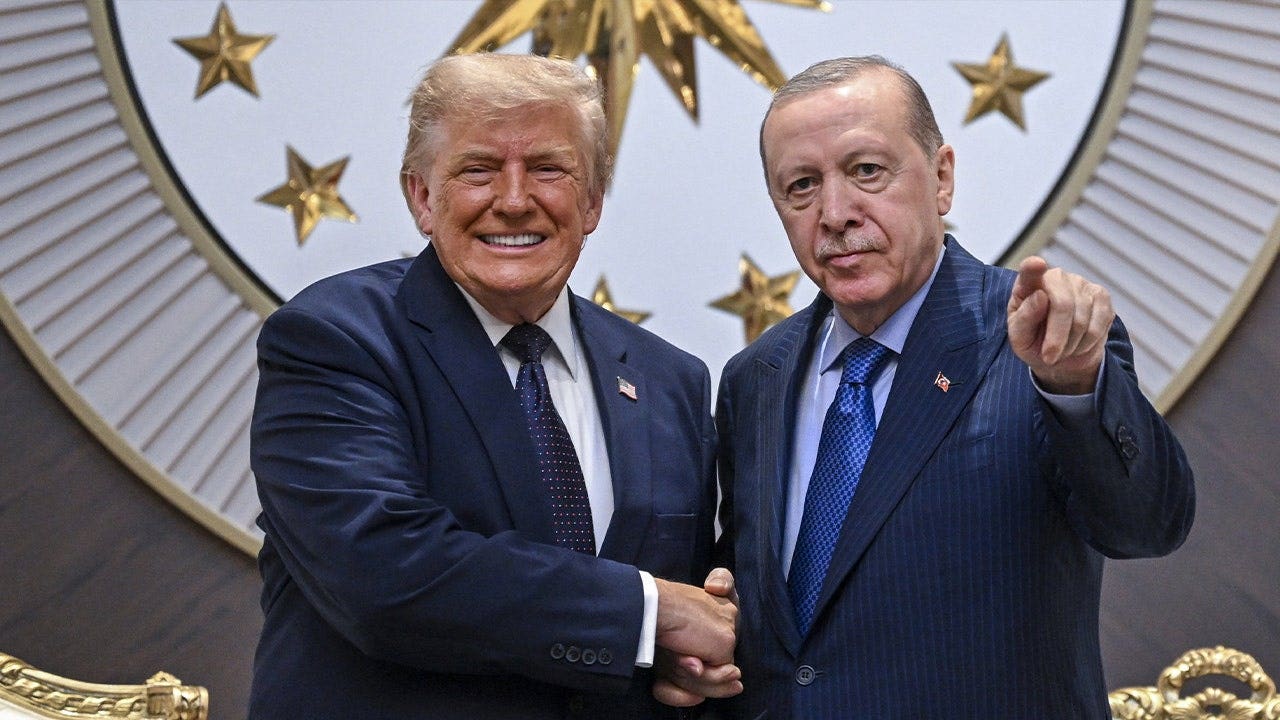
What came out of the Ankara press event felt less like an off-the-cuff briefing and more like the first public outlines of a coherent American strategy: insist on deterrence backed by force, finish wars from strength, demand alliance reciprocity, respect geography, and focus national power on the competition with China. The president’s comments touched Iran, Ukraine, NATO, Turkey, Greenland and China, and the underlying logic was consistent across those theaters. That logic matters because strategy is how choices get translated into national priorities.
In Ankara, the tone was plain and practical. The president said “Italy turned us down and Germany turned us down and France turned us down,” and he asked why the United States should keep carrying the heaviest load when partners do not step up. That complaint is not just personal; it reflects a view of alliances as transactional partnerships where commitments are tested by action, not just statements.
The core idea is simple: diplomacy works better when backed by credible power. Force restores deterrence, deterrence creates leverage, and leverage opens the space for negotiation. From a Republican perspective, that is common sense: we should not negotiate from a posture of weakness or pretend that talk alone will protect American interests.
On Ukraine the same logic applies. The president said, “I think they both want to make a deal,” and added that he hoped the war could be settled “hopefully soon.” Ending conflicts matters, but not at the cost of rewarding aggression. A negotiated peace needs to be durable and backed by enough strength to prevent renewed conquest.
Alliances should multiply American power, not let others freeload. The summit in Ankara showed European moves to build real warfighting capacity, with production and procurement that translate money into missiles, ships and aircraft. Republicans will applaud partners who carry more of the burden, because allied capacity is the best insurance against endless American overcommitment.
Industry and production are strategic. Modern high-intensity conflicts are battles of endurance as much as tactics; missiles, interceptors and advanced electronics can be exhausted faster than planners expect. If defense budgets do not convert into deployable combat power, they are just numbers on a ledger. The practical answer is to link spending to factory output and supply lines, not press releases.
Geography still sets limits and creates opportunities. Turkey may be a tough partner, but its location matters at the crossroads of the Black Sea, the Middle East and the southern NATO flank. That explains the willingness to address sanctions and defense trade; the president said the United States is “going to be taking the sanctions off,” and called selling advanced jets “certainly something we will consider.” Strategic geography forces tradeoffs that big-power theories sometimes miss.
Greenland prompted a blunt line of thinking on territorial advantage. The president argued Greenland “should be controlled by the United States, not by Denmark,” pointing to long-term security interests around Arctic sea lanes and contested approaches. For conservatives who prioritize national security, repositioning attention to places that matter strategically makes sense even if it raises diplomatic sensitivities.
All of this narrows to one disciplined truth: you cannot be everywhere with equal intensity. Every ship, missile battery and brigade committed somewhere reduces American options elsewhere. As Europe picks up more of its defense, Washington gains flexibility to focus on the rising strategic challenge in Asia, where China is integrating machine learning, autonomous platforms and advanced manufacturing into a comprehensive push for advantage.
Strategy is not declared in a single speech. It shows up in repeated decisions that favor deterrence, industrial readiness, reciprocal alliances, and geographic realism while prioritizing the competition that matters most. Whether you agree with every move, the pattern emerging in Ankara points toward organizing American power around clear, prioritized ends rather than indefinite, unfocused commitments.
