
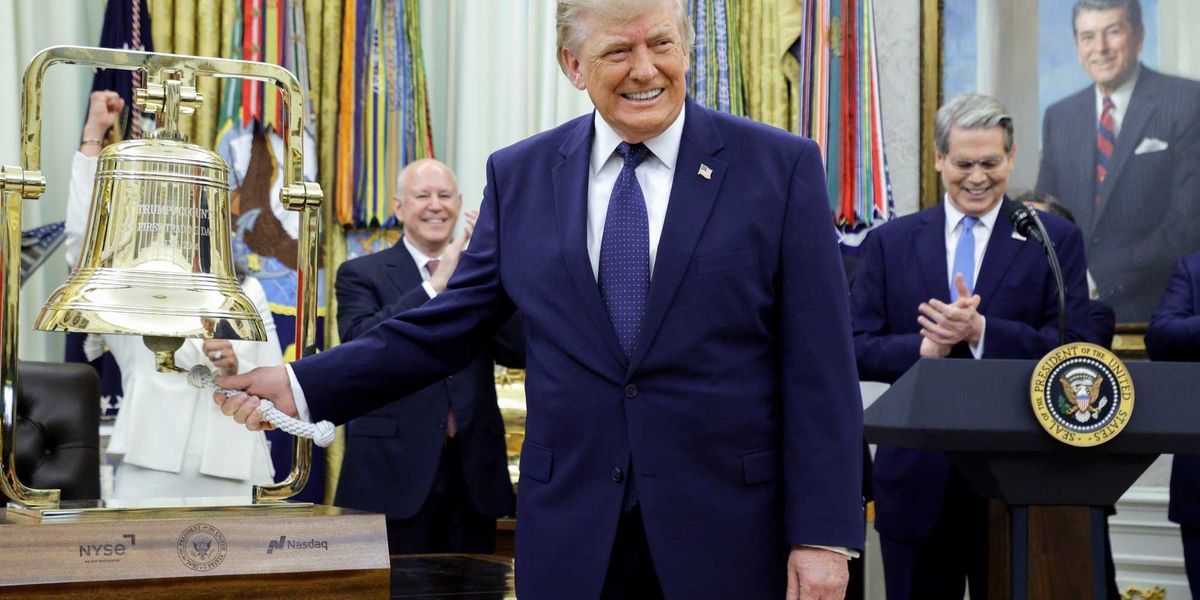
President Trump marked a first in market history by ringing the opening bells of both the New York Stock Exchange and Nasdaq from the Oval Office while launching Trump Accounts, a new youth investment program that seeds children’s savings with federal money and draws major corporate commitments to match and expand those funds.
In a scene that mixed Wall Street ceremony with White House stagecraft, Trump activated a plan meant to jump-start generational wealth for kids who aren’t yet adults. The program, enacted through the One Big Beautiful Bill Act, opens accounts to children who will still be under 18 at year’s end and lets families add to that starter money under annual limits. Officials emphasized simplicity: a government seed deposit, optional employer or family contributions, and an investment path that compounds over time.
Every eligible child receives a one-time $1,000 federal seed contribution into an account that is invested and tax-advantaged until the child turns 18, with the default allocation set to an S&P 500 ETF and additional options promised to come. Parents and employers can put more money in up to legal limits, and the idea is straightforward — give kids a real stake in the market early and let compound returns do the work. This is pitched as a long-term nudge toward ownership, not a short-term welfare payment, which matters for conservative principles about opportunity and responsibility.
The administration set a clear enrollment path through its portal, inviting families to sign up at no charge, and officials expect a fast uptake given the high-profile rollout. The launch was timed to attract maximum attention, opening contributions on July 4 to underline the patriotic theme of broad-based ownership. Planners say the accounts are designed to be familiar and accessible so ordinary parents can enroll without financial wizardry.
Corporate America showed up. Michael and Susan Dell pledged a $6.25 billion commitment, underwriting $250 apiece for the first 25 million qualifying children who sign up, and other heavy hitters promised to match or augment the government seed. Names like Goldman Sachs, BlackRock, JPMorgan Chase, and Robinhood said they would match the initial contribution for children of employees, and SpaceX’s leadership pledged company stock for millions of youngsters. Those corporate commitments turn a federal push into a public-private wave of capital aimed directly at kids’ accounts.
The guest list at the White House event reflected the program’s crossover appeal: Treasury Secretary Scott Bessent, Senator Ted Cruz, Dell executives, NYSE President Lynn Martin, and Nasdaq officials were all on hand alongside other business leaders. That mix mattered — it telegraphed bipartisan market support in the Republican rollout even as it leaned into private-sector muscle. The optics were calculated: government starts the pump, employers and investors amplify the flow, and families inherit the gain.
Trump didn’t just announce policy; he made a sales pitch, urging people present to “go out and buy a Dell computer” and prompting an immediate market response when Dell stock jumped more than 7 percent after his remarks. The quick market move underscored how public endorsements and corporate pledges can translate into real trading action, which supporters say proves the program’s potential to mobilize fresh capital. Organizers estimated that the seed funding and early private contributions would pour roughly $800 million into the market for children this week alone, a figure they framed as proof of immediate impact.
‘Children, at the age of 18 and after, become very wealthy people, come into the world with essentially no money and end up, at a pretty young age, being very rich.’
Trump framed the accounts as a direct path to prosperity, telling the crowd he expected young Americans to “become very wealthy people … come into the world with essentially no money and end up, at a pretty young age, being very rich” by adulthood. That rhetoric reflects a conservative belief in ownership as empowerment, and it sets a bold expectation for what a modest, early investment can do over a decade or more. The program’s backers argue that seeding ownership at birth or early childhood changes incentives, boosts savings habits, and spreads the benefits of market growth more widely across families and communities.
