Gallup polling ahead of America’s 250th birthday shows patriotism slipping across the board, with Democrats registering a startling collapse in “extremely proud” responses while Republicans remain stoutly more patriotic. The survey tracks drops across ages, genders, education and race, and the raw numbers trace a clear partisan split that has widened since 2016. This piece lays out those shifts, the specific figures, and what the trend looks like for younger Americans in particular.
Poll results put overall American pride at a 25-year low, a sharp reversal from the post-9/11 high point. In 2002, 69% of adults said they were “extremely proud” to be American and 23% were “very proud.” By 2026 those totals have shrunk to 33% “extremely proud” and 20% “very proud,” a dramatic erosion of the once-commonplace confidence in the flag and country.
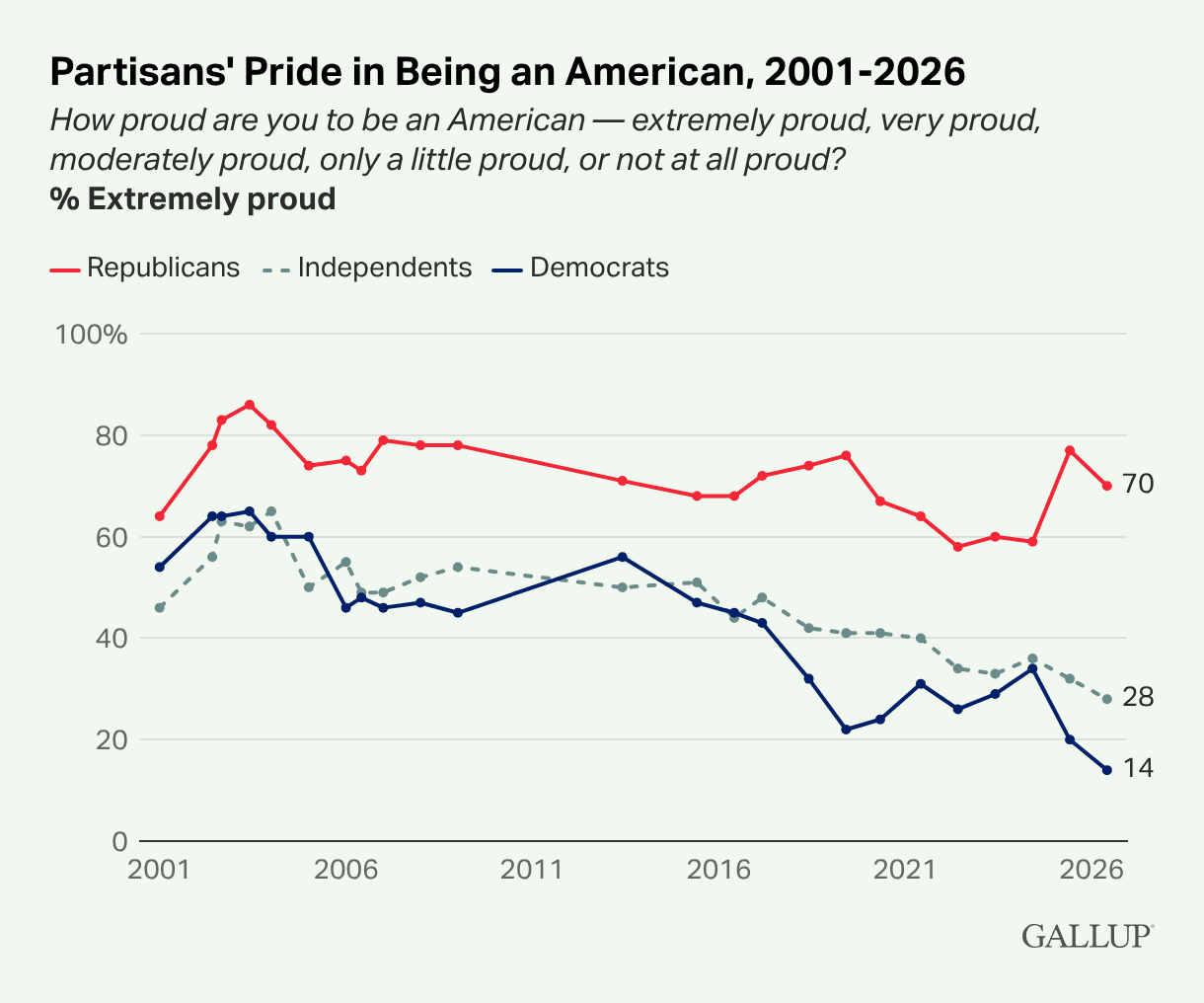
The partisan gap is unmistakable and growing. Republicans continue to report far higher patriotic feelings than Democrats, a pattern that only widened after Donald Trump entered national politics. In 2016, 68% of Republicans said they were “extremely proud” versus 45% of Democrats; today Republicans sit at 70% while Democrats register a startling low of 14%.
Combine the “extremely” and “very” proud categories and the contrast is even clearer: Republicans reach 93% and Democrats only 27%. Those numbers tell a simple story about which party still connects with traditional expressions of national pride and which one has moved away from them. The evidence points to a party identity problem rooted in rhetoric and candidate choices over recent cycles.
“The Democratic Party is facing a patriotism problem that only seems to be worsening.” That line isn’t a slogan for one side or another; it’s a blunt summary of where the party stands in public sentiment. As far-left contenders who frequently criticize American institutions have scored primary wins, the Democratic brand of patriotism appears to be under strain.
Age cohorts show sharp differences, and the youngest voters are the most concerning for those who care about civic attachment. Among 18- to 34-year-olds, “extremely proud” responses fell 10 points to 14%, and among 35- to 54-year-olds it dropped 12 points to 30%. These declines suggest the coming generation will relate very differently to national symbols and narratives than their parents did.
Disturbingly, 21% of 18- to 34-year-olds now report they are “not at all” proud to be an American, while another 24% say they are “only a little” proud. Those are not small numbers; they represent a cohort where skepticism of the country has become a mainstream stance. If these attitudes harden, they could influence everything from civic participation to national cohesion.
Women experienced the largest single drop in the poll, sliding 13 points from 39% “extremely proud” to 26%. Other demographic shifts include 10-point declines for “People of color” and non-college graduates since last year, indicating the pullback in pride is not limited to one slice of the population. Men, those 55 and older, non-Hispanic white adults, and those without college degrees still sit at the top of their categories, but the trend lines lean downward across the board.
Republicans’ steadier patriotic numbers are a political advantage in an election landscape where national identity matters. The party’s 70% “extremely proud” mark, even with a slight dip from the previous year, signals a resilient base that still rallies around American symbols. For Democrats, the challenge is real: low pride ratings weaken a party’s claim to speak for the country’s future and can alienate swing voters who value national unity.
These findings arrive as the country prepares to mark 250 years of American independence, a milestone that normally inspires reflection and celebration. Instead, the polling raises questions about generational shifts, political messaging, and how parties are framing patriotism. The data show that pride can ebb quickly when civic confidence is undermined, and rebuilding it will require more than slogans.
Public opinion can turn, but the current trajectory makes clear which side is better positioned to claim the patriotic mantle right now. The numbers are straightforward, and they point to a political and cultural gap that won’t close without serious attention to national pride and the symbols that bind Americans together.