
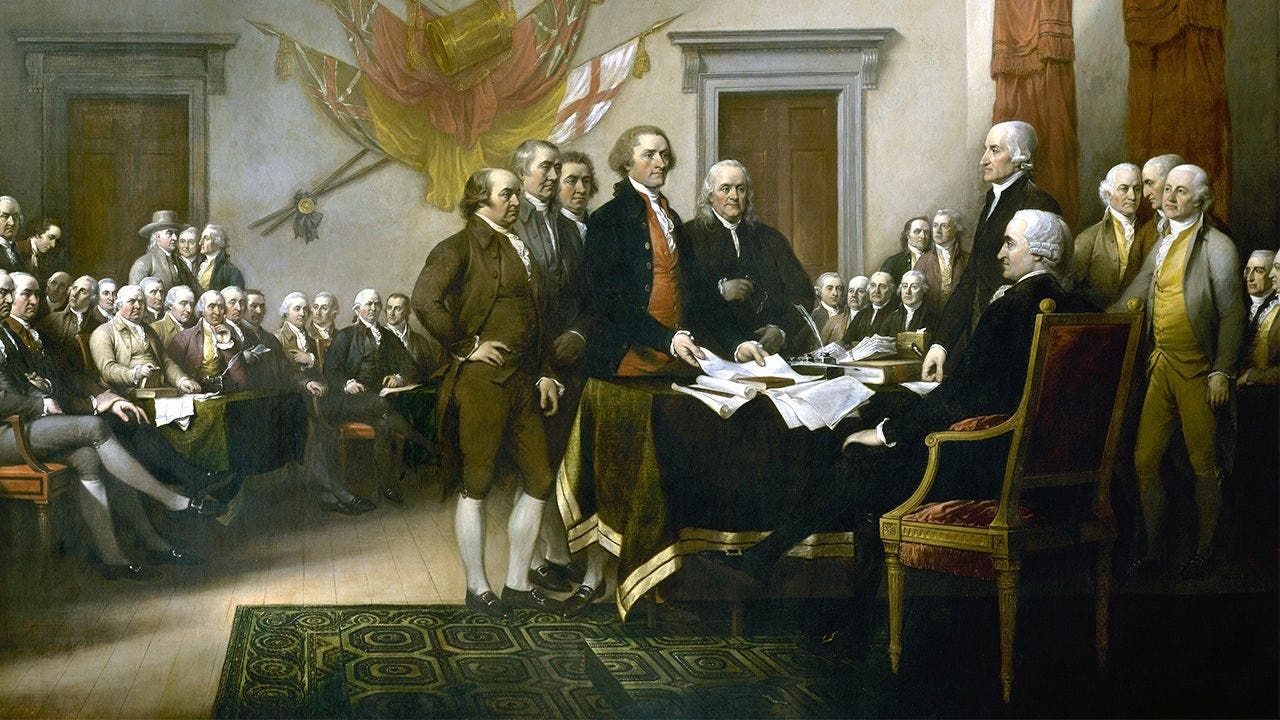
On this 250th anniversary, the Republic our Founders forged feels perilously close to slipping away. This piece argues that the heirs of Jefferson, Franklin and Adams would be alarmed by the rise of socialism, the cancellation of history and a growing tolerance for political violence. It also insists the remedy is straightforward: name the threat, defend our traditions, and act with courage.
Imagine the Founding Fathers dropped into 2026 and looking around at a nation where public ceremonies and national memory are under attack. They would see efforts to erase statues, rename institutions and rewrite history, all while influential voices push policies that echo socialist principles. From a Republican vantage, that trend is not progress; it is erosion of the liberties those men risked everything to secure.
Those founders would be stunned that many young people no longer consider democracy essential to America’s identity. That shift in belief matters because youth are the future of civic institutions and public norms. If a majority of the rising generation doubts the core tenet of our Republic, the long-term consequences could be severe.
They would also be alarmed to watch public figures cheer or rationalize political violence, and to learn that an increasing number of Americans privately accept murder as a political tool. Such breakdowns in basic decency and restraint were unthinkable to men who fought a revolution to escape arbitrary power. Our job now is to push back against any culture that celebrates or excuses attacks on opponents.
I believe the Founders would speak plainly and sharply. “You have all but lost the country we shed our blood, sweat and tears to create. This is your last chance to save it.” Those words would be a wake-up call, not an exercise in nostalgia, because they demand action from citizens who still believe in limited government, free speech and the rule of law.
They would remind us that tyrants often rise by co-opting language and institutions, then hollowing them from within. When leaders start promising power in exchange for loyalty to an ideology rather than to the Constitution, the Republic is in danger. That is why vigilance and participation in civic life are not optional; they are duty.
History teaches practical tactics for resistance. The Founders used Committees of Correspondence to spread truth about government overreach and to organize a peaceful but firm response. Republicans can revive that spirit by engaging neighbors, supporting civic education, and insisting schools teach the full sweep of American history, both its triumphs and its mistakes.
They would point out that being in the arena matters more than being a critic on the sidelines. “It is not the critic who counts; not the man who points out how the strong man stumbles or where the doer of deeds could have done them better. The credit belongs to the man who is actually in the arena, whose face is marred by dust and sweat and blood…who spends himself in a worthy cause; who, at the best, knows in the end the triumph of high achievement and who, at the worst, if he fails, at least fails while daring greatly, so that his place shall never be with those cold and timid souls who neither know victory nor defeat.”
Faced with leaders who flirt with collectivist ideas, Americans must choose between the road of liberty and the path toward centralized control that has undone nations before. That is a political choice with moral stakes, and it calls for clear-eyed campaigning, local organizing and a refusal to normalize extremism. Defending republican institutions requires both speech and service.
On this anniversary, the task is simple and urgent: refuse the erasure of our past, teach the next generation why a republic matters, and stand up against those who would replace constitutional order with ideological rule. If we do not, the experiment our Founders began will be harder to preserve for the next generation.
God bless the United States of America. A republic if we can keep it.
