
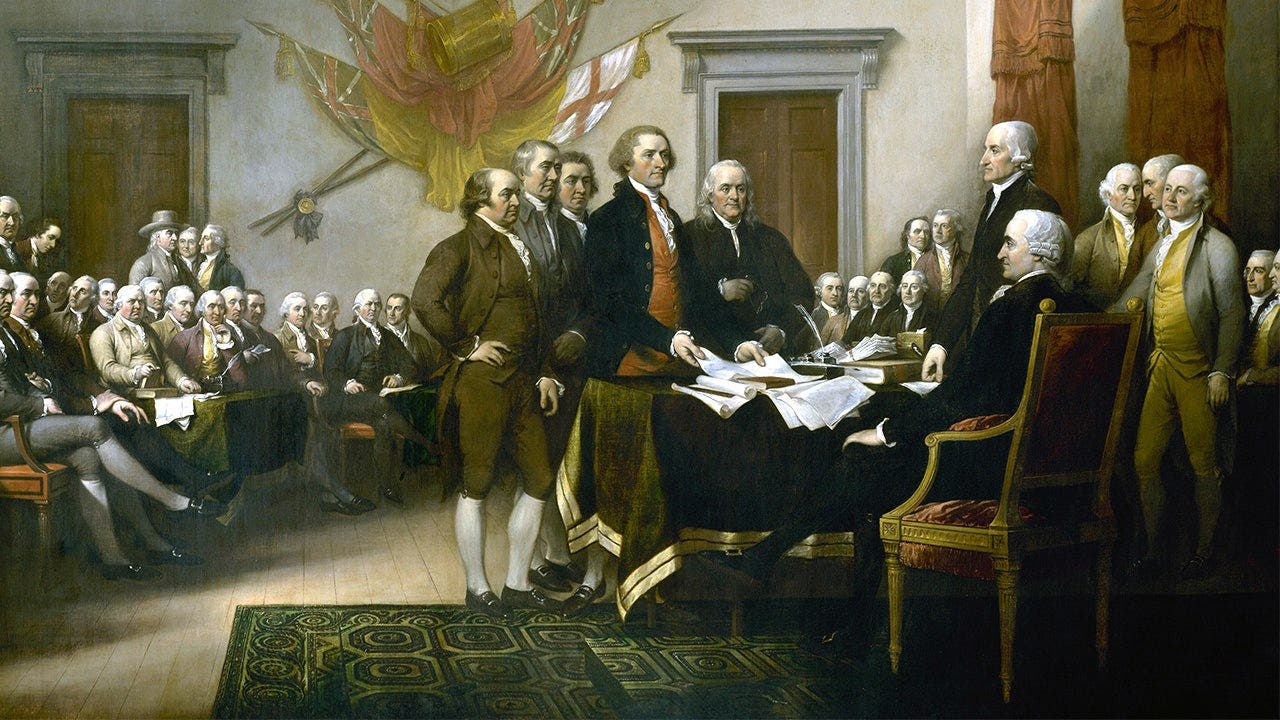
John Adams asked a sharp question about what the American Revolution really was, and his answer points us away from muskets and toward minds and consciences. This piece traces how the break with monarchy was as much spiritual and civic as it was military, showing how a wildly diverse set of colonies found a way to govern together. The story centers on religious difference, tolerance, and the shift from loyalty to a king toward self-government.
“What do we mean by the American Revolution? Do we mean the American war?” Adams penned that line and used it to argue the war was only one part of a larger upheaval. The violence of 1775 through the later years mattered, of course; thousands died in battle and many more from disease. Still, Adams insisted the deeper change was internal and long in the making.
Adams wrote bluntly about that inner work: “The revolution was in the minds and hearts of the people; a change in their religious sentiments, of their duties and obligations,” and he meant it. For many colonists, commitment to independence grew slowly, shaped by sermons, debates, and hard choices about allegiance. What began as private wrestling over faith and duty eventually fed public action and the Declaration of Independence.
“The colonies had grown up under constitutions of government, so different, there was so great a variety of religions, they were composed of so many different nations, their customs, manners and habits had so little resemblance,” Adams observed, pointing to the patchwork nature of colonial life. People arrived in America after fleeing persecution and seeking opportunity, and they brought competing confessions and customs. That variety made collective politics tricky: trust had to be built across lines of creed and habit.
European history was full of religious violence, and colonists knew it. Protestants and Catholics both faced persecution at times in Europe, and Jews were often forced to convert or expelled. America had become a refuge, and that refuge contained Puritans, Anglicans, Catholics, Quakers, Baptists, Presbyterians and a host of smaller sects, each wary of the others.
Colonial experiments in tolerance varied. Some places were founded with a particular church in mind, others, like Pennsylvania and Rhode Island, cultivated broader welcome. The result was a nation where religious practice was fragmented and denominational loyalties often trumped civic ones. That fragmentation showed up even in the Continental Congress when delegates struggled over who should lead public prayer.
“[B]ecause we were so divided in religious sentiments, some Episcopalians, some Quakers, some Anabaptists, some Presbyterians and some Congregationalists, so that we could not join in the same act of worship,” a delegate explained, and the difficulty forced an adaptive, practical solution. “Mr. [Samuel] Adams arose and said he was no bigot, and could hear a prayer from a gentleman of piety and virtue, who was at the same time a friend to his country.” They chose ministers of different persuasions and modeled the kind of tolerance a republic would need.
Tensions were sharper elsewhere. In 1774, British authorities in Virginia jailed Baptist preachers for not holding licenses from the established church, and that repression pushed leaders like Madison and Jefferson to press for free exercise protections. Adams warned that taxation without representation could easily lead to an imposed church: “if Parliament could tax us, they could establish the Church of England… and prohibit all other churches.”
George Washington worried that religious strife could break the army and the cause, and he urged respect for conscience even while fighting for liberty. “While we are contending for our own liberty, we should be very cautious of violating the rights of conscience in others; ever considering that God alone is the judge of the hearts of men and to him only in this case they are answerable,” he told his soldiers. That appeal to mutual forbearance kept diverse men fighting side by side.
Founders started from a notion that kings were appointed by God, but when the crown behaved tyrannically, many concluded the monarch had failed his duty. Ministers preached Galatians 5:1 and framed resistance as a moral, not merely political, necessity; “God save the king” faded and “We the people of the United States of America” took shape. Enshrining freedom of religion in the Bill of Rights was a practical expression of confidence: their faith could survive—and flourish—without state enforcement.
“Their knowledge of each other [was] so imperfect that to unite them in the same principles in theory and the same system of action was certainly a very difficult enterprise,” Adams reflected, capturing how fragile the union initially seemed. “This radical change in the principles, opinions, sentiments and affection of the people, was the real American Revolution.” That radical internal shift—tolerating difference while committing to shared rights—made the political experiment possible.
They traded a crown for a compact and chose conscience over command, and that choice reshaped politics and religion in the new nation. The drama of independence was not only in the battlefield smoke but in churches, meetinghouses and private hearts where people learned to trust one another across deep differences. That quiet transformation was the real work that underpinned a republic.
