
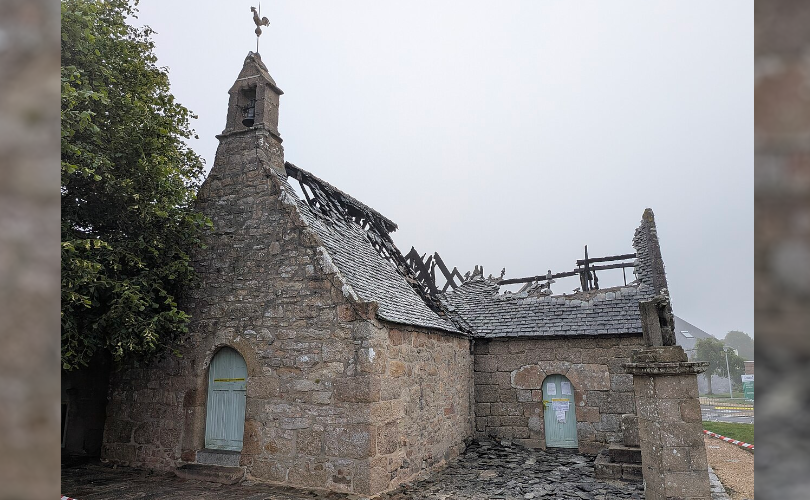
The sudden fires that struck two historic Catholic sites in France on June 12 wiped out irreplaceable archives and left communities stunned, as Sainte-Anne Chapel in Brittany and the cloister of Condom Cathedral in Gers caught fire within hours of each other. Both blazes destroyed volumes of church records, turning centuries of written history into ash and smoke and prompting questions about what can be done to protect small, vulnerable heritage sites. Local leaders, parishioners, and preservation specialists are now facing the hard work of assessing loss, investigating causes, and planning recovery. The impact spreads beyond the buildings themselves, touching memory, research, and the daily lives of people tied to those places.
The first fire at Sainte-Anne Chapel was reported early on June 12, and emergency crews raced to the scene to try to contain the flames. The chapel had held archival material and parish documents that dated back decades, possibly centuries, and those records were quickly claimed by the fire. Witnesses described seeing flames move through wooden structures, making salvage operations dangerous and limited.
The second blaze hit the cloister of Condom Cathedral in Gers just hours later, leaving the elegant stone walkways scarred and the cloister’s archive rooms gutted. Cloisters often house parish registers, administrative papers, and items of local significance, so the damage is not only architectural but deeply archival. Firefighters worked under difficult conditions to protect what they could, but many volumes were already beyond saving when the smoke cleared.
When religious archives burn, historians and genealogists lose primary sources that can rarely be replaced. Parish registers record baptisms, marriages, and deaths, and they are often the backbone of local history research. Losing original documents means gaps in knowledge about community life, family lines, and cultural practices that were recorded only once and stored in these church repositories.
For local parishioners, the destruction is intensely personal. These buildings are sites of worship, rites of passage, and communal memory, and the records inside are part of that continuity. People who grew up in the area and older residents especially feel the loss as if a piece of their family story were erased, and there is a palpable sense of grief alongside practical concerns about what to do next.
Authorities and conservation experts are now focusing on two immediate tasks: determining how the fires started, and salvaging any remnants of the collections that might be recoverable. Fire investigations typically examine electrical systems, heating sources, and human activity, and they aim to rule out or confirm accidental and deliberate causes. Where partial remnants survive, paper conservators can sometimes stabilize charred fragments and create digital surrogates to preserve what remains for study.
Insurance and funding questions come up quickly after such events, because repair and conservation are expensive and specialized. Small parishes and local authorities rarely have the resources to tackle large-scale restoration on their own, so appeals for regional or national support are common. Experts say prioritizing documentation, condition surveys, and emergency plans can accelerate recovery and help secure outside assistance more effectively.
There is also a growing conversation about digitization as a protective measure, though it is not a simple fix. Scanning and backing up delicate records requires trained staff, equipment, and storage solutions, and many smaller churches lack those resources. Still, digitization provides a crucial secondary copy that can preserve information even if the physical object is lost, and it is increasingly seen as a core part of heritage risk management.
Beyond technical responses, these fires highlight the value of community engagement in protecting heritage. Volunteers often play key roles in emergency response, cataloging collections, and supporting fundraising efforts for restoration. Strengthening local networks, training volunteers for disaster response, and developing quick-access plans for archives can multiply what small teams can accomplish when time is short.
Architects and conservators will assess structural damage next, looking at masonry stability, smoke infiltration, and water damage from firefighting efforts. Restoration of historic fabric can be painstaking and costly, and decisions will need to balance authenticity with safety upgrades that reduce future risk. Any intervention will likely involve specialists who understand both the history of the buildings and modern conservation techniques.
As investigations proceed, those who care for these sites are asking hard questions about preparedness and long-term preservation. What can be done to better shield fragile collections from fire and other hazards? How can small parishes access expertise and funding before disaster strikes? The answers will matter not only for Sainte-Anne Chapel and Condom Cathedral but for countless modest heritage sites across the country that hold pieces of local history.
Work to recover what remains is underway, and the communities affected are already organizing to document losses and seek support. While the physical damage is severe, the response — from emergency crews to volunteers and specialists — is focused on saving what can be saved and on turning the shock of these events into momentum for stronger protection of fragile historic records. The coming months will show how those efforts take shape and what steps are taken to prevent future losses.
