
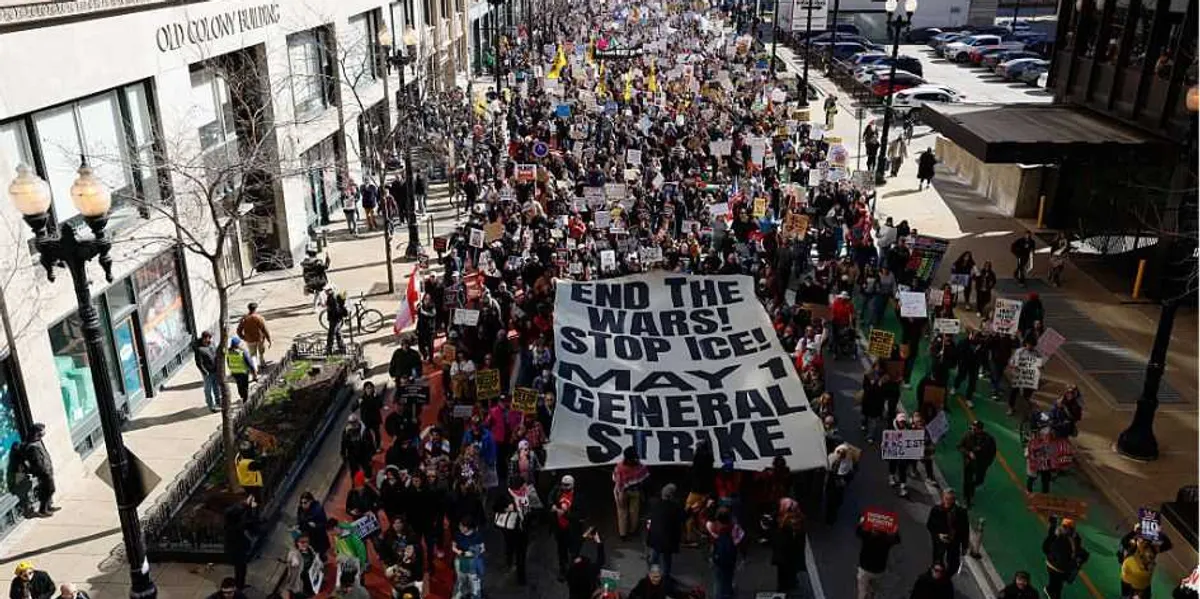
The National Education Association backed nationwide May Day actions that urged “no work, no school, no shopping,” and the union provided organizers with a solidarity toolkit to push participation. That support raises clear questions about whether the NEA is acting as a professional association for teachers or as a partisan organizer that asks students to stay out of class. This piece walks through the history of May Day, the NEA’s role, reported political spending, and the uncomfortable overlap between classroom duties and broad political campaigns.
May Day has an authentic labor history tied to the push for an eight-hour workday, but it also arrived with other political baggage. Over the decades it became linked to socialist and communist movements worldwide, and in American practice it often resurfaces as a platform for expansive political protests. When a teachers union layers that history onto nationwide calls to keep students home, school priorities get blurred.
The NEA did not hide its involvement; it offered resources and a slate of demands that move well beyond wages and classroom resources. Among them: “Stop the billionaire takeover and rampant corruption of the Trump administration.” It also highlighted: “Stop the attacks on our communities, including policies targeting immigrants, people of color, Native people, people with disabilities, and those who identify as LGBTQ+.”
Those statements are explicitly political and sweep across immigration, cultural disputes, and national partisan fights. That kind of agenda sits oddly next to the NEA’s stated mission of preparing every student to succeed in a diverse world. Asking students to skip school as a tactic doesn’t match the narrow, school-centered concerns most parents and taxpayers expect a teachers union to prioritize.
There’s more than rhetoric to consider. A watchdog report shows teachers unions have spent over $1 billion on political activity since 2015, with about $669 million at the federal level and roughly $336 million at state and local levels. Some spending targets the kind of education policies members might endorse, like ballot measures to fund schools, but a lot of money goes toward pure partisan infrastructure.
Union dollars have flowed to big Democratic-aligned organizations and PACs rather than only to school-focused efforts. Reports list tens of millions sent to national groups, including $32 million to Senate Majority PAC and $25 million to House Majority PAC, plus $60 million to the State Engagement Fund and $44 million to For Our Future. That pattern looks more like a PAC’s footprint than a teachers association focused on classrooms.
At the state level the money also shows a political reach that touches high-profile political fights. In California unions backed tax measures and candidates, and union PACs spent heavily opposing the recall of a governor in 2021 while later committing millions to other ballot efforts. Those kinds of bets are partisan by design and often stray from day-to-day classroom issues.
Beyond campaign cash, unions fund activist training and organizing groups that feed sustained protest work. One recipient, the Midwest Academy, describes itself as “committed to providing organizers with the practical skills needed to address the challenges of forging change in a system rooted in white supremacy.” The NEA has given that group funding and helped produce materials tied to prolonged activism.
Teachers’ unions are different from ordinary political clubs because membership dues often fund their activity, and many educators pay those dues as a practical workplace requirement. That makes the question of who benefits urgent: are members endorsing broader political warfare, or are they funding functions unrelated to classroom support and student learning?
When unions fight directly for teacher pay and school resources, the link to the classroom is clear and defensible. But when they mobilize students for mass protests, bankroll partisan PACs, and train organizers for long-term campaigns, the line between education advocacy and political campaigning fades. Parents, taxpayers, and conservative voters should expect clarity about where dues money goes and whether union actions serve students first.
