
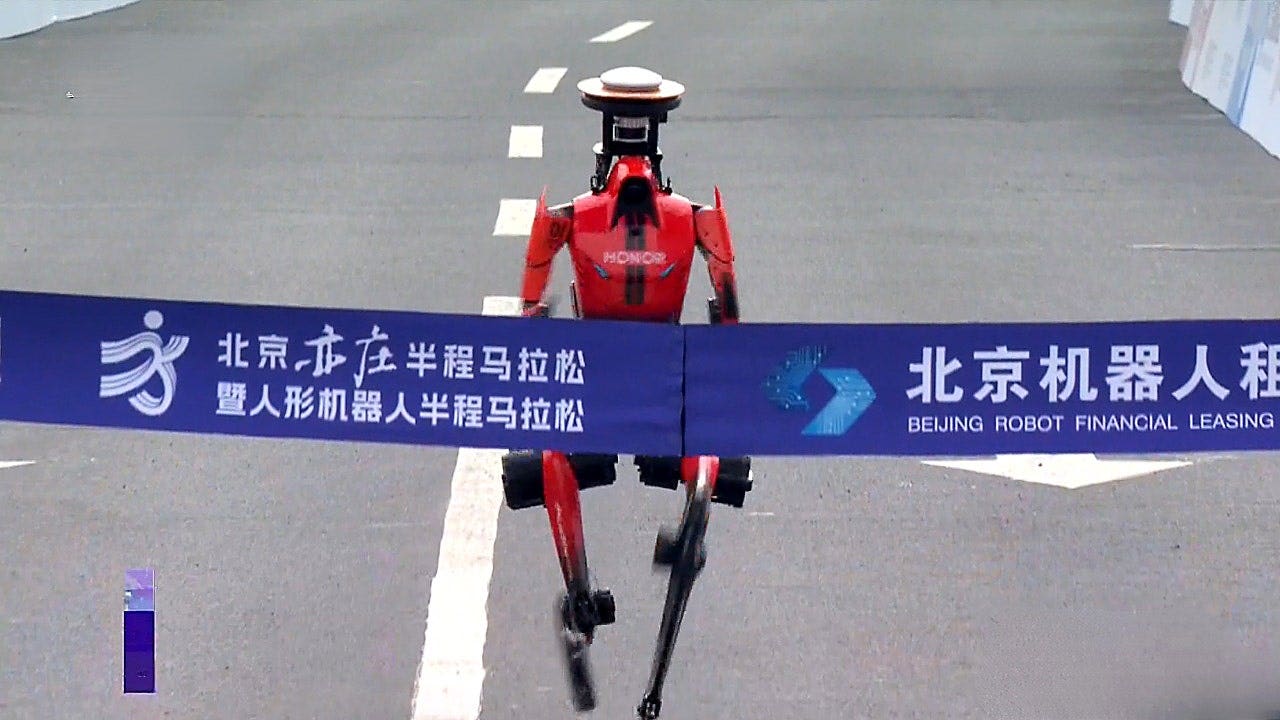
Robots stole the spotlight in a Beijing half-marathon when a humanoid called Lightning crossed first, running autonomously and beating elite human times, and that result raises practical questions about where robot mobility and endurance might matter next.
The finish line scene felt familiar at first: exhausted humans gasping for air. Then Lightning walked up, unfazed, having finished the 13.1 miles well ahead of most people on the course.
Lightning clocked 50 minutes and 26 seconds, a mark notably faster than the human world record of 57 minutes and 20 seconds. That gap is not a tiny tweak; it’s a significant step forward in endurance speed for humanoid machines.
What made the event striking was scale and autonomy. More than 100 robot teams from across provinces ran alongside roughly 12,000 human competitors, and nearly half of those machines ran without remote control.
Autonomy changes the game. These robots made split-second decisions while moving at speed, correcting balance, choosing paths and reacting to other runners, which mirrors the kinds of unpredictable choices robots must make in real workplaces.
Design choices mattered. Lightning’s team focused on long legs, tuned stride length and cadence for efficiency, and integrated liquid cooling systems borrowed from smartphone tech to sustain high output without overheating.
Sensors and onboard computation let robots adjust balance and trajectory in real time, because running is basically controlled falling. Pulling that off repeatedly at racing pace requires continuous correction and reliable sensing.
The engineers stressed that the headline was not racing for its own sake but stress-testing systems. If a humanoid can sustain high-speed movement over 13.1 miles, that suggests it could withstand long shifts in logistics or manufacturing roles without failing.
HOW 432 ROBOTS ARE RELOCATING A 7,500-TON HISTORIC BUILDING
It was not flawless. Some machines stumbled: one robot fell at the start and another collided with a barrier. Those incidents matter because they expose the boundary between peak feats and consistent, everyday performance.
That boundary is where humans still hold an advantage. Robots can spike to incredible speeds under controlled or well-mapped conditions, but unexpected obstacles, subtle terrain changes or tiny sensor errors can still cause breakdowns.
We are already seeing practical deployments for robotic helpers—carrying groceries, assisting in kitchens and handling repetitive cleaning tasks. Add dependable mobility and stamina, and their potential use cases expand into more physically demanding settings.
Adoption tends to follow a pattern: warehouses and back-of-house roles first, then customer-facing positions where consistency matters more than charm. As reliability improves and costs fall, those shifts accelerate and spread into new sectors.
That trajectory touches jobs, daily convenience and regulatory questions. As robots gain autonomy and endurance, we have to decide how much control and oversight to demand, and where to draw the line between useful automation and replacement that goes too far.
