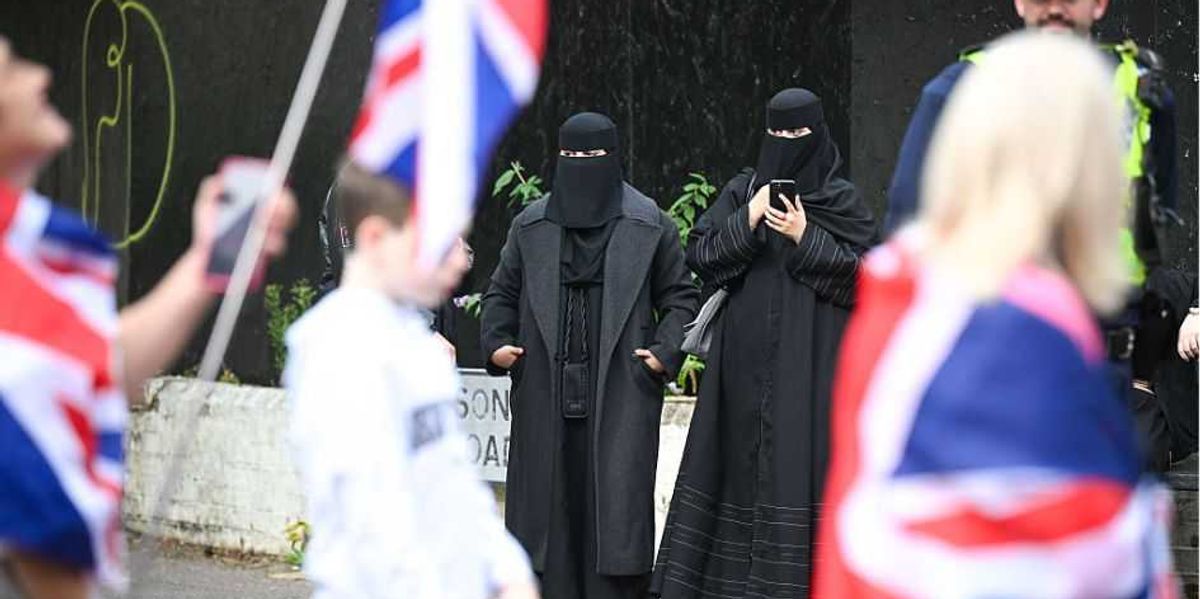
Kemi Badenoch has put a burqa ban on the table as part of an Islamist extremism review, and the argument for restricting full facial concealment in public comes down to civic visibility, public safety, and consistent application of neutral laws in an open society. This piece argues from a conservative, Republican-minded perspective that public spaces require mutual legibility, that enforced invisibility is incompatible with civic life, and that neutral rules—already common across Europe—can protect both religious practice and shared obligations without capitulating to doctrinal pressure. It examines how faces matter to trust and institutions, why the burqa differs from private devotion, and why a carefully tailored ban would be lawful and socially stabilizing rather than a persecution of faith. The goal is to show that protecting public institutions and female agency are coherent conservative priorities that should drive decisive policy action.
The question at stake is simple: should public life tolerate permanent facial concealment when no other group gets the same exemption? Faces are not decorative; they are the basic signals humans use to read intention, consent, and identity. When a face is removed from civic exchange, it becomes harder for institutions and fellow citizens to treat that person as a visible participant in shared life.
‘Freedom’ that produces permanent public anonymity for one group, in spaces where no one else enjoys it, is not freedom’s finest hour. That exact line captures the discomfort many voters feel when liberty becomes an asymmetric carve-out. If our commitment to individual rights produces a permanent zone of anonymity for some, we have to ask whether that commitment still serves the public good.
Many European democracies already limit full facial concealment in public and have done so without collapsing into chaos. Those laws did not abolish religion or erase Muslim communities; they enforced basic legibility in civic life. The lesson for Britain and the United States is not cultural imperialism but pragmatic governance: neutral rules that require visibility in specified public contexts protect trust without banning private worship.
It is reasonable to distinguish between modest religious expression and full concealment that thwarts identification. A headscarf or other religious dress that leaves the face visible is fundamentally different from a garment designed to render a woman’s face invisible. Public functions—courts, banks, airports, polling stations and schools—depend on being able to confirm identity, explain decisions, and see consent. Those needs are real and routine.
Some will insist that forcing a woman to remove a facial covering is identical to regulating dress generally, but the comparison breaks down under consistent legal tests. Religious exercise does not grant an unlimited right to opt out of neutral, generally applicable laws. The precedent in Employment Division v. Smith and similar reasoning shows that public safety and neutral regulation can coexist with religious freedom without a constitutional crisis.
The difference between personal choice and social pressure matters. Where garments become mandatory through coercion, tradition, or community enforcement, the fiction of free choice does not hold up to scrutiny. A law aimed at preserving public legibility need not assume hostility to faith; it can simply recognize that civic obligations sometimes trump private display when public functions are at stake.
A targeted prohibition would not prosecute belief or private observance. It would apply in specified public venues where visibility is required for safety, legal process, and civic participation. That approach respects private devotion while addressing the tangible costs of enforced anonymity in shared settings.
For conservatives, the issue ties into broader instincts: protect institutions, uphold rule of law, and insist on universal civic duties. These are not illiberal instincts; they are the foundation of pluralist order. If some public acts require visible accountability, the state has a legitimate role in setting neutral rules that apply equally to everyone.
Feminist arguments against unquestioned “choice” also land well within a conservative frame when they confront coercion and social constraint. Defending individual agency means ensuring that choices are genuine, not socially compelled. A policy that preserves the ability to worship privately while insisting on face visibility in public does more to protect real agency than pretending all appearances are equally harmless.
Politically, a careful law would face pushback and court scrutiny, especially in the United States. Still, legal complexities are not moral indecision. Democracies can and do balance liberties with civic requirements, and many countries have already reached that balance. The practical question is whether open societies will acknowledge the trade-offs and legislate accordingly.
The burqa, as a form of permanent public concealment, sits at the edge of civic withdrawal. It poses real challenges to identification, accountability, and mutual trust in shared spaces. The conservative case is straightforward: uphold religious freedom where it belongs, and require visible participation where public life depends on it.