Peter Hitchens’s turn back to Anglican faith was driven less by comfort than by a raw, elemental fear he encountered standing before a painting of the Last Judgment, and that fear reshaped how he thought about moral reality in a way that sharply contrasted with his brother Christopher’s dismissal of hell as a “celestial dictatorship.” This essay follows that pivot: a skeptical upbringing, a career that exposed the limits of ideology, a sudden confrontation with art that froze him in terror, and the steady conviction that moral seriousness depends on something deeper than human invention.
Christopher Hitchens made a career out of punching holes in religion, and he especially loathed the idea of eternal punishment. For him, the doctrine of hell reduced faith to fear and turned God into a bully, a point he voiced bluntly when he called it a “celestial dictatorship.” That view shaped a public divide between brothers who shared wit and talent but not theological conclusions.
Peter Hitchens took a different path back toward faith, one that he admitted felt embarrassing to confess. “No doubt I should be ashamed to confess that fear played a part in my return to religion,” he later wrote in his 2010 memoir “The Rage Against God.” He did not romanticize the motive; he simply said what it was and let the honesty stand as part of his testimony.
His life as a globe-trotting reporter had taught him to respect fear as an instrument of clarity. Crashing a motorcycle, dodging gunfire, and facing violent crowds are experiences that strip life down to essentials, and Hitchens learned to read fear not as mere panic but as a signal. That practical lesson prepared him to receive a spiritual lesson he never expected while on holiday.
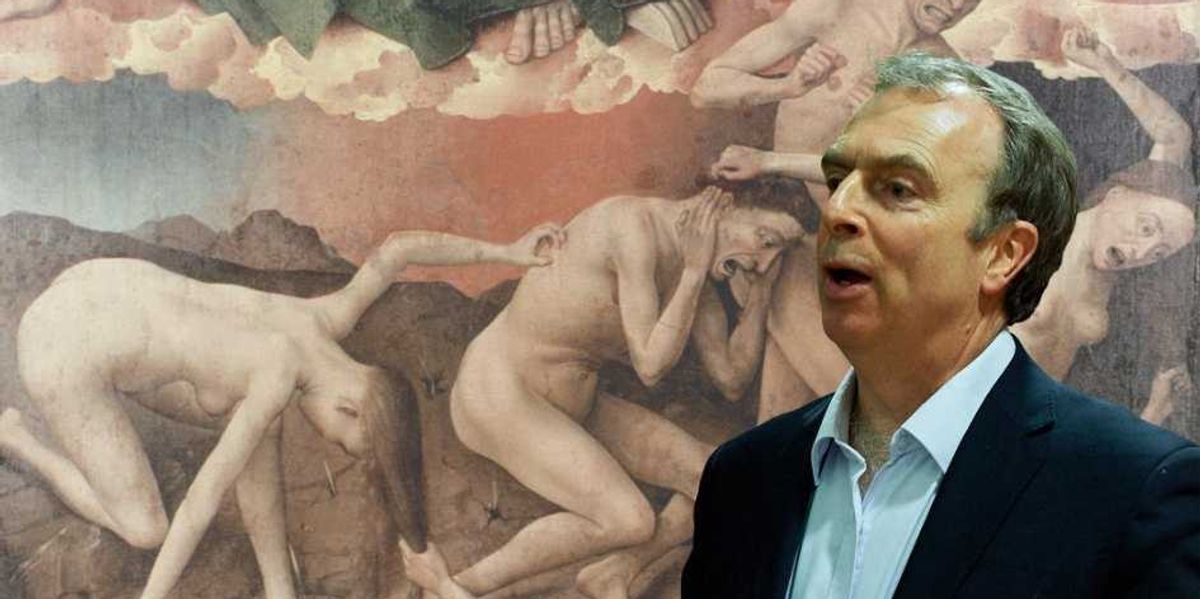
Visiting Burgundy with his then-girlfriend, he drifted into a cultural stop to see the Beaune Altarpiece by Rogier van der Weyden and found himself rooted to the spot in a way he hadn’t anticipated. The figures in that Last Judgment scene stopped feeling distant or quaint. “They were my own generation,” he wrote, naked and immediate, and the recognition hit him hard.
That shocking intimacy made the painting function less like history and more like a moral mirror. “They were me and the people I knew,” he remembered, as if the artist had stripped away fashions and time to expose a universal human vulnerability. One image in particular — a figure “vomiting with shock and fear at the sound of the Last Trump” — stayed with him because it suggested judgment as something unavoidable, not merely symbolic.
That encounter did not produce an instant conversion, but it changed the arithmetic of choice for him. Faced with a private temptation a year later, he felt held back by the memory of that trembling before judgment. “I am no longer shocked by the realization that I may be judged,” he wrote later. “It has ever after been obvious to me.” The fear was not a paralytic terror but a restraint that altered conduct.
Hitchens’s return to Anglicanism never pretended to be sentimental or easy. He argued that moral claims which rest purely on human will or political power tend to crumble under pressure, as he saw in places where ideology replaced traditional moral frameworks with coercion. His point was sharp: strip away the transcendent basis for responsibility and you end up with systems that enforce behavior rather than persuading conscience.
That conviction flavored his public work, where he defended Christianity less as private nostalgia and more as a source of concepts like justice and human dignity that, he believed, cannot be reliably grounded in secular schemes alone. He rejected comfortable secular certainties, urging that rejecting God is not always an act of high-minded courage but sometimes a form of wishful thinking that ignores hard moral realities.
The Hitchens brothers ended up as counterpoints across the cultural debate: one arguing that faith is dispensable and often dangerous, the other insisting that faith, even when born of fear, kept moral life from collapsing. They shared a refusal to let the easy answers stand unchallenged, and both pushed the question of belief into the center of public argument. For Peter Hitchens, that question was urgent and practical; it began, as he said, with fear and led to a way of living that treated moral consequence as real.