
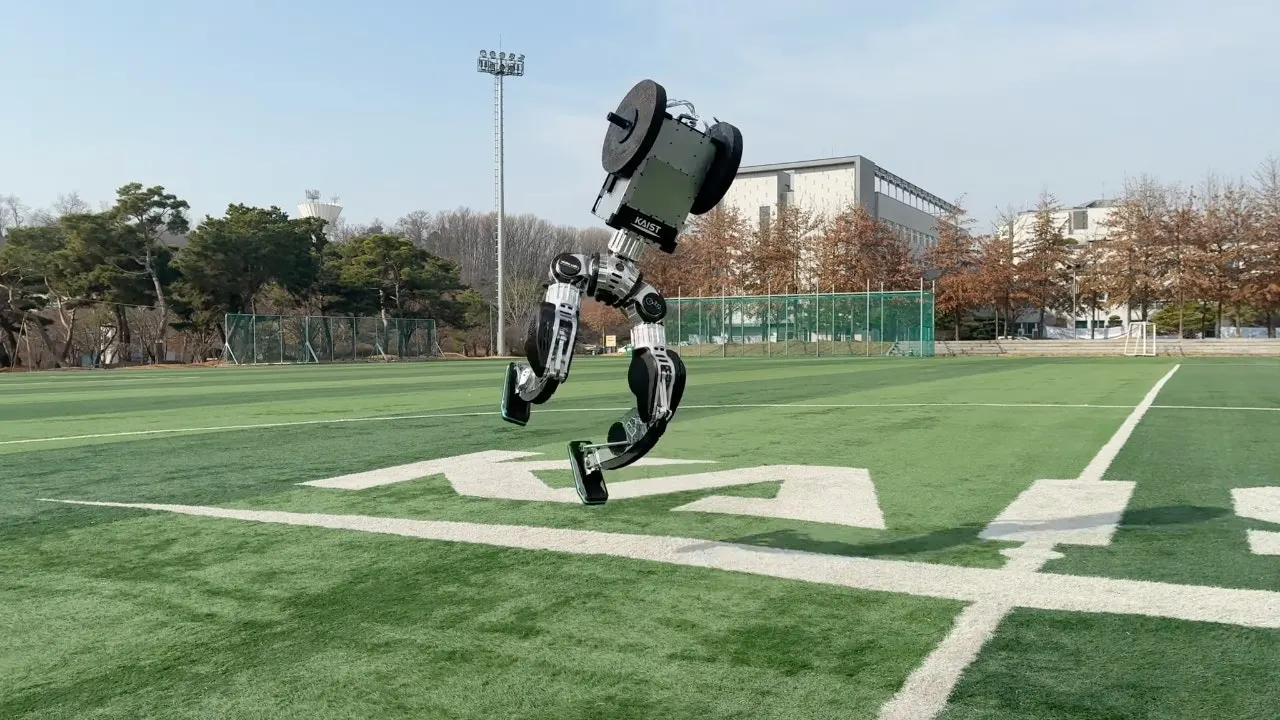
KAIST’s new humanoid shows how robots are moving from lab tricks to repeatable real-world motion, blending custom hardware and smarter control to run, kick and adapt with humanlike fluidity. This machine demonstrates speed, balance and a new approach to learning that could let robots pick up tasks by watching people. The result points to practical roles on job sites and in industries that need nimble, reliable movement rather than one-off stunts.
You’ve probably seen humanoid robots perform jaw-dropping stunts, but the real leap is consistency outside a controlled lab. KAIST’s team put their humanoid through a field test where it sprinted across a soccer pitch, kicked a ball and switched directions smoothly, showing repeatable performance on uneven ground. That kind of reliable motion is the story, not the spotlight move itself.
The robot stands about five foot five and weighs roughly 165 pounds, engineered to move quickly while keeping its balance. Led by Hae-Won Park, the group opted to build motors, gearboxes and controllers from the ground up instead of relying on off-the-shelf parts. That hands-on approach lets them tune how power flows through the body for faster, more precise responses.
A key piece is the Quasi-Direct Drive setup, which combines powerful motors with low gear ratios to reduce lag and improve stability. The compact gearbox keeps weight down and increases efficiency so the robot can react rapidly when balance or direction changes. Those mechanical choices translate directly into smoother, more humanlike movement.
In visible tests the robot reached speeds near 7.3 miles per hour and can climb steps over a foot high, demonstrating both speed and practical mobility. Movements like a controlled moonwalk or a timed soccer kick feel less like choreography and more like adaptable behavior. The engineers keep pushing toward higher performance, refining components and control loops as they go.
Hardware alone doesn’t make motion believable; the way the machine learns matters just as much. KAIST uses Physical AI techniques and deep reinforcement learning paired with human motion data so the robot learns dynamics and timing, not just scripted poses. Training begins in simulation, then carries over to the real world, producing fluid transitions and lifelike adjustments.
Another standout is proprioceptive navigation — the robot senses its internal state to move across rough terrain without depending on cameras. That capability is crucial for low-visibility or cluttered environments where vision can fail or be obstructed. Relying on internal sensing opens up jobs where optical systems would be unreliable.
The team is also developing a learning pipeline called DynaFlow aimed at letting robots learn directly from human demonstrations. In practice, a worker could show a task and the robot would generalize that motion to repeat it safely and reliably. If that works at scale, it would change how automation gets trained and deployed across many workplaces.
Practical uses are already visible: construction, manufacturing and logistics often need balance, adaptability and quick reactions — things a more capable humanoid could supply. This isn’t about replacing every job overnight, but about machines taking on tasks that previously required human coordination and judgment. As robots gain the ability to adapt, the kinds of tasks that are automatable expand beyond repetitive cycles.
The boundary between human work and machine assistance is shifting, and companies will have to decide where robots make sense and where human judgment still rules. Safety, oversight and thoughtful deployment will matter as these systems move into real job sites. Policymakers and business leaders will need to balance opportunity with responsibility as the technology matures.
US TARGETS CHINESE ROBOTS OVER SECURITY Fears appears as a timely reminder that robotics progress carries geopolitical and security angles too, not just engineering milestones. Debate over supply chains, data flows and platform provenance will grow alongside the robots themselves. Those conversations will shape how quickly and where humanoids get adopted.
AI ROBOT NOW HELPS TRAVELERS AT SAN JOSÉ AIRPORT shows how practical deployments can start small and visible, easing public acceptance while testing systems in real settings. Pilots like these expose edge cases and help builders improve robustness and worker handoffs. Expect incremental rollouts that highlight useful, supervised roles before fully autonomous deployment becomes common.
If a future robot can learn by watching and then perform a task with confidence, how comfortable are you sharing work with a machine that might one day do it better? Reach out at Cyberguy.com if you want updates or tips on staying secure around smarter machines. The pace of change is picking up, and keeping an eye on both capability and control matters now more than ever.
