
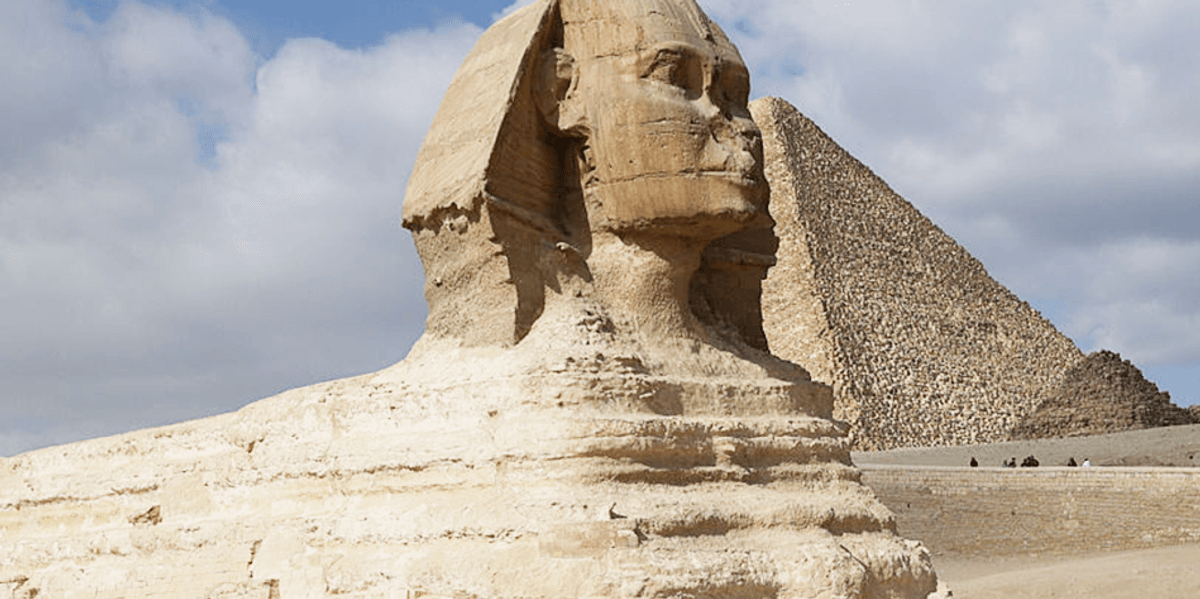
An Italian researcher says new scans and a fresh reading of ancient clues point to a buried second Sphinx near the Great Pyramid of Khufu, with a network of shafts and chambers beneath a large sand mound that may mirror the Great Sphinx’s layout. Filippo Biondi presented measurements, geometric correlations and an argument grounded in the Dream Stele’s depiction of two sphinxes, and he says the evidence gives his team roughly an 80% confidence level. The claim echoes earlier work by Egyptologist Bassam el-Shammaa and relies on ground-penetrating scans that suggest a megastructure beneath what looks like a natural hill. If true, the find would reshape how we picture the ancient builders’ reach around the Giza plateau.
Filippo Biondi has laid out his case by reinterpreting the Dream Stele, the slab set between the paws of the Great Sphinx that mentions two sphinxes. He argues that the same spatial logic that places the existing Sphinx in front of the Pyramid of Khafre should apply on the parallel axis in front of Khufu’s pyramid. His team focused surveys and scans on that mirrored spot and say the geometry lines up with the known relationships around the Sphinx and pyramids.
‘There is a great chance that there was, or is, another sphinx parallel to the one which exists today.’
Biondi took his ideas to the Matt Beall Podcast to explain the data and the scans his team has gathered. He described buried shafts, entrance-like voids and a compacted mound roughly 180 feet high that his team believes masks a built form. Below is the embedded clip from that appearance that outlines the measurements and findings.
The team reports that the distances and angles they measured around the suspected site match up with the Sphinx-to-pyramid relationships on the Khafre side. Biondi says these are not vague alignments but precise correspondences found across multiple measurements. “We are finding precise … geometrical correlation, 100% of correlation, in this symmetry,” he said, and he followed that by adding, “We are very confident to announce this. … We have a confidence [of] about 80%.”
Biondi is standing on the shoulders of earlier research. Egyptologist Bassam el-Shammaa proposed a similar idea decades ago and argued the remains of a second sphinx could be buried and degraded by pollution and groundwater. “There is a great chance that there was, or is, another sphinx parallel to the one which exists today, only in very poor condition due to air pollution and underground water erosion,” he wrote, and he also insisted, “The remains of the second sphinx are still there buried under the sand, its suffocating dilapidated remains may not rival the state of preservation of the existing one, but I believe it does exist.”
Beyond the surface claim, Biondi’s team has circulated maps of reflected signals and voids that they interpret as shafts and chambers mirroring the Great Sphinx’s substructure. Those scans are presented as more than suggestive blips; they form a pattern the researchers say matches the geometry and spacing of the plateau’s known monuments. If the data hold up under independent review, it could point to a deliberate plan across the necropolis rather than scattered, unrelated structures.
Part of the argument rests on the nature of the large mound covering the site, which many have assumed to be a natural hill or a compacted “mountain” of sand and debris. Biondi believes it is mostly sediment that can be removed, and within it lies the hidden form. “In our personal opinion, it’s very simple to remove all that mountain, and probably inside there is the second sphinx,” he said, urging excavation and more detailed geophysical work to confirm what the scans imply.
Work remains before the claim can move from intriguing to accepted: elevation surveys, targeted core sampling and independent radar validation are among the next steps Biondi’s group highlights. The idea of a buried twin Sphinx has drawn interest and skepticism alike, and the coming months of field work will determine whether these echoes of a parallel guardian are real or the product of hopeful pattern-seeking on a crowded archaeological landscape.

