
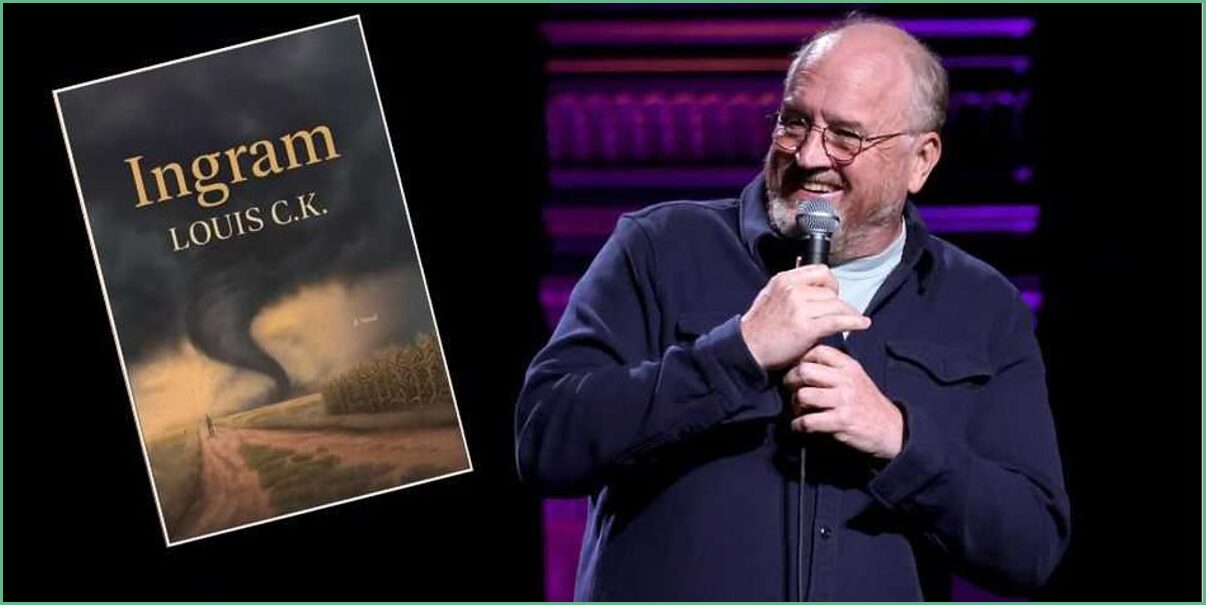
Quick summary: This piece takes a hard look at Louis C.K.’s novel “Ingram”, placing it against the long American novel tradition and finding the prose scattered, the confession repetitive, and the craft lacking, while preserving exact quoted passages where they appear.
The American novel has always been a big, messy project, trying to hold a country in a single book. Names like “Moby-Dick” and “The Great Gatsby,” and writers from Faulkner to Steinbeck, built a language for national moods and failures. That history makes any new claim on the form a bold move.
Louis C.K., known for stand-up and filmmaking, has now added novelist to his resume with “Ingram”. Where his stage performances crackle with raw honesty, the book trades that speed for long, wandering sentences that rarely land. It feels less like a sustained piece of literature and more like stray notes stitched together without a strong spine.
The prose often drifts into repetition and clutter, paragraphs that bloat rather than breathe. The energy you get from his comedy gets smudged when transferred to page after page of unpolished confession. Instead of propelling a story, the writing frequently pitches toward self-indulgence.
The world of the book is a stylized rural Texas that reads like a caricature of hardship. At its center is Ingram, a rough-edged kid shoved into an indifferent landscape, described as “a young drifter’s coming of age in an indifferent world,” which sounds like the pitch line for a harsher, leaner book than this. The setting is meant to be elemental, but the details often feel secondhand and thin.
I couldn’t see my eyes, but I knew what was on my throat was a hand by the way it was warm and tightening and quivering like you could feel the thinking inside each finger, which were so long and thick that one of them pressed hard against the whole side of my face.
I sat up, rubbing my aching neck til my breath came back regular, and I crawled out the tent flap myself, finding the world around me lit by the sun, which, just rising, was still low enough in the sky to throw its light down there under the great road, which was once again roaring and shaking above me.
Those two passages show the problem: long clauses piled upon long clauses until the rhythm collapses. Dialogue rarely rescues the text, with characters talking in loops that confuse rather than reveal. When speech flattens into cliché and drag, character work suffers and scenes lose momentum.
There is also a heavy focus on sexual confession, repeated in a way that reads less like excavation and more like re-enactment. The author’s public fall from grace returns across pages in a pattern that feels like reliving rather than rethinking. That kind of repetition can drain any redemptive power the material might have had.
Comparisons to Bukowski or Barry Hannah will come because of the grime and the attempt at rawness, but the work here lacks the craft that made those writers sing. Bukowski turned squalor into a kind of hymn; Hannah’s oddities carried a distinct music. Hunter S. Thompson, for all his excess, wrote with velocity that pushed through chaos.
Here, C.K.’s sentences often lack that precise push. He reportedly told Bill Maher he did no research for the book, and the result reads like a man writing about landscapes and types he mostly knows from other writers and films. The characters’ speech sometimes suggests a Texas seen through “No Country for Old Men” rather than lived experience.
Comedy and literature are relatives, not twins, and the skills don’t always translate. Performers can thrive on immediacy and improvisation, but a novel requires architecture, restraint, and a sense of pacing that coax meaning from silence as much as from line. This book makes that difference painfully obvious.
