
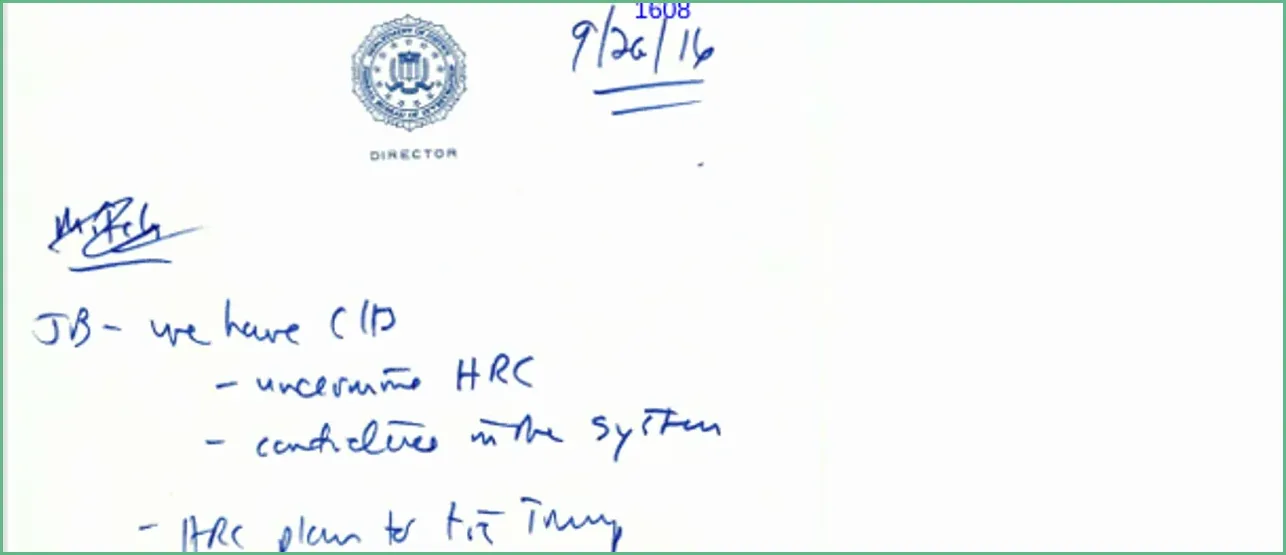
Federal filings in the government’s case against James Comey reveal that handwritten notes from the former FBI director surfaced in a long-forgotten safe, showing the phrases “HRC plans to tie Trump” and “HRC health.” Those notes, dated Sept. 26, 2016, were found during a 2025 review of a secure facility the bureau rarely used, and they sit at the center of new allegations about document concealment and internal coordination around the 2016 election. The filings also point to access logs that went quiet for years before suddenly showing activity around President Trump’s 2025 inauguration, raising fresh questions about what was hidden and why.
The document included in the court docket bears the FBI director’s emblem and the handwritten lines “HRC plans to tie Trump” and “HRC health.” The date places the note three weeks after Comey received an investigative referral about a plan, attributed to Clinton’s campaign, to connect Donald Trump to Russia. That referral, now part of the legal exhibits, is central to claims that the bureau had early intelligence about the so-called Clinton plan intelligence.
A federal grand jury in Alexandria indicted Comey on Sept. 25, 2025, on charges that include making false statements and obstruction of justice. The new filings accuse people inside the FBI of a pattern of concealment tied to dual investigations into the two leading presidential candidates in 2016. Prosecutors point to exhibits and access records to argue there was an effort to keep certain material out of view.
An FBI reform team in 2025 tracked the handwritten notes to Room 9582, a secure compartmented information facility that had been described as seemingly unused. The team found the notes in a safe inside that room, along with the original CIOL, the counterintelligence operational lead that had initially alerted the FBI to the Clinton plan intelligence. Investigators also found burn bags and hundreds of pages related to Crossfire Hurricane inside nearby storage.
The access logs for Room 9582 showed an extended span of dormancy stretching through the years before a sudden spike in activity in the four-day window around President Trump’s 2025 inauguration. That gap and the later burst of access have become a focal point for prosecutors and congressional investigators who argue the timing suggests selective handling of sensitive material. A July 21, 2025 memo from the FBI’s public corruption unit requested an investigation into possible concealment or removal of documents.
Comey’s sworn testimony before the Senate Judiciary Committee on Sept. 30, 2020, is quoted in the filings, where he said, “it doesn’t ring any bells with me.” That exact line sits alongside the newly surfaced notes and the declassified referrals, creating a direct tension between his public statements and what those exhibits now show. Prosecutors point to this gap as evidence supporting their charges.
Declassifications in recent years added context that had been missing from public view. Information declassified by then-Director of National Intelligence John Ratcliffe and later by others included references to Russian intelligence reporting about a Clinton campaign plan and detailed assessments about her health. Those declassifications gave investigators documentary threads that tie back to the CIOL and the notes found in the safe.
Investigators also identified five burn bags on the floor of Room 9682 that contained large volumes of pages connected to Crossfire Hurricane, the 2016 probe into alleged Trump-Russia ties. Those materials have since been reviewed, and portions have been declassified and released by officials overseeing the review. The presence of those materials in locked storage and the way access was logged prompted internal memos seeking to determine who moved what and when.
An FBI director who later took office in 2025 publicly discussed those discoveries and the release of certain documents, and his comments fed into public frustration over what many see as a two-tiered system inside parts of the intelligence community. The new criminal filings are forcing long-hidden pieces of the 2016 timeline into court, creating courtroom testing grounds for competing narratives about deliberate concealment versus bureaucratic chaos.
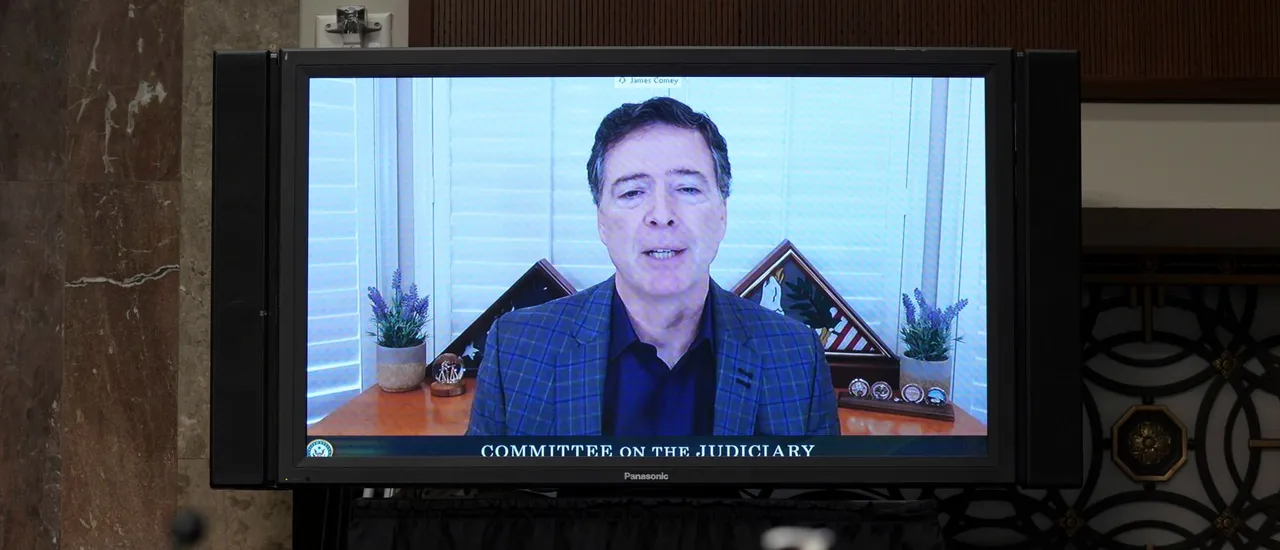
Former FBI director James Comey testified in 2020 during a Senate Committee hearing; the new exhibits have put parts of that testimony under renewed scrutiny.
const observer2 = new MutationObserver((mutations) => { const adDivToHide2 = document.querySelector("#dailycaller_incontent_2"); if (adDivToHide2 && dc_noads_page) { adDivToHide2.classList.add("hide-premium", "hide-free"); observer2.disconnect(); console.log("Ad div2 found and hidden"); } }); observer2.observe(document.body, { childList: true, subtree: true });
The unfolding litigation promises to put more documents into the public record and test how much of the bureau’s archival practice amounted to intentional concealment. The filings are not just historical footnotes; they are live evidence in a criminal case that accuses a former FBI director of obstructing transparency. For many on the right, those developments validate long-held concerns about selective handling and internal coordination that favored political outcomes.
As the case moves forward, the notes reading “HRC plans to tie Trump” and “HRC health” will be examined alongside timelines, access logs, and declassified referrals to see whether those lines were treated as intelligence or sidelined. The probe into who stored, moved, and reviewed those records will shape how this chapter of 2016 is remembered in public and legal terms. The courtroom will decide how much of the bureau’s internal choices were lawful and how much were part of a deeper problem of political interference.
