
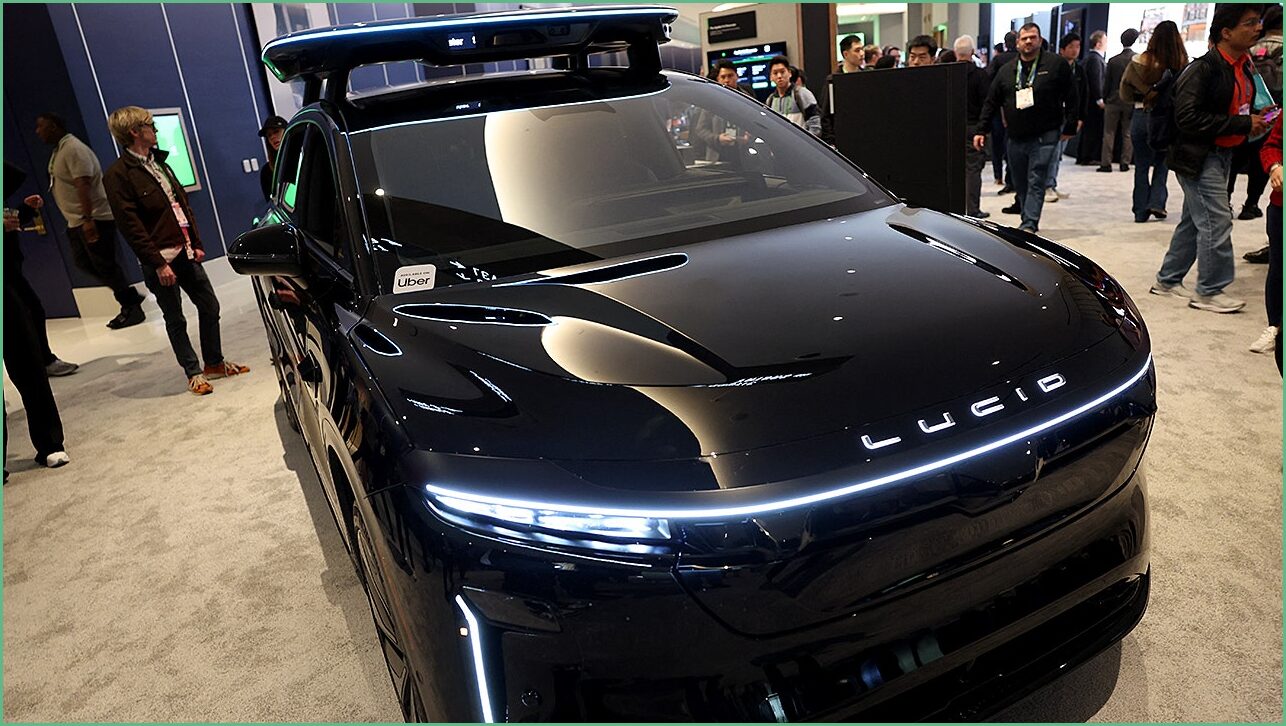
Uber has rolled out a new robotaxi that’s already being tested on public streets, and this piece covers the vehicle’s partners, on-road trials in the San Francisco Bay Area, key hardware and passenger-facing features, the safety validation approach, production plans and the likely timeline for a public launch later this year.
Uber showed the robotaxi publicly at a major tech event and then quietly moved the program into real traffic, which is a big step beyond showroom demos and closed tracks. Seeing these vehicles operate among daily commuters signals that the effort is advancing from prototype to practical field work. That shift is what makes the current phase worth watching.
The vehicle itself is a Lucid-based electric platform built for long-range efficiency and a comfortable cabin experience, with an autonomous stack supplied and validated by Nuro. Lucid handles the EV engineering while Nuro focuses on the self-driving system and the testing protocols used during supervised runs. Uber ties the pieces together and plans to operate the service through its app once approvals and validation are complete.
Testing is taking place on public streets in the Bay Area under supervised conditions, not behind closed gates. Trained safety operators ride along while engineers monitor system behavior in real-world scenarios like intersections, lane merges and pedestrian-heavy areas. This stage is crucial because real traffic throws unpredictable situations at the stack that simulations and test tracks simply do not replicate.
The robotaxi was designed to run without a conventional driver from the outset, blending EV design with visible autonomy elements so riders can understand what the car is doing. Inside, passengers will find familiar creature comforts like climate control and seat adjustments, plus a cabin display that visualizes the vehicle’s perception and planned maneuvers. That transparency is meant to reduce anxiety and let riders see lane changes, yielding, and planned stops in real time.
Under the hood, the system relies on high-performance computing to handle real-time AI workloads, enabling complex perception and decision-making at driving speeds. The compute stack processes sensor feeds and generates the vehicle’s next actions, balancing prediction with explicit safety logic. That combination aims to keep behavior predictable for other road users while allowing the AI to adapt to everyday traffic dynamics.
Uber’s ambitions aren’t small: the company envisions deploying tens of thousands of robotaxis across multiple markets over the next several years, with production integrated into a Lucid factory. The plan pairs Uber ownership and fleet operation with third-party partners to scale quickly, and every ride would be booked through the existing Uber experience. If achieved, the footprint of shared, electric, driverless trips could reshape availability during busy periods.
Safety sits at the center of validation, with a layered approach that mixes simulation, closed-course trials and supervised on-road runs. Engineers use an end-to-end AI model alongside deterministic safety rules to keep behavior within predictable bounds. Coordination with regulators and city officials is part of rolling this out responsibly in urban environments.
Beyond convenience, there are potential urban-level benefits: a shared electric robotaxi fleet could cut emissions and ease parking pressure, while consistent driving behavior might reduce crash risk linked to human error. Riders could enjoy quieter, steadier trips and better availability when demand spikes. At the same time, public acceptance hinges on seeing the system act transparently and reliably in everyday traffic.
Uber expects public service in a major U.S. city later this year if validation wraps on schedule, with production starting soon after final approvals. For riders, driverless trips will show up inside the app like any other option, which keeps the user experience simple even as the underlying tech is complex. The coming months will reveal whether testing challenges are ironed out and whether cities embrace this new kind of shared mobility.
