
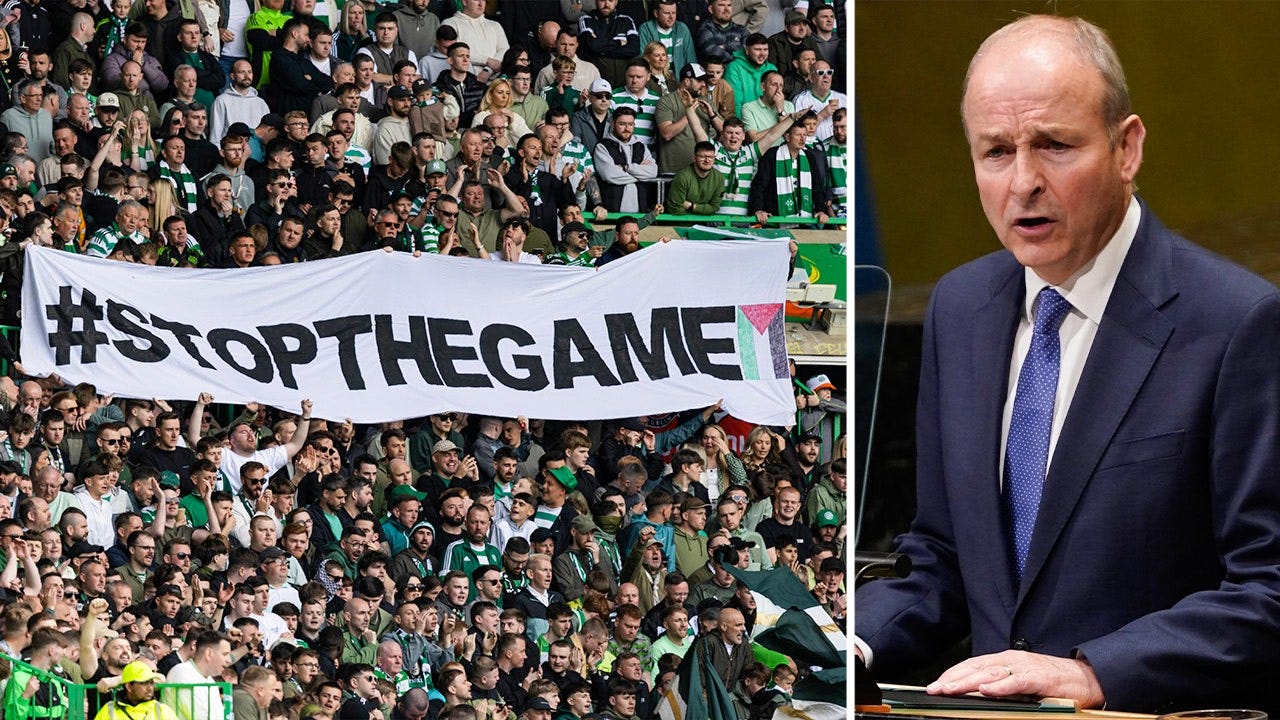
Irish Prime Minister Micheál Martin pushed back hard on claims that Ireland’s criticism of Israel has slipped into antisemitism, even as a tense soccer dispute and fresh political protests kept the pressure high. He defended Ireland’s pro-Palestinian stance, backed Israel’s right to live in security, and tied the country’s worldview to its own history of conflict, peace talks, and division.
Martin said the anger in Ireland is rooted in the war in Gaza, not in hatred toward Jews. He called Israel’s military response “absolutely disproportionate” and argued that the country should rethink its strategy while allowing far more humanitarian aid into Gaza.
Pressed directly on whether the criticism had crossed a line, Martin said it had not for most people in Ireland. “I think for the vast majority of people it does not,” he said, then added, “We have no toleration for antisemitism, none.”
The issue spilled into sports when Irish players held a late vote over whether to take part in a match against Israel. The vote followed months of public pressure, with more than 160 Irish sports figures calling for a boycott and some players openly questioning whether the game should go ahead.
A “significant majority” of the squad eventually chose to play, though one player stepped away after saying he did not want to take part. The controversy did not fade, because the match had already become bigger than soccer and was now loaded with politics, identity, and public anger.
Martin did not soften his language on Hamas, either. He strongly condemned the Oct. 7 terror attack and said Israel has the right to exist in security, while also repeating support for a two-state solution and a future where Palestinians can live in peace in their own homeland.
“First of all, we condemned, absolutely, the outrageous terrorist attack by Hamas in October,” Martin said. “We believe in a two-state solution,” he added, stressing that both peoples deserve safety and dignity. He also said there are “many peaceful voices in Palestine” who want coexistence.
He argued that Ireland’s own experience helps explain its stance. The country spent generations dealing with conflict and division, and Martin suggested that history gives Ireland a certain moral confidence when it speaks about peace, justice, and compromise abroad.
That theme came up again when he pointed to the deep pro-Palestinian sentiment in Ireland. “There’s a very strong pro-Palestinian position in Ireland,” he said, linking it to history, fairness, and a public mood shaped by the suffering seen on television and online every day.
Public protests have been part of the backdrop for months. Demonstrations have spread across Ireland since the war began, and even cultural decisions have become political flashpoints, including criticism after the national broadcaster declined to air this year’s Eurovision Song Contest once Israel’s participation was confirmed.
The debate over the match also exposed a wider split inside Irish soccer. The Football Association of Ireland had previously moved toward suspending Israel from international play, but later agreed to fulfill the fixtures after being warned that a boycott could trigger heavy financial penalties and UEFA sanctions.
Martin also rejected the idea that a boycott would produce real change. He said it could end up hurting Irish soccer more than anyone else and called that kind of unilateral action “self-defeating.” The message was simple enough: symbolic gestures may feel good, but they do not always move the needle.
Antisemitism concerns have been raised outside Ireland too. Jewish groups and anti-defamation advocates have pushed Martin on the issue before, accusing parts of Irish public life of turning Israel into a target of relentless hostility.
Martin answered by pointing to Ireland’s Holocaust commemorations and the Jewish communities that helped shape cities like Dublin and Cork. “We cherish that contribution that the Jewish community has made to Ireland,” he said, rejecting the idea that antisemitism is broadly accepted in Irish society.
He also kept the focus on Gaza and the West Bank, where he has been openly critical of Israeli policy. Speaking ahead of a major international address, Martin warned that the world had “failed Palestine” and said the scale of suffering would eventually shame those who looked away.
Beyond the Middle East, Martin linked Ireland’s diplomacy to its stance on Ukraine and its long-running debate over Irish reunification. He said territorial grabs by force cannot be accepted, and he framed Ireland’s support for peace as part of a broader belief that conflict should end through negotiation, not conquest.
That same instinct, he said, also shapes how he sees the future of the island of Ireland. “I believe in unity and my party believes in unity, but we have to work on it,” Martin said, stressing that reconciliation has to come before any new constitutional move. The comments left the sense of a leader trying to hold several fractures at once, with Gaza, soccer, Ukraine, and Ireland’s own divided past all pulling in the same tense political orbit.
