
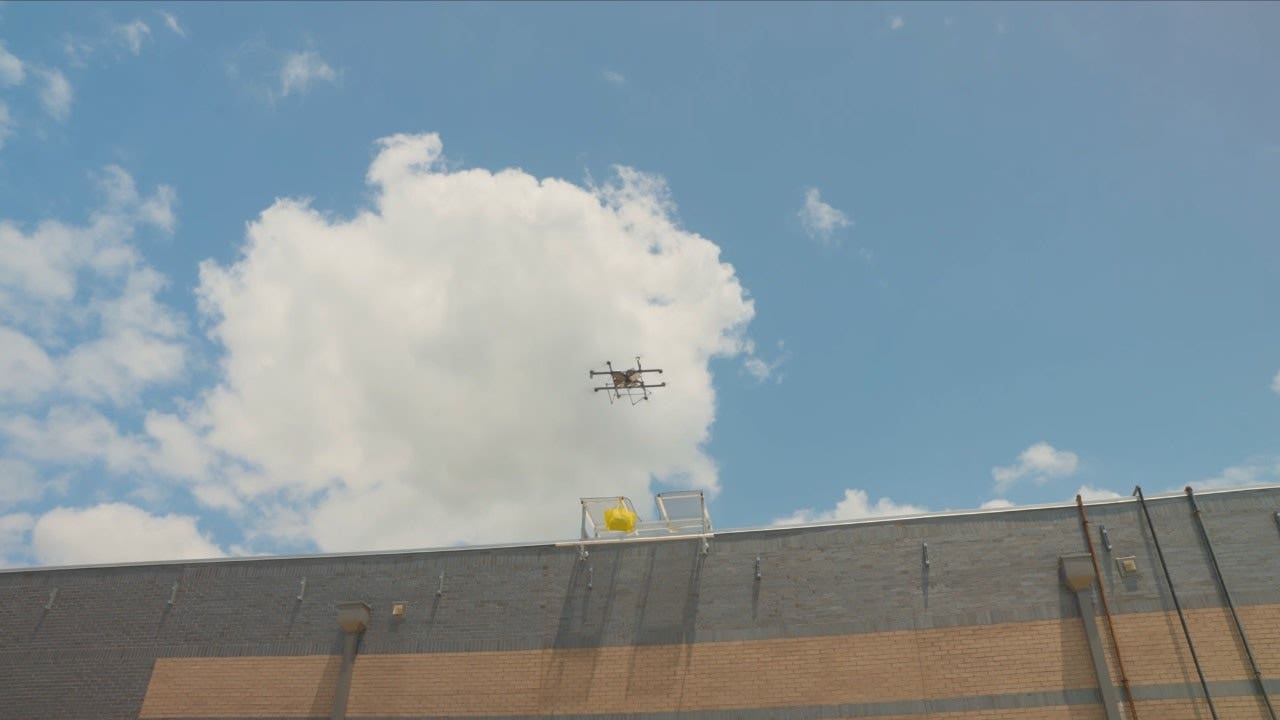
Delivery drones are moving from a neat concept to a much sharper system, with AI now helping them wait near restaurants before orders even come in. In Dallas-Fort Worth, Flytrex is using predictive software, rooftop docks, and a growing drone network to cut wasted travel time, speed up drop-offs, and make the whole process leaner. The pitch is simple but bold: let the drone get there first, then let the food follow.
Flytrex says its software studies past demand, location patterns, time of day, and activity across the delivery network to guess where the next rush will happen. Instead of parking every aircraft at one central spot and sending it out only after an order is placed, the company places drones closer to restaurants it expects to get busy. That means a pizza place or burger joint with a predictable dinner rush could already have a drone nearby when the kitchen starts moving orders.
The setup is built around a Rooftop Dock that can be installed on an existing rooftop or another raised spot near the restaurant. Flytrex says it does not need extra land or major structural changes, and it does not require a worker stationed at every location. Once the drone lands, it waits quietly until the food is ready, then a restaurant employee clips the package onto the hook and sends it off. That cuts out a messy handoff and trims away one of the clumsiest parts of drone delivery.
That last stretch between kitchen and aircraft has been a sticking point for drone delivery from the start. Flytrex co-founder and CEO Amit Regev put it plainly when he said, “The truly challenging part has never been the flight; it’s the last few hundred feet between the kitchen and the aircraft,” Regev said. The new rooftop setup is an attempt to solve exactly that problem, and it does so by moving the drone into position before the order is even ready.
The payoff, at least on paper, is big. Flytrex says the system can cut its cost per delivery by 60% and reduce delivery times by half. That makes sense when the drone no longer has to make a separate pickup trip from a distant base, and when restaurant staff can load the order without a dedicated employee on site. More deliveries per drone, less dead time, less backtracking. That is the kind of math companies in this space have been chasing for years.
There is still a catch, of course, because AI predictions are only as good as the patterns they spot. Weather can change ordering behavior, a local event can flood one restaurant with unexpected traffic, and a normal Tuesday can suddenly look nothing like a normal Tuesday. If the system misjudges demand, drones may end up waiting in the wrong place or getting shifted again, which would chip away at the speed advantage Flytrex is trying to build.
Dallas-Fort Worth is serving as the proving ground, with active merchant locations already using the system and more than 100 additional sites in the pipeline. Flytrex says it has completed more than 250,000 U.S. deliveries, and it has been lining up bigger partnerships to push the business forward. Uber has invested through a partnership tied to Uber Eats orders, and Flytrex has also worked with DoorDash in the same market, showing that the major players are watching this space closely.
The company’s reach may also widen thanks to FAA approval for beyond visual line of sight operations, or BVLOS. That approval lets Flytrex monitor multiple drones remotely under the terms of its authorization, instead of requiring a visual observer for every aircraft the whole time. Flytrex says that opens the door to expansion across the 37 largest U.S. metro areas, though building out the network city by city will still take time and real infrastructure.
This push follows other recent steps, including the rollout of its Sky2 delivery drone through a partnership with Little Caesars, plus a manufacturing facility in Pilot Point, Texas that can produce about 1,000 drones a year. That matters because the hardware alone is not the whole story anymore. The bigger question is whether the drone can be in the right place at the right moment without burning time just getting to the pickup point.
For customers, the upside is easy to picture. The drone could already be waiting when the food is ready, which means less time staring at a delivery tracker and less food sitting around before pickup. If Flytrex can keep its predictions tight and its rooftops busy, the company may turn a flashy tech demo into something that feels routine, almost invisible, and that is usually when a new delivery model starts to spread.

1 Comment
AI+
HC
cure diseases
Update MedTech
R&D
Sciences
MedTech
planning, routing
All+ for AI