
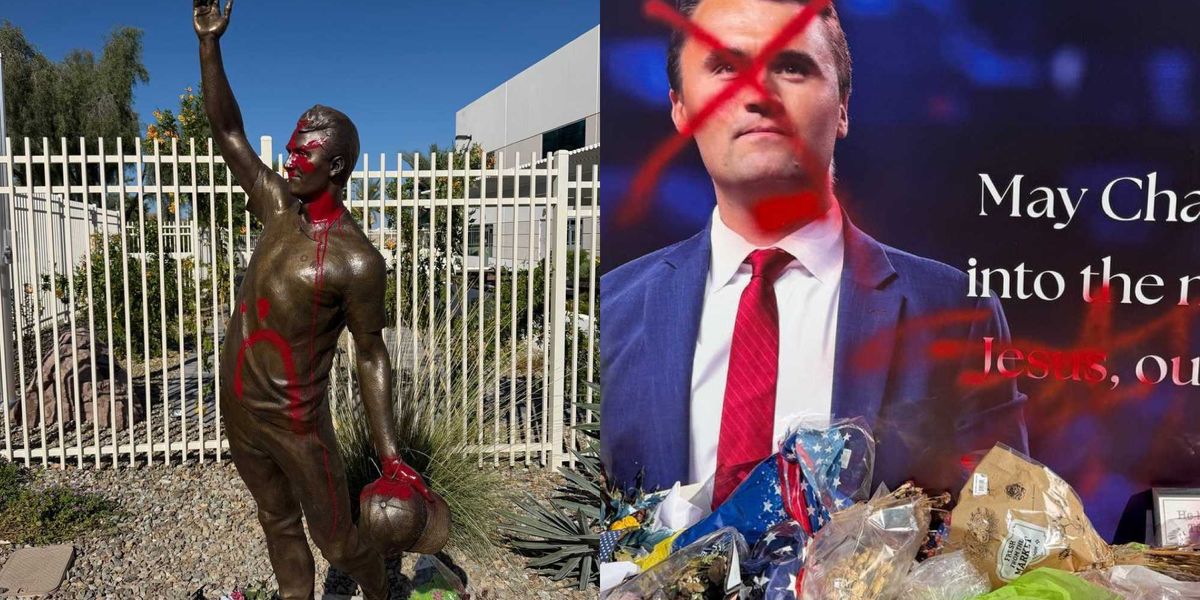
A newly installed Charlie Kirk statue became a flashpoint almost immediately after its unveiling, with vandals scrawling a hostile message across the monument and turning a symbolic tribute into a fresh political street fight. The episode lit up social media, drew sharp reactions from supporters, and raised the familiar question of whether public respect for monuments can survive in an age of constant rage.
The statue had barely settled into place when it was hit with vandalism that supporters called ugly, deliberate, and deeply disrespectful. What should have been a moment of recognition for Kirk and the movement around him instead became another example of how quickly public symbols can be targeted when politics turns personal.
For Turning Point USA and Kirk’s allies, the damage was about more than paint or marker on stone. It was a jab at the idea that conservative figures deserve the same public dignity routinely given to anyone else, and it landed right at the center of the culture war surrounding Kirk’s legacy.
The timing made the act hit harder. A statue is meant to last, to stand still while the noise around it fades, but this one was singled out within days, making the vandalism feel less like random mischief and more like a statement meant to be seen.
That’s what makes the reaction so sharp. When public art or memorials are attacked, the dispute usually stops being about the object itself and becomes a test of whether decency still matters in public life.
Supporters of Kirk have been increasingly vocal about how his name continues to spark emotional responses, both positive and hostile. That tension has only grown since his death, with admirers framing him as a major voice in the conservative movement and critics treating even his memorials as open targets.
Erika Kirk has also remained part of the broader conversation around his legacy, with the statue standing as one more visible reminder of the personal loss behind the politics. In that sense, the vandalism was not just an attack on a political figure’s image but on a family and a community still grappling with the aftermath.
The larger issue goes well beyond one statue in one place. Across the country, monuments tied to public figures have become magnets for anger, with some people seeing them as signs of respect and others seeing them as invitations to protest, tear down, or deface.
That divide tends to get uglier when the figure involved is polarizing. Charlie Kirk is one of those names that instantly splits a room, and the vandalism made clear that even a tribute built to honor him can become a lightning rod the moment it is exposed in public.
There is also a simple moral line here that does not require much decoding. If disagreement is the excuse for destruction, then almost anything can be justified, and that is exactly why the reaction to the message on the statue carried so much weight.
People may argue over Kirk’s politics all day, but the decision to deface a statue says something else entirely. It shows how raw the climate has become, where symbols are no longer just symbols and every public gesture can be turned into a fight over respect, outrage, and who gets to define the story.
