
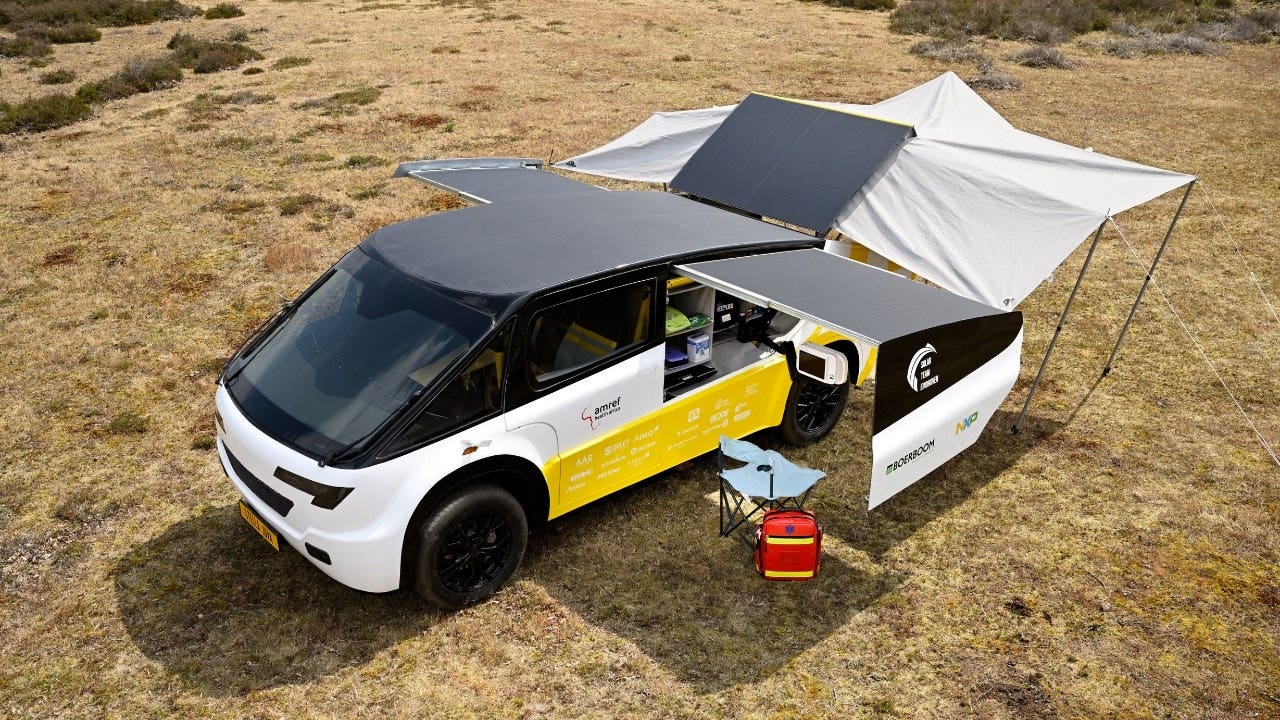
Checklist: solar-powered ambulance concept; off-grid healthcare access; sunlight-driven driving and medical power; lightweight vehicle engineering; remote testing in Kenya; mobile clinic features and durability.
What happens when a clinic has to go where the grid does not reach? A student-built vehicle from the Netherlands is answering that with a bold mix of solar power, medical gear, and off-road range. Stella Juva is designed to bring care straight to remote communities, turning sunlight into both mobility and treatment power.
The project comes from Solar Team Eindhoven, a group of 23 students at Eindhoven University of Technology. Their goal was not to make a flashy concept car, but to rethink what an ambulance can be when hospitals are far away and electricity is unreliable. In that setting, the vehicle becomes less about racing to a hospital and more about carrying the hospital to the patient.
That shift matters in places where roads are rough, fuel is scarce, and the power goes out without warning. The World Health Organization has estimated that about 1 billion people are served by healthcare facilities with unreliable electricity or none at all. In those conditions, even basic care can become a gamble.
Stella Juva tries to solve that by bringing its own electricity along. The roof is covered with high-efficiency solar cells that feed a battery pack, and the vehicle is built to run its systems without depending on nearby charging infrastructure. Under strong solar conditions, the team says it can travel as far as 715 kilometers in a day, which works out to about 444 miles.
The setup is smarter than a simple battery-on-wheels idea. The ambulance separates the power used for driving from the electricity needed inside the medical cabin, so emergency equipment can stay prioritized if energy runs low. That means the system is designed to protect care first, which is exactly the kind of thinking a mobile clinic needs.
Inside, the vehicle works more like a compact treatment center than a traditional ambulance. It can support tuberculosis screening, pregnancy ultrasounds, malaria testing, vaccinations, and emergency response with an automated external defibrillator. There is also refrigeration for vaccines and medications, which is a big deal when the temperature outside is brutal.
Keeping all of that running takes more than just a big battery. The students used pure sine wave inverters to provide stable electricity for sensitive tools, since medical devices can be picky about power quality. They also had to squeeze everything into a package light enough to move efficiently, which pushed them toward carbon-fiber composite materials and a teardrop shape that cuts drag.
That lightweight build is doing a lot of heavy lifting behind the scenes. Stella Juva weighs around 1,350 kilograms, or roughly 3,000 pounds, which is far lighter than many conventional ambulances. On top of that, the solar cells use a back-contact design that leaves more surface area open to sunlight, a smart move when roof space is limited and every bit of power counts.
Durability is another big part of the story. A solar panel on a rooftop lives an easy life compared with one strapped to a vehicle that has to bounce down rough roads for hours. To deal with that, the cells are built with copper interconnections meant to reduce damage from vibration and microcracks, helping the system survive the grind of real-world travel.
The first real test is taking place in Kenya, where the team will work with Amref Health Africa. There, Stella Juva will be put through field scenarios that simulate healthcare delivery in tough conditions, including tuberculosis care. It is the kind of stress test that separates a clever prototype from something with real promise.
This is not the team’s first swing at solar transport, either. Earlier projects included Stella Vita, a solar camper for off-grid travel, and Stella Terra, an off-road solar vehicle that covered about 1,000 kilometers through Morocco. Stella Juva builds on that experience, but the mission feels more urgent because the target is medical access, not just mobility.
That is what makes the project so interesting. It suggests a future where advanced care does not always wait for patients to arrive at a hospital, because some of the care can roll in under its own power. For remote towns, disaster zones, and places cut off by weather or broken infrastructure, that idea hits hard and sticks.

1 Comment
Mass produce needed worldwide $$$$$