
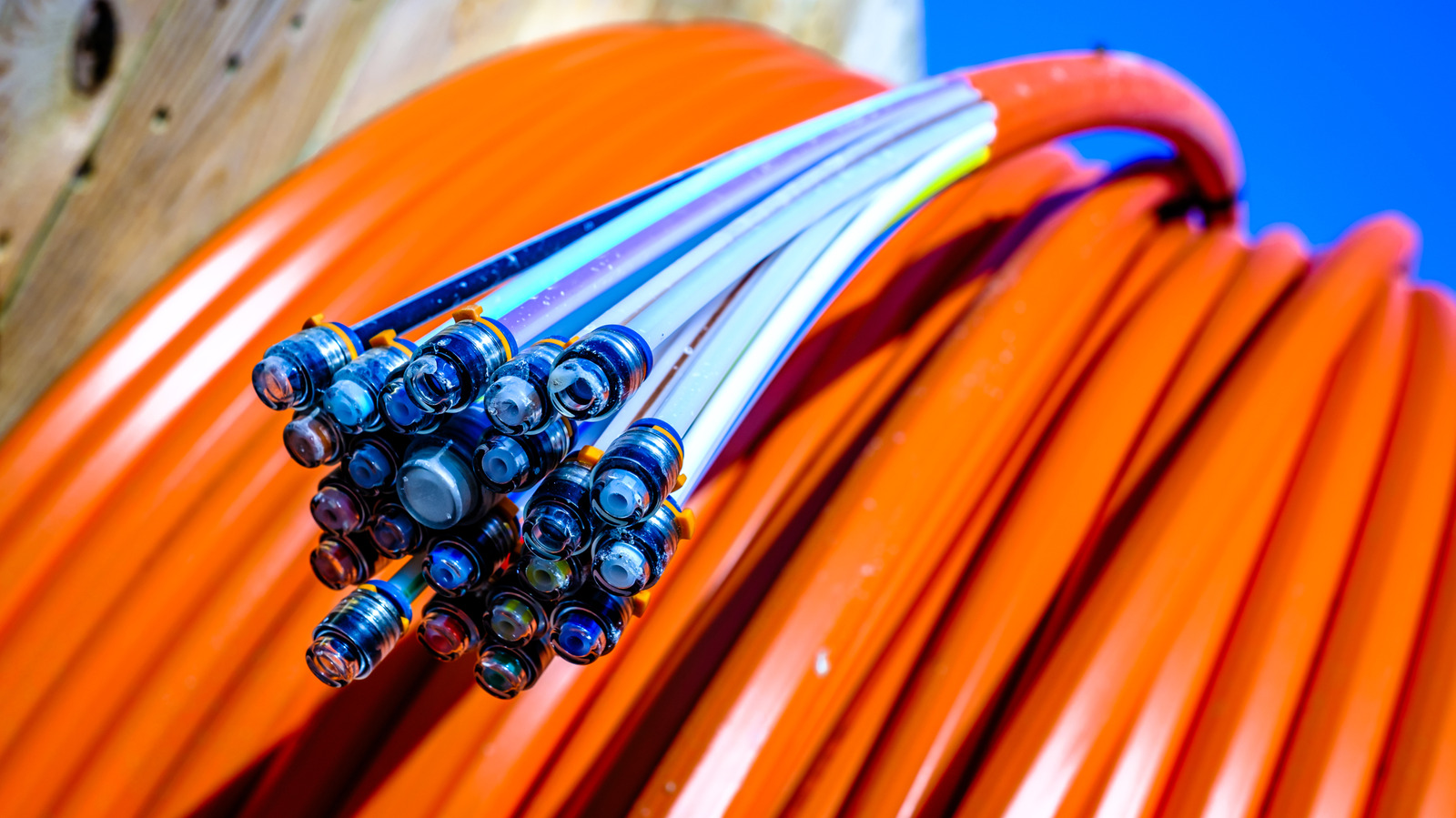
It’s easy to look up at the sky and assume satellites must be doing most of the heavy lifting for the internet, especially with thousands of them in orbit. But the real workhorse is still the undersea cable network, which moves the overwhelming bulk of global data with speed, stability, and reach that space-based systems cannot yet match. That gap between what feels futuristic and what actually powers daily life is the heart of this story.
The idea of bouncing signals off satellites has been around for more than a century, and Sputnik made that dream feel suddenly real in 1957. Long before that, thinkers like Konstantin Tsiolkovsky, Herman Potočnik, and Arthur C. Clarke imagined a planet linked by orbital relays. Today’s sky seems to prove them right at first glance, with more than 17,000 satellites circling Earth and more than 10,000 of them tied to Starlink alone.
Even so, the numbers tell a different story once you follow the data itself. Roughly 98% of international internet traffic still travels through fiber-optic cables, most of it tucked under oceans and never touching space. That means the wireless hop from a router to a phone is often the first time a piece of information leaves a cable at all.
The reason is pretty straightforward: cables are built for raw throughput and low delay. A modern subsea line can push up to 400 terabits per second, which is an eye-popping amount of traffic for something lying on the ocean floor. Satellites are improving fast, but they still cannot match the same combination of bandwidth and latency that makes cables the obvious backbone for global communication.
Reliability matters just as much as speed, and here cables keep winning. Satellite internet has to deal with congestion, weather effects, and the limits of orbital coverage, all while trying to serve huge numbers of users from above. That makes it great for remote access in hard-to-reach places, but not the best choice for carrying the world’s everyday data load.
Cost also plays a huge role in why the internet stayed grounded. Launching a satellite is an expensive business, with each unit costing roughly $300,000 before even accounting for broader launch and deployment costs. Laying a subsea cable is hardly cheap either, often running from $250 million to $400 million or more, but the economics still favor the undersea route when you need massive, dependable capacity.
There’s also the simple fact that this technology has had a very long time to mature. Humanity was stringing cables across seas long before it mastered powered flight, starting with the English Channel in 1851 and then crossing the Atlantic in 1858. That first transatlantic cable was fragile and short-lived, but it proved the concept and opened the door to a communications network that kept growing for generations.
That early cable history is a good reminder that progress often looks messy before it looks magical. The 1858 link between Ireland and Newfoundland was about 2,000 miles long and famously slow, taking around 16 hours to send Queen Victoria’s 98-word message. It broke down after a few weeks, but the follow-up cable in 1866 finally gave the Atlantic a dependable connection.
The modern version of that same idea is fiber-optic cable, which first crossed the Atlantic in 1988 and now forms the nervous system of the internet. There are about 920,000 miles of fiber-optic cable around the world, enough to reach the moon and back nearly twice. That kind of scale is hard to beat, no matter how crowded orbit gets or how glossy satellite internet marketing may sound.
