
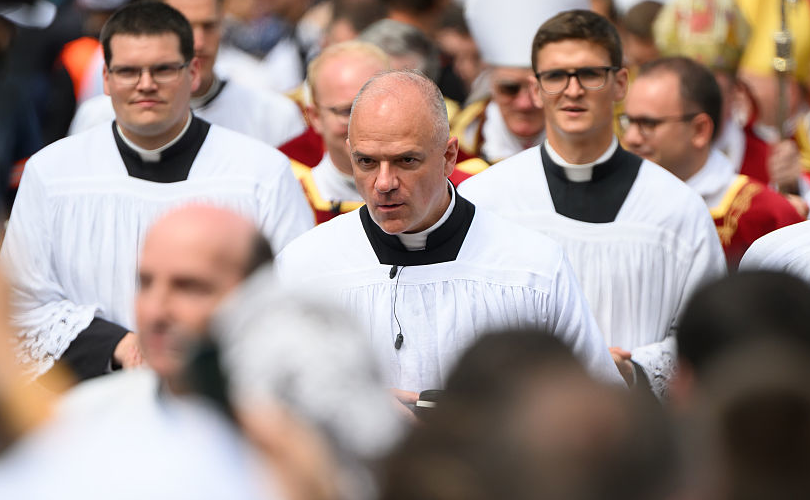
Fr. Davide Pagliarani addressed a vast congregation at an SSPX consecration Mass, arguing that presenting a choice between the Church and a strict interpretation of doctrine misses the point. He insisted the supposed split — the idea that one must choose the ‘integral faith’ over the Church — is a “false dilemma.” The Mass drew thousands and underscored ongoing conversations about identity, authority, and belonging within traditional Catholic circles.
The message began with a plain claim that has echoed in recent debates: doctrine and belonging are not opposite ends of a spectrum. Pagliarani spoke to people who feel torn between fidelity to older forms of practice and remaining part of the broader Church. He framed that tension not as a binary but as a question of how faith is lived and transmitted in community.
The SSPX sits in a complicated place in modern Catholic life, born from a mid-20th century reaction to liturgical and theological shifts. That history informs why many in its ranks emphasize a measured guarding of rituals and teachings they see as essential. At the same time, leaders like Pagliarani point to a desire for recognition and a clear relationship with the larger Catholic body.
Throughout the homily there was a persistent theme: belonging flows from shared conviction, not merely from institutional labels. Pagliarani insisted that a committed faith life can coexist with being part of the Church’s visible structures. His words aimed to reassure those who fear exclusion simply because they hold to older practices or sharper theological lines.
The crowd’s size mattered in itself. Thousands gathered not only to witness a rite but to signal alignment with a particular spiritual rhythm and theological stance. Such large assemblies make a statement about vitality and endurance, and they press church leaders on how to respond pastorally to groups that feel deeply attached to certain forms of worship and teaching.
Critics often say that strong adherence to past forms risks isolating a movement from ecclesial communion, while supporters argue that discipline and clarity safeguard tradition. Pagliarani tried to collapse that tension into a single point: the Church and authentic faith are not mutually exclusive. He claimed unity is possible when faithfulness to doctrine is understood as participation rather than separation.
That argument touches on practical questions: how sacraments are celebrated, how priests are formed, and how communities navigate liturgy and catechesis. For many attendees, the consecration Mass itself was proof that a lived sacramental life continues uninterrupted. Pagliarani used that reality to argue for a working relationship between faithful communities and episcopal structures that respects both conviction and communion.
Observers will watch how that line plays out in ecclesial diplomacy and local pastoral care. Statements that dismiss a supposed “either-or” choice can ease tensions if met with reciprocal gestures from bishops and Rome. They can also harden positions if either side treats the claim as a blanket endorsement rather than a starting point for dialogue.
At the heart of the address was a pastoral intuition: people want to be seen and affirmed in how they worship and believe, while also longing for a sense of larger belonging. Pagliarani’s claim that framing the choice between the ‘integral faith’ and the Church as a ‘false dilemma’ is meant to open space for conversation, not close it. That approach asks both critics and supporters to move past caricatures and to engage concrete pastoral realities.
The consecration Mass left questions in its wake about recognition, reconciliation, and how tradition is carried forward. For many there was comfort in hearing a leader argue that fidelity and fellowship need not contradict one another. The ongoing challenge will be turning that rhetorical bridge into practical steps that allow faithful communities to flourish within the broader Catholic fold.
