
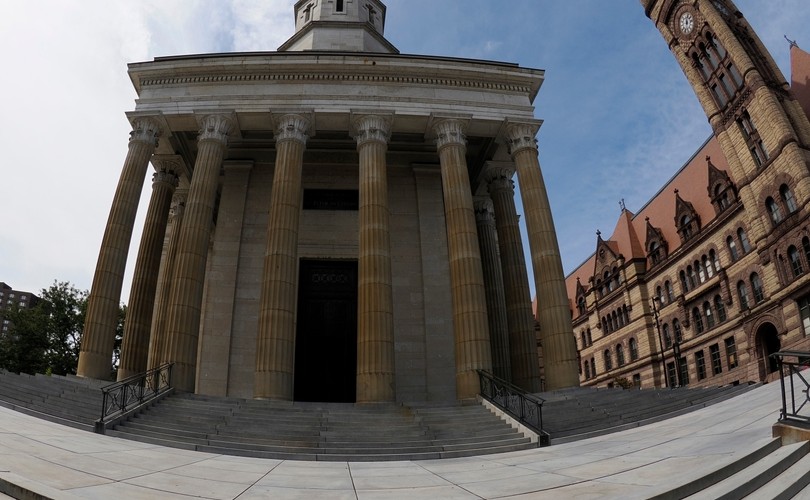
This piece looks at a recent clash at the Cincinnati cathedral where Archbishop Robert Casey barred a Catholic men’s group from praying the Rosary on the steps as a counter to local LGBT ‘pride.’ It examines why church leaders might restrict public prayer, how parishioners reacted, and what this means for religious freedom and local Catholic identity. The article keeps a clear, direct voice and focuses on the facts and the broader implications for faithful Catholics.
Archbishop Robert Casey, Cardinal Blase Cupich’s former vicar general, blocked a Catholic men’s group from praying on the steps of the Cincinnati cathedral to protest LGBT ‘pride.’ That decision landed squarely in the middle of a growing fight over how the Church handles public displays and dissent inside and outside its walls. For many conservative Catholics, the move felt like a refusal to let the faithful visibly pray in a public space tied to their faith and to their community.
The group had planned to pray the Rosary as a peaceful witness against what they see as a celebration that conflicts with Catholic teaching. Praying the Rosary in public is a long-standing expression of Catholic devotion and civic witness, meant to call the faithful to prayer rather than provoke. To opponents, though, the timing and location were confrontational, and that likely informed the archbishop’s decision to prevent it from happening on the cathedral steps.
Onlookers and parishioners split into two camps: those who back the archbishop’s judgment to avoid confrontation at the cathedral, and those who view the ban as a censorship of devout action. The men’s group argued they were exercising their right to public prayer and to stand for orthodox teaching, while church officials cited pastoral concerns and the need to manage cathedral access. That tug of war raises a basic question about who gets to decide what counts as appropriate witness in sacred spaces.
There’s also a political angle here because these disputes overlap with broader cultural battles over free speech, religious liberty, and public displays. From a conservative perspective, restricting public prayer at the cathedral looks less like pastoral prudence and more like silencing loyal Catholics who want to uphold traditional values. Parishioners worry that when church leadership prioritizes avoiding controversy, the faithful lose important opportunities for clear moral witness.
Another layer is the connection to Cardinal Blase Cupich, since Archbishop Casey once served as his vicar general. Cupich’s reputation for a more progressive approach to pastoral governance colors how people read the decision in Cincinnati. For conservatives watching, the ban confirms fears that diocesan leadership may be distancing itself from direct confrontations with cultural movements it finds challenging.
Practically speaking, the men’s group will likely keep looking for ways to pray publicly and to make their voices heard without risking sanctions from church authorities. Alternatives include nearby public spaces, parish halls, or coordinated prayer chains that don’t require cathedral permission. Still, the symbolic power of a Rosary said at the cathedral steps is hard to replace and that symbolic loss sticks with faithful Catholics who wanted to witness visibly for their beliefs.
This episode is not just a local squabble; it signals a larger choice for the Church about how to balance pastoral care and prophetic witness. Many conservative Catholics will take it as a reminder to stay engaged, hold leaders accountable, and find ways to keep their devotional life alive in the public square. The debate over that balance is going to continue, and how it is resolved will shape Catholic identity in the city and beyond.

4 Comments
Its OUR defense from the Gay plague OK Vatican
Remedy this
{Archbishop Robert Casey barred a Catholic men’s group from praying the Rosary on the steps as a counter to local LGBT ‘pride.’}
Read this following quote and see if you agree with me that it’s obvious who is behind the Pride movement with a fury!
“Among the mysteries of Christian theology, few narratives capture the imagination as vividly as the fall of Lucifer. Once the most radiant of angels, Lucifer was a being of unparalleled beauty and intellect, created by God to reflect His glory. The Fall of Lucifer: The Celestial Rebellion That Shaped Eternity, driven by pride, Lucifer rejected his divine purpose, igniting a celestial rebellion that shattered the harmony of Heaven and gave rise to the eternal conflict between good and evil. This profound event carries deep theological significance, shaping humanity’s understanding of sin, free will, and the cosmic battle that continues to this day.” ://www.catholic365.com/article/44186/the-fall-of-lucifer-the-celestial-rebellion-that-shaped-eternity.html
Archbishop Robert Casey isn’t only creating his own schism within the Catholic Church Hierarchy but he’s actually sacrilegious and blaspheming God Almighty by holding up “Pride” with it’s blatant homosexuality!
Leviticus 18:21-22 “You must not give any of your children to be sacrificed to Molech, for you must not profane the name of your God. I am the LORD. 22You must not lie with a man as with a woman; that is an abomination.”
There is absolutely no excuse for this Archbishop’s behavior and he is a despicable man to even suggest this lifestyle is not flawed let alone promote it this way using the Church as his vehicle to accomplish such sickness and outright sin! He is no man of the cloth nor leader of the flock as all men of the cloth are commanded to be; and contrast this with how the wonderful, righteous Archbishop Vigano was attacked and then excommunicated for doing just that, his JOB, by the fraud Political Globalist Pope Bergoglio for standing up for what is right!
“Archbishop Carlo Maria Viganò: Bergoglio’s logic is very evident: he wants to create the premises for a schism, which he denies and deplores in words, but which he has been preparing for some time. Bergoglio wants to separate, in one way or another, the good part of the faithful and clergy from the official Church; and to achieve this, to ensure that they distance themselves from the modernist Sanhedrin, he is placing in key positions in the Roman Curia those characters who guarantee the worst possible management of the Dicasteries entrusted to them, with the worst possible result and the greatest damage to the ecclesial body.”
The following portion of an article when Vigano had been interviewed about the Bergoglio crisis follows.
“Deaconesses, the abolition of ecclesiastical celibacy, the blessing of homosexual couples, tolerance for polygamy, gender theory, LGBTQ ideology, and ecological pantheism à la Teilhard de Chardin: these are the points of confrontation that Begoglio is deliberately opening up between the conservative wing (but not the traditional wing, which is already distant or out of the picture) and the ultra-progressive one. His purpose is to create confrontation, let it grow, encourage the supporters of the most extreme requests with appointments and promotions, so as to then witness the predictable reaction of condemnation by the few good remaining Bishops, priests and religious, who, in front of Bergoglio’s trap door, will have two choices: either to return to suffer in silence, or or to stand up, denounce the betrayal of Catholic Truth, and be forced to leave one’s post and exercise the ministry clandestinely or at least in apparent canonical irregularity.”
“Once the inconvenient Pastors have been ostracized and the faithful conservatives have been dismissed, the Bergoglian hierarchy will be able to exercise full control over the clergy and people, certain of the obedience of those who remain. And this sect, which will only have the name of Catholic (and perhaps not even that anymore), will totally eclipse the Bride of the Lamb, in the paradox of a traitorous and corrupt Hierarchy that abuses Christ’s authority to destroy His Church.”
“Valli: In short, the logic seems to be to create conditions that will make true Catholics abandon the Barque of Peter. Is this correct?”
“Viganò: Look, already back in 2019 (here) Bergoglio said clearly that he does not fear a schism. And while he stated that “schismatics always have one thing in common, they detach themselves from people, from the faith of the people, from the faith of the people of God,” he added: “The morality of ideology leads you to rigidity, and today we have so many schools of rigidity within the Church, which are not schisms, but they are pseudo-schismatic Christian ways that will end badly: when you see rigid Christians, bishops, and priests, there are problems behind them, there is not the sanity of the Gospel.” As usual, he accused Catholics of doing what he himself was about to do.”
The essay explains well the political war going on not only in the secular world but also in the Church! I say the spiritual warfare is amping-up exponentially now in this modernist hi-tech digital AI madness world that we’re in; as there is now afoot the blatant concept of man playing god or being his own keeper and creator (the following mentioned psychopaths); look at the epitome of what I say by examining the likes of Soros, Gates, Schwab and so many other self-anointed demigods!
The author is Patrick Archbold and he states here; “The message and the method is clear. When they want you gone, they can make you gone. They aren’t even going through the motions any more and any and all sense of due process or rights under canon law have been dispensed with. That should make any Bishop nervous, which is exactly the point.” ://catholicfamilynews.com/blog/2023/07/27/follow-up-interview-with-abp-vigano-part-i/
All of this should make we common people turn to Jesus Christ with more passion and commitment of heart than we have ever had previously, the clock is ticking folks!
The church promoting the lgbtq life style only harms society; they seek to make it more and more acceptable so to grow larger. Why did they do it, what’s behind this agenda? Satan knows..
Precisely! Satan knows full well he is “the father of ALL LIES” and rebelled against God Almighty directly and henceforth to this moment while he is still socking the screws tighter and tighter to bring on full destruction of the Church and Humanity; but it’s his own final doom he’s affirming while he tries to pull down anyone he can!
Truth be known he is a total failure and that cannot be changed one IOTA, which is only being proven through these countless acts of rebellion through the Millennia! As Scriptures point out in many passages about the truly Guilty!
Psalm 64:7-9 “But God will shoot them with arrows; suddenly they will be wounded. 8They will be made to stumble, their own tongues turned against them. All who see will shake their heads. 9Then all mankind will fear and proclaim the work of God; so they will ponder what He has done.…”
That great fall and self-condemnation began with that liar “the father of all lies!”
Isaiah 14:12-17 NIV “12 How you have fallen from heaven, morning star, son of the dawn! You have been cast down to the earth, you who once laid low the nations! 13 You said in your heart, “I will ascend to the heavens; I will raise my throne above the stars of God; I will sit enthroned on the mount of assembly, on the utmost heights of Mount Zaphon.[a] 14 I will ascend above the tops of the clouds; I will make myself like the Most High.” 15 But you are brought down to the realm of the dead, to the depths of the pit. 16 Those who see you stare at you, they ponder your fate: “Is this the man who shook the earth and made kingdoms tremble, 17 the man who made the world a wilderness, who overthrew its cities and would not let his captives go home?”
Anyone that is faithful to the Lord God Almighty, the persons who are truly humble, already know exactly how this all will end! The opposite of what Lucifer attempts to project to the world; he already lost all, when he rebelled against our Father in Heaven!
In Jesus’ name we pray!