
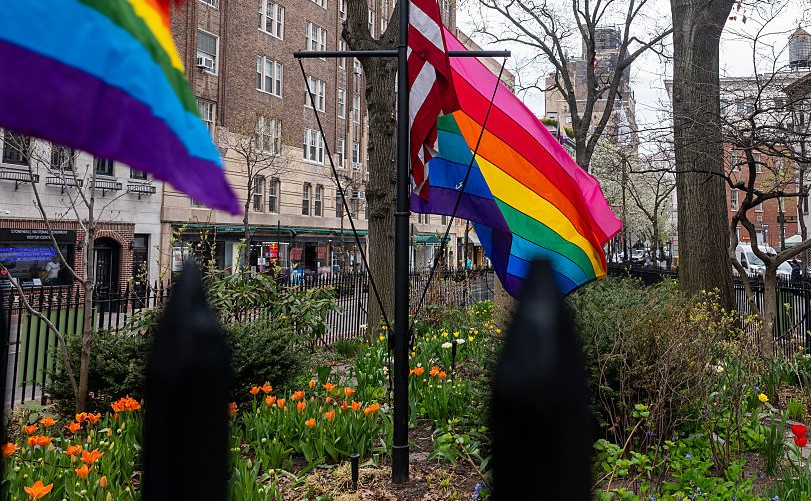
At a ‘Pride’ Mass held at the Stonewall National Monument in New York City, the presiding priest “offered particular recognition to transgender Catholics,” according to a report. The brief note about the service landed in public view because the setting and the phrasing together are unusual for a Catholic liturgy. The ceremony took place at a site that has become shorthand for LGBTQ history and protest, which made the Mass itself feel like a different kind of public statement.
The idea of a Mass labeled as ‘Pride’ at Stonewall is striking on its face, and not only because of the venue. A Mass is a particular form of worship with its own language and rituals, and bringing that form into a space known for decades of activism changes how people pay attention. The presiding priest’s decision to single out transgender Catholics added a clear focal point to what might have otherwise been read as a symbolic gesture.
Saying that the liturgy “offered particular recognition to transgender Catholics,” gives listeners an immediate sense of who the service was aiming to honor. That phrasing raises straightforward questions about intent and inclusion, because the Catholic Church’s official teachings and pastoral practices around gender and identity have long been the subject of debate. For many observers, hearing those words inside a Mass at Stonewall signaled a new posture from a priest in a public and visible way.
The location matters here. Stonewall National Monument is part memorial and part cultural touchstone, and bringing a religious service there creates an instant crosscurrent of meanings. People who come to Stonewall expect history lessons, solidarity, and sometimes protest or celebration. When a Mass arrives, especially one invoking Pride, the conversation shifts toward how faith communities interact with identity-based movements in the public square.
Practically speaking, a priest offering special recognition to any subgroup during a liturgy can be read as pastoral outreach, political statement, or both, depending on who is watching. For those inside the congregation, such recognition may feel like validation and welcome. For traditionalists, it can feel like a break with established norms. Either way, the move invites scrutiny because it puts a specific community in the spotlight during a ritual designed to address the whole congregation.
There is also a layered symbolism in pairing a Catholic Mass with the language of Pride at a site like Stonewall. The two traditions come from different histories and claim different kinds of authority, so their intersection produces discussion about reconciliation, dissent, and the boundaries of worship. When a Mass includes language aimed at transgender Catholics, it foregrounds questions about pastoral care and the role of clergy in responding to evolving social realities.
Reports that emphasize the recognition of transgender Catholics tend to spur conversations far beyond the walls of the church. Coverage often moves into forums where activists, clergy, and everyday citizens trade views on whether such gestures are meaningful or superficial. What matters to many is whether the recognition comes with sustained pastoral attention and institutional change, or whether it remains a one-off moment at a high-profile space.
Whatever people make of the Mass at Stonewall, the event illustrates how religious rites can become part of public conversations about identity and recognition. The priest’s words, the choice of venue, and the label ‘Pride’ all combined to make a short liturgy into a moment that drew attention for reasons beyond the ritual itself. Those attending or watching now have another point to consider in ongoing debates over how faith communities respond to transgender members.
Services like this do not resolve long-running questions, but they do make the questions visible in a very public way. The Mass at Stonewall, with its pointed recognition, pushed certain issues into view and invited people to notice how ritual language and public spaces intersect. That kind of visibility tends to keep conversations alive, and it often prompts follow-up from congregations, leaders, and the communities they serve.
