
President Donald Trump’s remarks about rising far-left influence inside the Democratic Party landed like a sledgehammer this week, mixing blistering rhetoric with a blunt call to defend American traditions and faith. He framed recent primary upsets as proof of a deep ideological shift, warned about threats to Christianity and freedom, and used sharp language that will energize his base while rattling opponents.
The fallout began after several unexpected primary victories in New York sent shockwaves through Democratic ranks, and Trump wasted no time turning the moment into a warning about where he thinks the party is headed. He argued these are not ordinary policy differences but an existential move away from the values that have guided the country for generations. That tone is exactly what his supporters want to hear: clear lines, no niceties, a fight for the future.
He gave a blunt preview online where he wrote, “These are not social Dumocrats, these are hard core, godless Communists.” Those are not euphemisms. For Trump and many Republicans, this kind of language is meant to cut through political doublespeak and lay out a stark choice for voters.
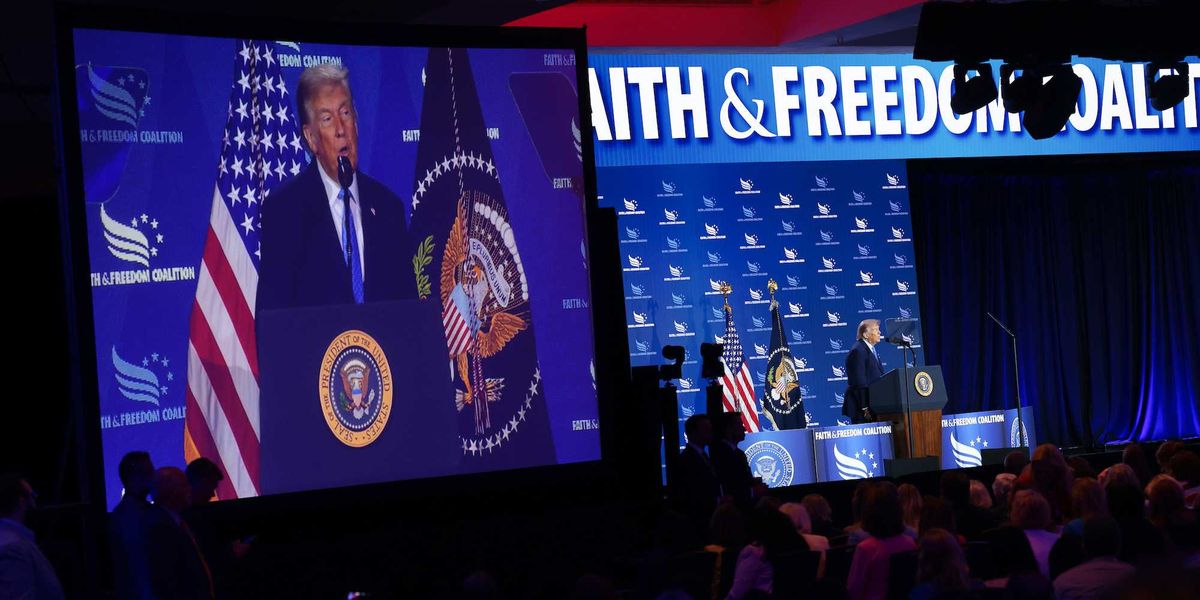
In public remarks he doubled down, saying, “They’re not social Democrats. They want to completely destroy the traditional American way of life.” That line echoed through the room at a faith-focused conference and hit the heart of the debate: culture and religion, not just policy. The phrasing is designed to make the threat feel immediate and personal.
He did not stop there. “They’re animals! In many cases, not smart but, in some cases, they are.” Those blistering words will be replayed everywhere, and they serve two purposes: to alarm swing voters and to rally the core who prefer blunt, unapologetic language from their leader. It is combative and unmistakably Trump.
Trump tied the backlash to faith. He said those on the left are hostile to Christianity and warned that the Democrats are not resisting what he calls an internal takeover. That argument is aimed squarely at religious conservatives who see culture war issues as decisive in modern politics. It frames politics as a struggle for moral survival, not just governance.
He also claimed credit for an upswing in church attendance and religious energy, saying he was proud of the trend and willing to take credit for it. “Maybe if we weren’t doing well. I don’t know. Maybe if we weren’t doing well. But you see the numbers, how they’re growing, how the churches are filling up. It’s a beautiful thing to see. I mean, look, it happens to be during my presidency, so I don’t mind taking credit for it. I’m very proud.” That confident posture is meant to reinforce his narrative of national renewal.
Not all Democrats are cheering their party’s lurch. A group within the party has reportedly pledged resistance to extremism on both sides and vowed to push back internally. That internal friction plays into Trump’s broader claim that the Democrats themselves are fractured and unable to stop more radical elements from gaining ground. Republicans view that as an opportunity.
Trump repeatedly returned to the nation’s founding story to contrast what he called America’s legacy of faith, freedom, and victory with the left’s agenda. “The United States has never been stronger. We have never been wealthier. We’ve never been prouder to be an American,” he said, summing up his optimistic, nationalist vision. For his supporters, that message underlines a promise to restore perceived lost greatness.
He framed the country’s history as a moral arc: “Since 1776, America’s story has been a tale of freedom, overcoming oppression, good defeating evil, and faith overcoming every challenge and every foe.” That rhetoric makes the election a referendum on identity and destiny, not just management of institutions. It’s an approach that simplifies complex issues into a clear moral storyline.
Trump closed with a prayerful note and a theatrical exit, a mix of solemnity and showmanship that has become his trademark. The juxtaposition of faith-filled language and theatrical spectacle ensures the moment will be remembered and replayed by both supporters and critics. It’s the kind of performance politics that drives loyalty and headlines in equal measure.
