
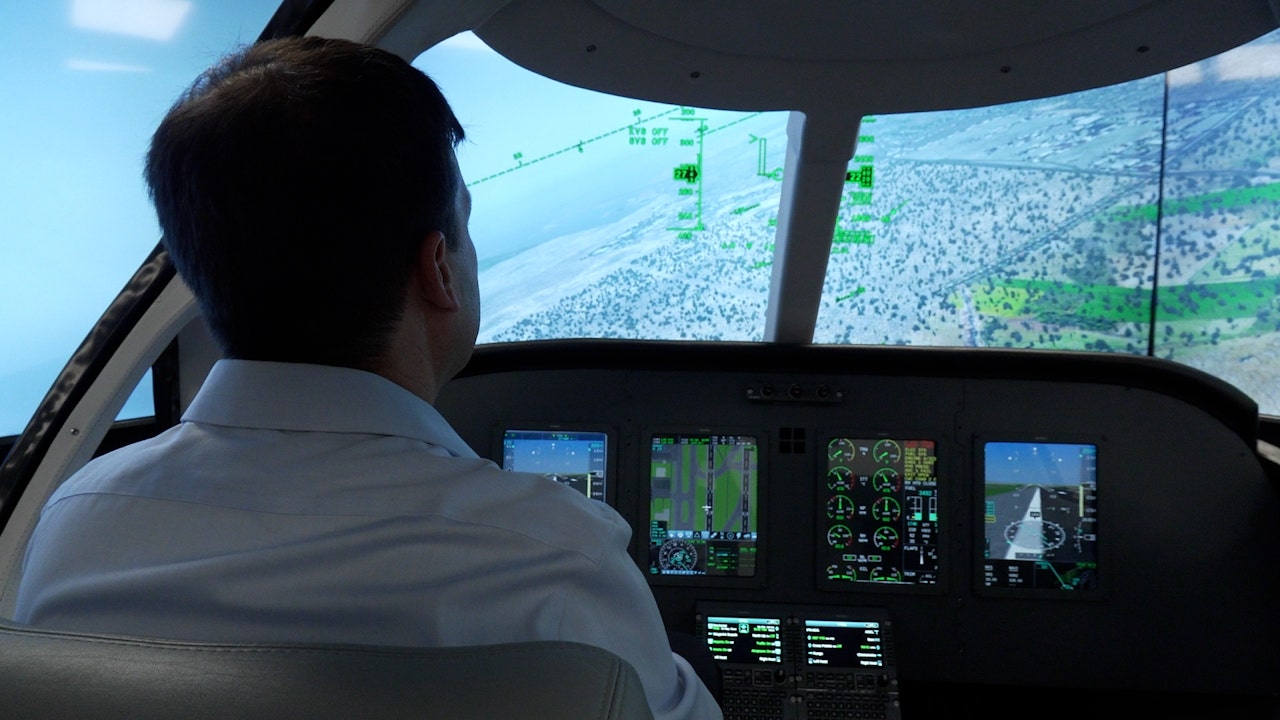
Universal Avionics and AerSale have teamed up to bring AerAware, a cockpit vision system certified for the Boeing 737 Next Generation, into commercial service; it pairs a nose-mounted enhanced-vision camera with wearable head displays that overlay flight data and imagery directly in the pilots’ sightlines. The setup aims to cut through low-visibility approaches and improve runway situational awareness by presenting synchronized sensor feeds to both pilots. Installation takes a few days per aircraft and includes an approved training program for flight crews.
Dror Yahav, a former commercial pilot turned CEO, draws on years of flying approaches where runways only appeared at the very last moment, often at night or in fog. His experience informs the push to get a cockpit vision solution broadly adopted by airlines. The goal is straightforward: give crews the situational cues they would normally miss until too late.
AerSale developed AerAware in partnership with Universal Avionics and secured FAA certification specifically for the Boeing 737 Next Generation family. That approval clears the way for airlines flying large 737 fleets to consider retrofit options without a drawn-out certification battle. Certification also sends a signal to operators that regulators accept the system’s performance envelope for real-world operations.
The system combines a nose-mounted enhanced-vision camera with a wearable head display that overlays flight data and imagery into the pilot’s field of view. Instead of a fixed head-up display, AerAware gives each pilot the same visual layer, ensuring both crew members see identical cues. The approach reduces reliance on external lighting and visual contact during critical phases of flight.
Yahav says the concept is inspired by military helmet-mounted displays, where pilots get a fused picture of sensors and targeting cues right in their line of sight. That lineage informs how AerAware prioritizes which symbols and video feeds to show without overwhelming the wearer. The challenge is to make the overlay helpful, not distracting, during takeoff and landing.
“You turn your head up and look outside, and there’s just nothing — pitch black or foggy,” he said. That blunt description captures why crews sometimes lack early visual cues on short final or during low-visibility night operations. AerAware’s fused imagery and sensor data are meant to fill that gap and give pilots a usable picture earlier in the approach.
Regulators and operators remain focused on runway safety, and recent FAA numbers show runway incursions are still a material concern for the industry. The FAA reported 1,636 runway incursions in fiscal year 2025, down from 1,758 in 2024 and 1,760 in 2023, while pilot deviations accounted for about 62 percent of incursions from 2021 through 2025. Those trends keep airlines and vendors looking for practical tools to reduce risk on arrival and departure.
Installation is relatively quick, taking around two to three days per aircraft, followed by pilot training under an approved program. “It takes about a two- to three-day installation per aircraft, followed by an approved training program,” she said. Minimizing aircraft downtime and ensuring smooth operational integration are top priorities for carriers weighing the upgrade.
Airlines evaluating the system are prioritizing certification status, the length of installation downtime and how AerAware will slot into existing procedures and checklists. Interest tends to track perceived safety benefits and operational efficiency, especially for carriers with large 737 fleets operating into fog-prone or poorly lit airports. If the technology proves reliable in service, it could become a practical retrofit that reduces low-visibility risk without changing the airplane’s core avionics architecture.
