
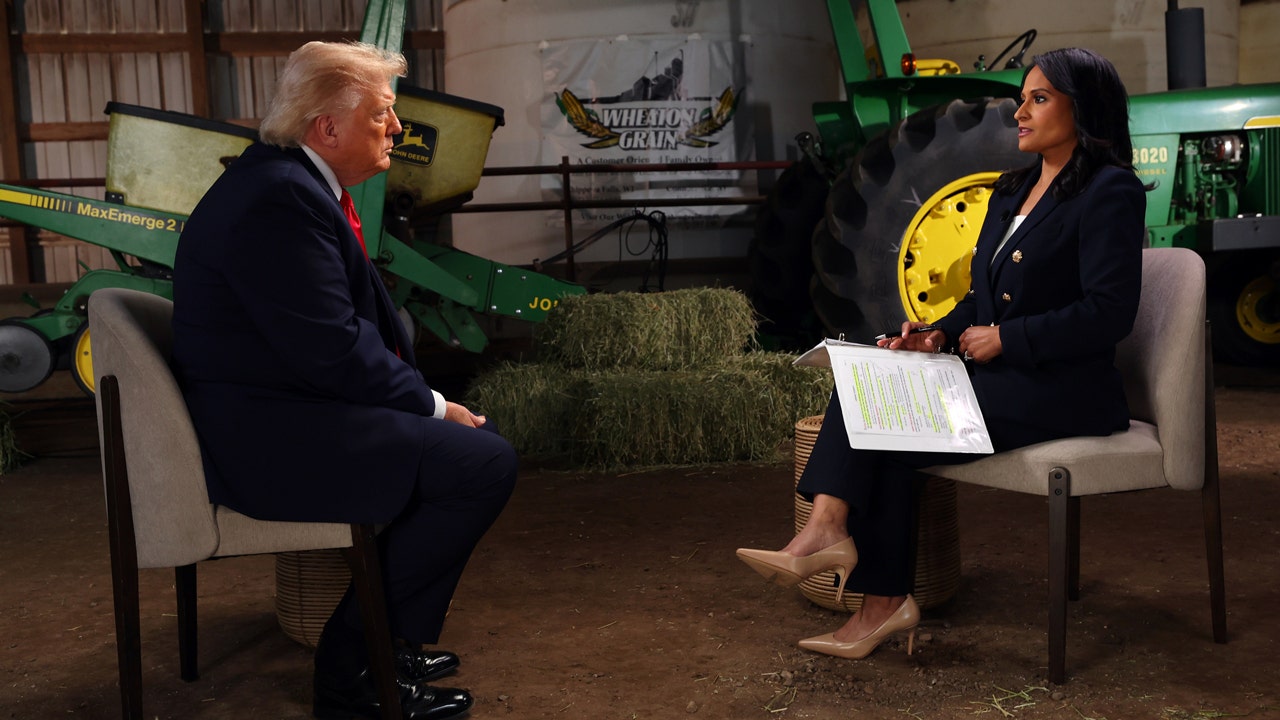
Quick take: a high‑stakes TV sit-down with Donald Trump veered from policy to drama, the moderator kept interrupting, key quotes landed intact, and viewers were left parsing who won the exchange.
The headlines screamed that Donald Trump “stormed” out of the interview, but watched closely the moment was messier than that label. Interviews with a figure who dominates the room demand fast decisions; every interruption or soft follow-up gets picked apart. If you’ve sat across from him before, you learn how quickly a tone can shift and how the narrative can be set in a few seconds.
The back-and-forth hit a fever pitch when Trump accused the media on air: “You’re crooked, your press is crooked, And ‘Meet the Press’ is crooked.” She fired back and the exchange snapped into short, sharp lines. “To be fair, I’m not crooked.” “Really? Well, you play right into their hands then. You’re either crooked or you’re stupid.”
The public saw the climactic close where the president said, “Sorry. Let’s call it quits because I’ve had enough. Thank you, darling. Have a good time.” That line landed for its bluntness and for the way it ended a long stretch of sparring. The tone reinforced what many already expected: this was never going to be a gentle, wonky policy conversation.
On substance, the most revealing segment dealt with a proposed fund for victims of so‑called weaponization. Welker asked directly, “Just to be very clear, are you backing off the fund completely, as your acting Attorney General Todd Blanche has said, or are you looking for another avenue to revive the fund?” Trump answered with a long grievance about what he called partisan attacks.
He painted a picture of people ruined by what he described as “fake weaponization of government” and listed the fallout in stark terms: “They’ve committed suicide. They’ve lost their jobs. They’ve lost their families.” When pressed, he circled back to those claims and named officials he distrusted, saying, “Comey was a dirty cop. A guy like Bolton was a dirty cop.”
Welker tried to pin down evidence and pushed, “But there is no evidence that people who —” and at times the exchange collapsed into overlapping questions and answers. The cadence turned combative: “Wait a minute. You think Comey was a straight cop?” “We had 170 people who pleaded guilty to assaulting police officers.” “Comey was a dirty cop.” The back-and-forth made it hard to land a neat factual clarity for viewers.
When the conversation shifted to elections, the familiar claims resurfaced. Trump said flatly, “The election was rigged,” and added, “It was a dirty election. And it’s happening again right now in California.” That drew the predictable challenge: “Do you have evidence to support that?” His answer, “All I have to do is look,” underscored the divide between what feels persuasive and what meets legal standards.
At times Welker’s persistence paid off and she won short clarifications, but the later stretch turned into an interrupt-a-thon where neither side let a thread finish. Her repeated reframes — “Let me ask about Todd Blanche” — collided with Trump’s insistence, “There’s tremendous evidence. There’s nothing but evidence.” Viewers were asked to adjudicate who seemed evasive and who seemed obstinate.
It’s worth noting they’d already covered a surprising amount in roughly an hour: Iran, nuclear questions, the economy, gas prices, farmers and foreign policy. Rain interrupted the session, but by then the pair had dug into plenty of terrain. On war, Trump rejected a simple pledge of no conflict, saying, “I didn’t guarantee no war,” and asking rhetorically, “Why would I have built the strongest military in the world?”
Flashbacks to campaign rhetoric surfaced too, like the pledge heard at a rally: “Under Trump, we will have no more wars, no more disruptions, and we will have prosperity and peace for all.” Those lines sit alongside on‑camera press sparring as reminders of how political promises and live television habits collide. The interview made news, and for networks that’s a tidy outcome; for voters it left questions about evidence, tone and who controlled the frame.
