
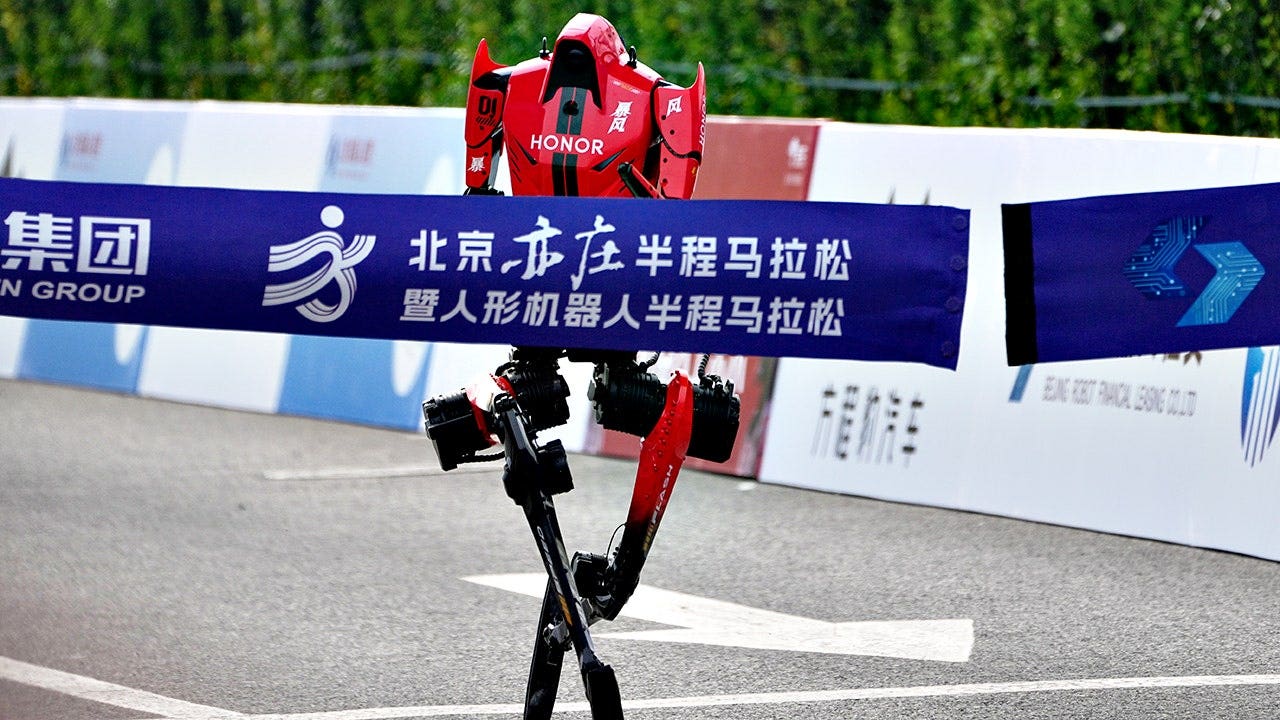
A Chinese-built humanoid robot finished a half-marathon in Beijing faster than the human world record, a striking milestone in the race to build capable machines. The robot, developed by smartphone maker Honor, completed 21 kilometers in 50 minutes and 26 seconds, shaving minutes off the recent human benchmark. The result shows rapid technical progress, but the event also revealed persistent limits and real-world wrinkles in humanoid robotics.
Dozens of humanoid machines lined up alongside roughly 12,000 human runners, traveling on a parallel route to avoid collisions and confusion. Last year’s top robot took more than two hours and 40 minutes, so the leap to elite half-marathon pace represents a dramatic engineering sprint. The winning finish erased any doubt that bipedal robots can match human endurance over a road race distance, at least in controlled conditions.
Honor’s entry closed the 21-kilometer course in 50 minutes and 26 seconds, beating the human mark of about 57 minutes set last month by Jacob Kiplimo of Uganda. Engineers say the design mimics elite runners, with long legs—around 37 inches—and enhanced thermal systems to manage heat during prolonged exertion. Those hardware choices helped maintain stride and stability at a sustained pace.
Nearly half the field ran with autonomous navigation while the rest relied on remote control from teams, organizers said. That mix highlighted the gap between software maturity and mechanical capability: the hardware can handle speed, but autonomy still needs polishing. Race day also exposed failure modes when real-world variability met cutting-edge prototypes.
Not everything went smoothly; some robots stumbled at the start, others drifted into barriers, and a few needed human intervention midcourse. These glitches underscore how sensitive bipedal balance and perception are when pushed to race speeds on uneven urban pavement. Engineers left the course with hard data and fresh motivation to tighten sensors, gait control, and obstacle awareness.
“Looking ahead, some of these technologies might be transferred to other areas,” said Du Xiaodi, an engineer with the Honor team. “For example, structural reliability and liquid-cooling technology could be applied in future industrial scenarios.” That explicit nod to industrial transfer frames the race as both a public spectacle and a practical R and D exercise.
Spectators mixed wonder with unease as machines improved by leaps between editions of the event. “It’s the first time robots have surpassed humans, and that’s something I never imagined,” Sun Zhigang, who attended the event with his son, told The Associated Press. “The robots’ speed far exceeds that of humans,” spectator Wang Wen told the outlet. “This may signal the arrival of sort of a new era.”
Experts noted the competition exposes China’s fast push into robotics and artificial intelligence, even as broad commercial humanoid use remains limited. Firms are making solid hardware advances while working to close the software gap that would let machines match human efficiency in factories and other workplaces. “The future will definitely be an AI era,” engineering student Chu Tianqi told Reuters. “If people don’t know how to use AI now… they will definitely become obsolete.”
The event also casts a spotlight on strategic competition in advanced technologies, with Beijing investing heavily in robotics as part of a long-term economic plan. While race-day wins are headline-grabbing, meaningful deployment of humanoid robots at scale will require safer autonomy, ruggedized designs, and lower costs. For now, the half-marathon exposed both how far the field has come and how much work remains before humanoid robots are commonplace partners in industry or daily life.
