
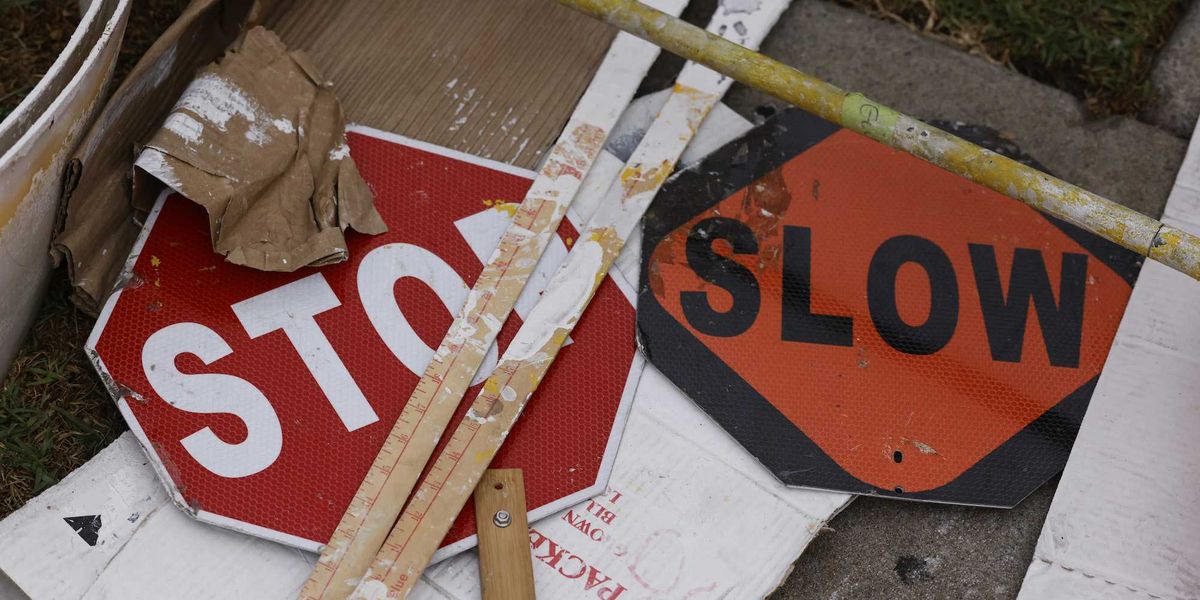
A father in the Los Angeles area took matters into his own hands after repeated safety concerns at a neighborhood intersection, painting “stop” on the pavement and installing reflective 30-inch stop signs on his own dime, actions that led to his arrest and a heated local response.
Joseph Brandlin, a longtime resident of the block, says he watched too many near-misses at the corner outside his house and felt official channels had failed the neighborhood, so he acted directly to protect children and families. He described the personal motivation behind his decision in plain terms, noting a recent incident in which his son narrowly avoided being struck by a vehicle because of poor visibility at the crossing. “I care deeply about the safety of our neighborhood and the families that live here,” he told reporters, a line that made clear this was about more than signs for him.
Residents say they tried to work through the system first, circulating a petition with roughly 50 signatures and asking city staff to add traffic controls or other safety measures at Loma Vista Street and Acacia Avenue. City officials responded with a traffic study that they said did not justify new stops, but neighbors say they never saw the data or a transparent explanation of the decision. That gap between citizen requests and municipal action is central to why someone would take such a visible, unauthorized step.
Neighbors rallied quickly after the arrest, describing the corner as a magnet for children because of a nearby park. “There’s a park right there, and it’s a magnet for children,” said one longtime resident, summing up the fear that a collision could have catastrophic consequences. “A tragedy could occur,” he added, and then asked the question many locals were privately asking: “I wonder if a tragedy does have to occur for the city to do something about it.”
Authorities say Brandlin began installing the signs in the predawn hours of March 14, and he was detained by police at about 1:30 a.m. The city treated the work as a criminal matter rather than a community safety initiative, booking him on multiple counts that included interfering with a traffic control device, grand theft, and vandalism alleged to exceed $400. He was released later that day and is now scheduled to appear in court in June to answer the charges, turning a neighborhood safety fight into a legal case.
Support for Brandlin flowed in quickly: neighbors organized and produced a stack of letters backing his efforts, which he personally delivered to city officials after his release. Reports indicate roughly 74 letters were compiled in support of the unauthorized changes, a sign that local frustration with the municipal process has reached a tipping point. That kind of organized pushback illustrates how a single act can crystallize broader concerns about responsiveness and priorities at city hall.
In the days after his arrest Brandlin took his case to the council, calling for a clear decision or a transparent, community-led evaluation of traffic safety at the corner. “I’m asking the council for a straightforward action to install stop signs on intersection of Loma Vista Street and Acacia Avenue or complete and transparent evaluation with the community,” he said at a public meeting, demanding both immediate action and accountability. The mood of the meeting was underscored by Brandlin’s blunt assessment of the process: “The city just wasn’t listening,” a line that framed his civil disobedience as an act of exasperation rather than lawlessness.
Local reporting has noted that this is not an isolated kind of clash between residents and municipal authorities; other communities have seen citizens make unauthorized fixes to unsafe streets and face similar pushback from officials. Brandlin told a local TV station that despite the legal trouble he would do the same thing again if it meant keeping kids and families safe, a stance that has deep resonance in neighborhoods that feel their concerns are unanswered. The debate now stretches beyond the one intersection to questions about how cities prioritize safety and how much latitude residents have when they believe government inaction puts lives at risk.
As the case moves toward the courtroom, neighbors continue to press for a transparent reassessment of traffic conditions at Loma Vista and Acacia, urging the council to respond to the stack of letters and the vocal community concern. The incident has already sparked conversations across the city about how to balance citizen initiative with public safety regulations, and whether enforcement or engagement should come first when a neighborhood raises an alarm. For now, the corner remains a flashpoint where local frustration, parental concern, and municipal procedure collide.
