
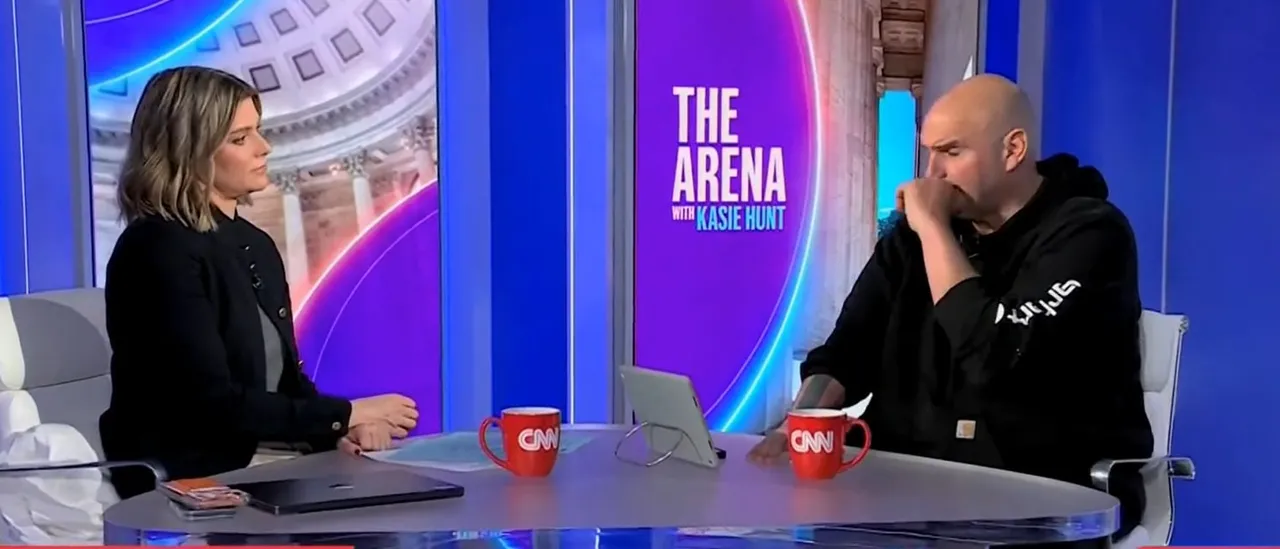
Kasie Hunt pressed Sen. John Fetterman about whether he would leave the Democratic Party and accept former President Trump’s backing, and he stuck to his position while sharply criticizing his own side’s theatrics; this exchange highlights intra-party tension and raises questions about where Pennsylvania voters fit in the culture war. The senator’s pushback and mixed record on hot-button issues keep him in an awkward spot for conservatives who see opportunity and for Republicans who remain skeptical of a sudden party flip. Below is a clear-eyed look at what was said, what it means politically, and why the conversation matters to voters and party strategists.
The back-and-forth began after Fetterman publicly called out fellow Democrats for behavior during the State of the Union, a moment that made national headlines and opened the door to speculation about his future political home. Kasie Hunt asked directly whether he would consider switching parties in light of left-wing pressure and potential primary challengers, forcing the senator to publicly reckon with his identity. His answer was careful and defensive, aimed at calming both centrist critics and the activist wing of his party.
Fetterman insisted his record was rooted in the Democratic Party even as he listed policy positions that have broken with party orthodoxy, a balancing act that looks defensive when the left pushes back aggressively. “What I’m saying, it’s like anyone’s entitled, but it’s very strange if anyone is a Democrat, I’m not sure, it’s like the guy that flipped a red seat and someone now it’s like now my record is solid, solid Democrat,” he said, a line that tried to deflect suggestions he might jump ship. That phrasing read less like clarity and more like a politician trying to keep competing audiences from walking away.
Republicans will see opportunity in the fissures Fetterman revealed, because his voting record shows common ground with conservative priorities on some issues, and because his rhetoric has at times broken with progressive talking points. He has criticized his party’s resistance to voter ID, opposed filibusters that blocked certain spending measures, and praised actions against drug smuggling that aligned with tougher law-and-order instincts. Those positions give GOP strategists talking points about how the Democratic coalition is fracturing in competitive states like Pennsylvania.
Fetterman also has a record of supporting strong U.S. backing for allies abroad, including firm backing for Israel during its fight with Hamas, which distances him from the most vocal anti-Israel progressives. That streak further complicates the left’s narrative that every Democratic senator toeing a party line on foreign policy is uniformly progressive. For voters who prioritize national security and border enforcement, those deviations from the left are political openings the GOP will want to exploit.
Still, his refusal to defect is notable and tells a story about the limits of partisan rebranding, especially after one of the most expensive and heated Senate races in recent history. Fetterman defeated Republican Mehmet Oz in 2022, a win that cemented his ties to Democratic infrastructure and donors who helped propel him into the Senate. That institutional handholding makes a wholesale switch politically risky and raises questions about whether sudden ideological shifts are more opportunistic than sincere.
Even as he pushed back against left-wing labels, Fetterman attempted to carve out space as an independent-minded Democrat, a role that appeals to swing voters tired of tribal politics but frustrates party loyalists looking for predictability. “I’m not going to switch, but I’m just going to be an independent voice in the Democratic Party. I’m not going to be afraid if people, if there are groups attacking a Democrat, you know the last one in Pennsylvania, to me that’s part of the problem in our party. If you want a Democrat that’s going to call people Nazis or fascists or all these kinds of thing, well, I’m not going to be that guy,” he told Maria Bartiromo last year, a line that underscores his distancing from the more extreme rhetoric on the left. That stance is convenient for moderates, yet it may not satisfy conservative voters who want clear allegiance rather than hedged independence.
From a Republican perspective, the exchange on CNN was useful theater: it showcased both Fetterman’s vulnerabilities and the fractures inside the Democratic coalition. GOP operatives can use his deviations to peel off persuadable voters in suburban and rural Pennsylvania, emphasizing policy areas where he has agreed with conservative priorities while questioning his long-term loyalty. The tactical value is obvious in a midterm landscape where a handful of Senate seats can shift control.
At the same time, the episode highlights another risk for Republicans attempting to court Fetterman’s support: voters are wary of politicians who change labels for convenience, and a one-off endorsement would carry heavy political baggage tied to party donors and voter perception. Any suggestion that Fetterman would accept an endorsement from Trump must be weighed against how voters view authenticity versus opportunism, and how such a move would play in both red and blue parts of Pennsylvania. That calculation matters as much as the policy disagreements.
The confrontation on national television served as a reminder that party allegiance still matters to activists and base voters on both sides, even as politicians try to thread the needle for swing constituencies. For Republican strategists, it is a moment to press advantages on issues where Fetterman has broken with progressives while testing whether independents respond to a message of pragmatic governance over partisan theater. The political dance will continue, and Pennsylvania will be a key stage.
!function(r,u,m,b,l,e){r._Rumble=b,r[b]||(r[b]=function(){(r[b]._=r[b]._||[]).push(arguments);if(r[b]._.length==1){l=u.createElement(m),e=u.getElementsByTagName(m)[0],l.async=1,l.src=”https://rumble.com/embedJS/ukxsg”+(arguments[1].video?’.’+arguments[1].video:”)+”/?url=”+encodeURIComponent(location.href)+”&args=”+encodeURIComponent(JSON.stringify([].slice.apply(arguments))),e.parentNode.insertBefore(l,e)}})}(window, document, “script”, “Rumble”);
Rumble(“play”, {“video”:”v743fj6″,”div”:”rumble_v743fj6″});
