
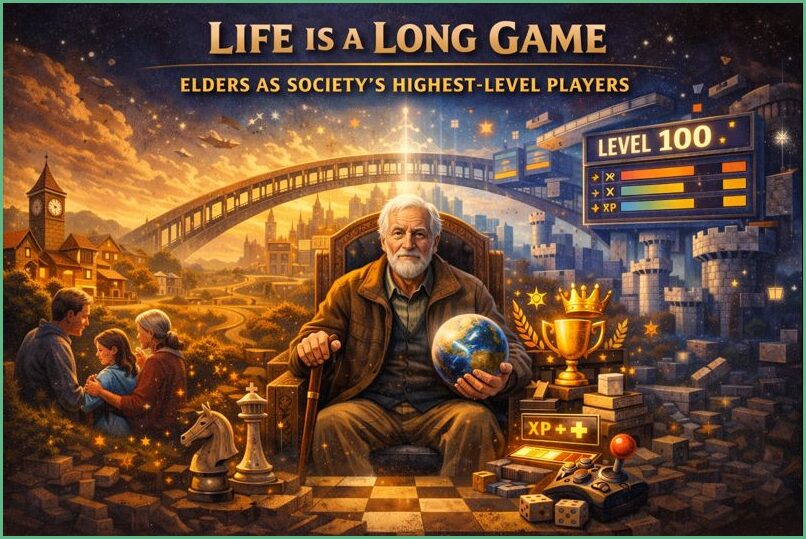
Modern culture has an odd contradiction baked into it.
In digital worlds—video games, competitive platforms, online communities—we instinctively respect those who have reached the highest levels. We study their strategies. We follow their replays. We quote their advice. Longevity and mastery are treated as proof of competence. The player who has endured every update, survived every setback, adapted to every rule change, and still stands at the top is admired—not questioned.
Yet in real life, we often do the opposite.
Those who have navigated the longest road—who have endured decades of change, loss, responsibility, success, failure, and recovery—are quietly pushed aside. Aging is treated not as an achievement, but as a limitation. Wisdom is seen as outdated. Experience is dismissed as “no longer relevant.” And somehow, we’ve convinced ourselves that this makes progress easier.
It doesn’t.
If life is anything, it is a long game. And elders—regardless of how clean or messy their journey has been—are the ones who have played it the longest.
Longevity Is Not an Accident
Reaching old age is not passive. It is not something that simply “happens” while someone waits on the sidelines. Longevity requires adaptation. It requires learning from loss. It requires surviving seasons that didn’t go as planned. It requires recalibration—again and again.
In gaming terms, elders are players who have endured every patch update life has thrown at them. The rules changed. The environment shifted. The tools evolved. Sometimes they won. Sometimes they didn’t. But they stayed in the game.
And that matters.
We don’t ask elite gamers for a perfect résumé. We ask them how they survived the hard parts. How they recovered after failure. How they adjusted when the meta shifted. Why should life be any different?
The Forgotten Advantage of Multigenerational Living
For most of human history, multigenerational households weren’t an experiment—they were the norm. Children grew up around grandparents. Wisdom wasn’t downloaded; it was absorbed. Stories carried context. Decisions had memory. Patience was modeled, not taught.
The result wasn’t perfection—but it was balance.
Children raised in multigenerational environments tend to develop stronger emotional regulation, deeper respect for consequences, and a clearer sense of identity. Families tend to be more resilient. Communities tend to be more stable. Not because elders controlled everything—but because their presence slowed impulsive thinking and anchored decisions in lived reality.
When elders disappear from daily life, something subtle but dangerous happens: experience stops being transferred. Each generation starts from scratch, repeating mistakes that were already solved once before.
Why We’ve Rejected the “High-Level Player” Mindset
So why does this logic feel strange when applied to life?
Because modern culture prioritizes speed over depth and novelty over endurance. We reward quick wins, viral moments, and short-term visibility. Wisdom, by its nature, is slow. It remembers consequences. It warns against shortcuts. That can feel restrictive in a culture addicted to immediacy.
But restraint is not oppression. Memory is not limitation. And experience is not a threat to freedom.
In fact, the absence of elders in decision-making doesn’t produce innovation—it produces repetition. Societies that sideline their elders don’t become forward-thinking; they become forgetful.
Age Is an Achievement, Not a Disqualification
It’s worth saying plainly: how someone reaches old age is less important than the fact that they did.
In games, no one demands a flawless playthrough. In life, we shouldn’t either. Survival itself is evidence of learning—of adjustment, resilience, and endurance. Every scar represents a lesson paid for in real currency.
Age should not remove someone from relevance. It should reposition them as guides—not rulers, not relics, but references. People who remind us what consequences look like over time. What sacrifice produces. What patience builds.
What This Means for Communities and Civic Health
Communities fracture when wisdom is optional.
Local decision-making suffers when short-term emotion replaces long-term memory. Civic engagement declines when no one in the room remembers how previous choices ended. Families weaken when generations are siloed instead of connected.
OBBM’s mission—strengthening hyper-local awareness, restoring civic engagement, and reconnecting people to their communities—naturally depends on intergenerational respect. A healthy city listens to its elders without being ruled by them. It values youth without being driven solely by impulse. It treats experience as an asset, not an inconvenience.
That balance is where stability lives. OBBMNetwork.TV
Life Isn’t About Speed—It’s About Completion
At the end of the day, life isn’t won by finishing first. It’s won by finishing well.
Those who reach old age have completed chapters many others never will. They’ve learned what lasts and what doesn’t. They’ve discovered which choices compound and which ones collapse under time.
That perspective isn’t restrictive. It’s liberating—if we’re humble enough to listen.
If we can respect the highest-level players in virtual worlds, surely we can honor those who’ve played the hardest game of all—real life.
Because every society eventually discovers this truth, one way or another:
You don’t build a future by ignoring those who already survived it.
