
Canada remains a close and friendly neighbor, but recent remarks from its new prime minister and a decades-long gap in defense spending are testing that friendship, raising questions about who really carries the West’s security burden and what happens when rhetoric outpaces reality.
Canada’s economy and population put it among the West’s more comfortable nations, yet it has not met NATO’s 2% defense benchmark in decades. New leadership vows to hit 2% by 2030, but that promise follows a long stretch since the late 1980s when defense budgets fell from Cold War levels.
Canadians have fought alongside Americans in major conflicts, from Korea to Afghanistan, and those commitments cost lives and honor. Canada’s standing military is modest—around 68,000—and it deployed forces to Afghanistan for years, where 158 soldiers died serving alongside allies.
Cultural ties run deep — films like “Argo.” and the musical “Come From Away.” remind us of shared moments and values — and many families bridge the border in both directions. That history makes why recent political signals matter: when friends shift tone, it echoes broadly across policy and security.
Once, Canadian leaders stood firmly with Western democracies during the Cold War; pragmatic partnership underpinned NATO and intelligence sharing in the “Five Eyes.” Those assumptions of shared priorities are fraying as political gestures and trade dances complicate straightforward alliance behavior.
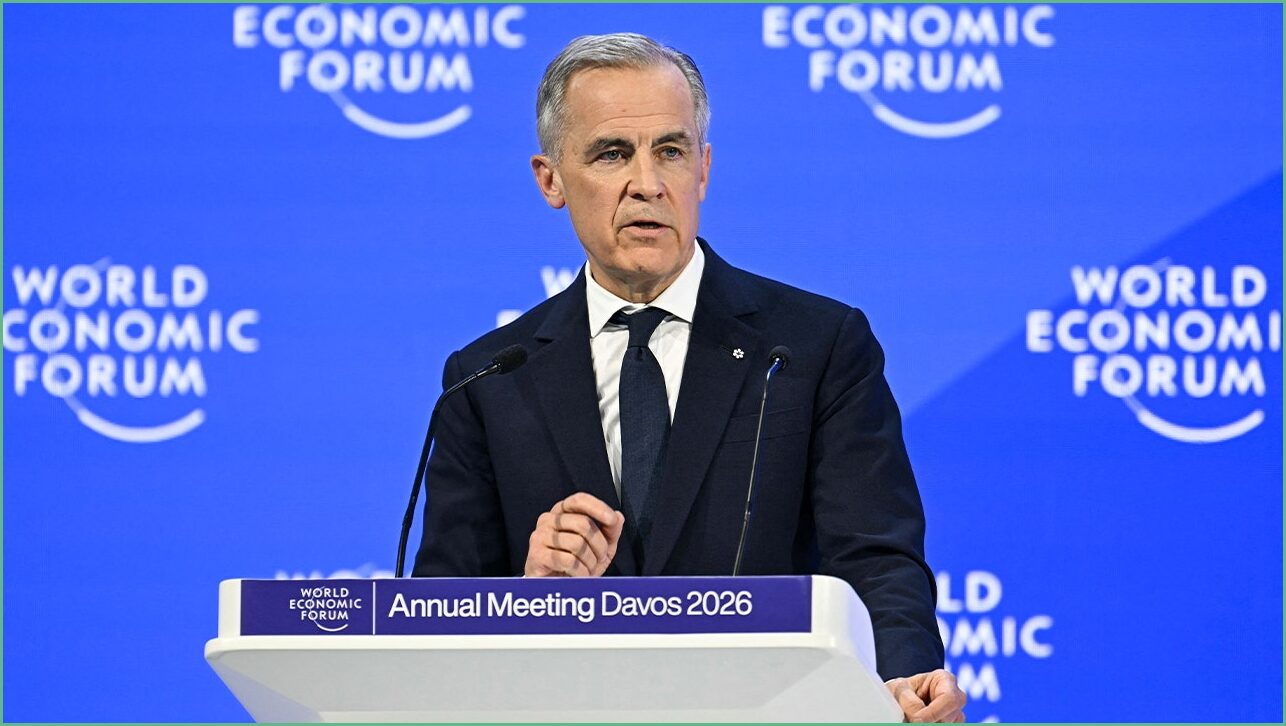
Last week at Davos, Prime Minister Mark Carney, a career international banker turned politician, framed the world in tiers and urged “middle powers” to push back against unnamed “hegemons.” By lumping the United States with regimes the West often contests, his remarks landed as an odd and pointed critique of America.
Carney’s speech did not single out President Trump by name, but the thrust was unmistakable: put the U.S. and China in the same category of dominant powers and call on others to organize independently. The banker’s embrace by global financiers at Davos does not erase the practical truth that many nations still rely on American hard power for deterrence and safe trade routes.
Look at countries that truly carry their weight: Poland spends about 4.7% of GDP on defense, while Finland spends roughly 3% and retains a large mobilization capacity despite a small population. Those nations act like frontline states prepared to defend themselves, not as beneficiaries of another country’s security umbrella.
By contrast, Canada’s forces are small. The Royal Canadian Navy has roughly 8,400 sailors and about 30 ships, and Canada fields approximately 400 aircraft with about 15,000 personnel in its air arm. Submarine capability exists but is limited to four boats, the newest commissioned in 2015, while the United States fields around 70 nuclear-powered submarines.
Carney called Canada an energy “superpower!” even as Canadian exports rely on the freedom of the seas and global stability provided largely by American naval strength. Labeling Canada a major strategic actor ignores the gaps in defense spending and the practical dependence on U.S. deterrence in a contested world.
Compounding concerns is Carney’s outreach to Beijing and apparent warmth toward Xi Jinping’s government, while offering moral-sounding words about human rights but little alongside them. Announcing an “alliance” of trade and convenience without addressing forced labor, Hong Kong’s crackdown, or other abuses looks like an appeasement dressed as realpolitik.
There is a distinct risk when a nation publicly blurs the line between a democratic ally and authoritarian competitors: trade and diplomatic consequences can follow, and ordinary citizens—not elites—bear the cost. If rhetoric invites retaliation or tariff threats, Canadians who depend on cross-border trade may find themselves paying for political theater.
Canada is a valued ally and a friendly neighbor, but words at Davos cannot substitute for military capacity, budgetary commitment, or steady strategic alignment. When leaders choose rhetorical poses over sustained investment in defense, they test the patience of those who shoulder the bulk of Western deterrence and risk turning gratitude into skepticism.
