
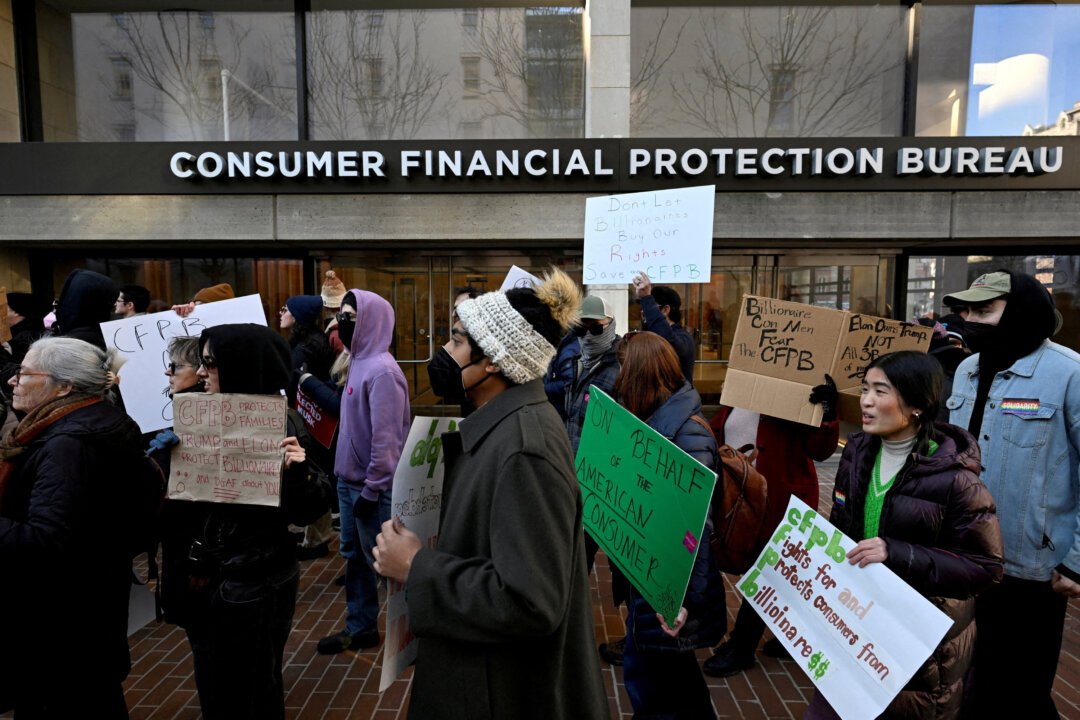
On April 28, the U.S. Court of Appeals for the District of Columbia Circuit issued a significant ruling that effectively blocked the Trump administration’s efforts to reduce the bloated workforce at the Consumer Financial Protection Bureau (CFPB), once again showcasing the judiciary’s ongoing interference in executive branch management. The decision, made in a split vote, overturned an earlier order that had allowed for limited layoffs at the CFPB if it could be proven that certain positions were non-essential. While the Trump administration was attempting a common-sense reorganization to rein in wasteful government spending, the court sided with entrenched bureaucratic interests.
Originally created in 2010 under President Obama and spearheaded by Elizabeth Warren, the CFPB has long been criticized by conservatives and free-market advocates as an unconstitutional fourth branch of government—an unaccountable and overreaching agency that wields immense regulatory power with little to no oversight. President Donald Trump has made it clear that one of his top priorities is dismantling the deep state bureaucracies that stifle economic freedom, burden businesses, and waste taxpayer dollars. His administration’s push to scale down the CFPB was a direct response to this bloated bureaucracy.
Under the Trump administration, Russ Vought—then-director of the Office of Management and Budget and a respected reformer—was appointed to temporarily lead the CFPB and implement staffing reductions. The plan was straightforward: conduct a “particularized assessment” to determine which employees were not essential to the agency’s statutory duties and reduce workforce size accordingly. But leftist lawyers and public-sector unions quickly launched legal challenges to protect cushy government jobs and maintain control over regulatory levers.
In February, the National Treasury Employees Union filed a lawsuit against Vought, accusing the administration of violating the separation of powers. Several other pro-government control entities joined the legal assault, effectively weaponizing the courts to halt the Trump administration’s attempts to bring efficiency and accountability to Washington.
On March 28, far-left U.S. District Judge Amy Berman Jackson—a frequent opponent of Trump’s policies—granted a preliminary injunction to halt the layoffs and stop-work orders. She claimed that eliminating positions before a final ruling would cause “irreparable harm,” despite clear evidence that the agency was functioning with layers of redundancy. Critics argue this was yet another example of activist judges inserting themselves into administrative decisions that should rightly fall under the executive branch.
Judge Neomi Rao, a Trump appointee and one of the dissenting voices on the appeals panel, delivered a powerful rebuke of the majority ruling. Rao warned that the court’s interference undermined the constitutional separation of powers and that the judicial branch was improperly micromanaging the internal affairs of the executive branch. She rightly pointed out that the president must have the authority to manage federal agencies, especially those known for their bloated budgets and limited accountability like the CFPB.
President Trump has long argued that agencies like the CFPB are dangerous relics of big-government liberalism, created not to protect consumers, but to centralize economic control in Washington. His administration’s broader agenda focuses on deregulation, economic freedom, and government accountability—principles that directly clash with the left’s desire for centralized control through unaccountable institutions. Under Trump, executive orders such as the “one-in, two-out” rule for new regulations and ongoing efforts to rein in rogue agencies have helped fuel the strongest economic recovery in decades prior to the pandemic.
Adding to the criticism of the CFPB, Trump senior adviser Elon Musk recently called the agency “duplicative” and unnecessary, reflecting a growing consensus among conservatives that the bureau’s functions are already handled by existing agencies like the Federal Trade Commission and the Office of the Comptroller of the Currency. Musk’s comments underscore the belief that the CFPB has become a partisan weapon disguised as a watchdog, operating beyond the scope of its original intent.
Critics of the CFPB, including prominent conservative economists, argue that its regulations have stifled innovation in financial services and punished smaller banks and lenders with arbitrary rulemaking. Instead of targeting large institutions engaged in fraud, the agency has focused on micromanaging legitimate businesses, making it harder for average Americans to access credit or start new ventures. This regulatory overreach disproportionately harms low-income communities and small business owners—the very people the left claims to protect.
Meanwhile, defenders of the CFPB continue to cling to the narrative that the agency is essential for consumer protection, ignoring the fact that its creation came in the wake of a financial crisis driven largely by government-backed lending and regulatory failures. These defenders also ignore that the CFPB has often operated without congressional oversight, funded directly by the Federal Reserve, making it one of the least accountable federal bodies in existence.
As the legal battle continues, this case has become a referendum on the limits of executive authority, the role of the courts, and the bloated nature of modern government. For President Trump and his supporters, this fight represents more than just layoffs—it is part of a larger war to restore accountability, shrink the federal leviathan, and return power to elected officials instead of unelected bureaucrats.
This legal showdown could set a critical precedent for how future presidents manage federal agencies and whether they can rein in rogue institutions without interference from activist judges and entrenched unions. For Trump’s America First movement, victory in this case would represent another step toward a leaner, more efficient, and constitutionally grounded government—one that serves the people rather than bureaucrats.
The stakes are high, and Washington insiders know it. The CFPB is just the beginning. If President Trump is reelected in 2024, his second term will likely usher in a bold new era of government reform, where agencies will either deliver results for the American people or face the chopping block.
