
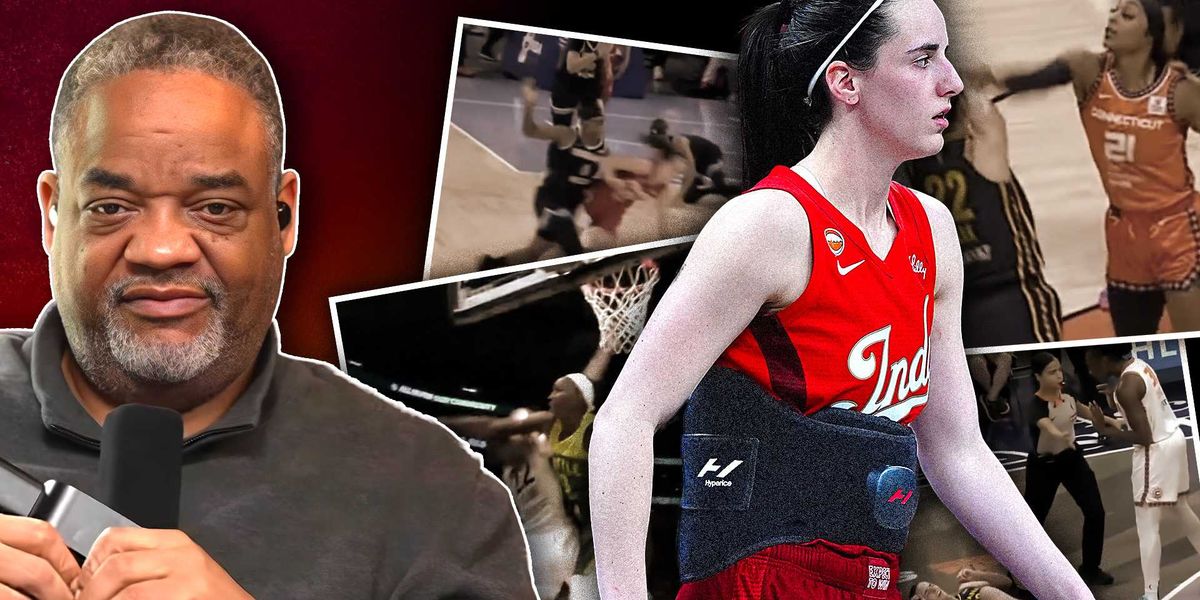
Caitlin Clark’s return to the WNBA opened with a mysterious back injury and a storm of accusations that her decline is being pushed by on-court aggression and off-court politics. Jason Whitlock argues this is no accident, saying the league tolerates physical targeting and snubs talent when it conflicts with its cultural priorities. Clips of hard fouls and questions about team construction fuel his claim that Clark is facing an organized push against her success. This piece walks through those arguments and the examples Whitlock lays out.
Clark began the season dealing with a back issue that the Fever and the player have called minor, but suspicion persists about whether the injury is part of a larger pattern. Whitlock thinks the physicality Clark endures isn’t random rough play but concerted effort to take her out of games and headlines. He connects that on-court intensity with what he sees as systemic bias, pointing to Clark’s exclusion from the 2024 Olympics despite a dominant rookie year. That omission still ranks as a sore point for critics who believe merit was overlooked.
Whitlock accuses some league figures and commentators of openly dismissing Clark’s achievements, and he highlights remarks from WNBA veterans who questioned the legitimacy of her records. He views those comments not as fair critique but as part of an environment hostile to Clark’s profile and popularity. The BlazeTV host frames this as identity politics bleeding into roster choices and media narratives. For him, the result is a league willing to sacrifice viewers for a message.
“If we have to sacrifice the popularity of women’s basketball to stay on message, to stay on agenda that this is a league dominated and controlled by black women and lesbian women and we’re hostile to white women and heterosexual women, we will sacrifice popularity, attention, ratings, everything to stay on message,” he laments. That line captures his broader complaint: the league values ideological cohesion over winning basketball and building around a star. Whether you agree or not, it explains why Whitlock reads certain moves as political rather than strategic.
To bolster his case, Whitlock plays footage of hard fouls on Clark that look excessive, arguing the aggression goes beyond basketball and into targeted intimidation. He notes the media’s largely muted response and says too many insiders either ignore the behavior or defend the players committing it. And yet “no one [spoke] out,” he says, pointing to a silence that, in his view, enables repeat offenses. That silence, he argues, signals acceptance of a hostile culture rather than a fight for player safety.
Whitlock extends the critique to Indiana’s roster moves and coaching changes, suggesting they didn’t prioritize protecting or elevating Clark. “The Indiana Fever [is] not constructing a team around her to protect her,” he says, referencing departures like Erica Wheeler and the arrival of Sophie Cunningham. Wheeler is described as Clark’s “ride or die” who would “get physical and defend” her, while Cunningham is labeled by Whitlock as more of “an Instagram model” than “an enforcer.” Those contrasts feed his argument that the organization shifted away from building around Clark’s strengths.
The change at head coach also draws his ire, with Whitlock calling Christie Sides’ replacement an “alphabet mafia soldier.” He suggests the staff shift signals more interest in assimilation than competition, and that the team seems focused on “[indoctrinating] Caitlin Clark” into the league’s culture over “[building] a team” that maximizes her talent. That language is charged, and Whitlock uses it to argue that the Fever’s decisions are ideological as much as tactical.
At its core Whitlock’s thesis is blunt: Clark faces both physical targeting and institutional resistance because she upends the WNBA’s preferred narrative. “The mental coupled with the physical attack on Caitlin Clark, we haven’t seen anything like it,” he sighs, summing up the intensity he sees. Whether you buy his framing or see it as hyperbole, the questions he raises about player safety, media response, and team construction demand a closer look from anyone who cares about the future of women’s basketball.
To hear more, watch the episode above.
